Home
Porsche
Cayenne Electric
News
The Porsche Cayenne Electric’s Biggest Surprise? Its Battery
“We’ve learned so much over the years.” Why Porsche ditched the battery “box” for a pack that’s lighter, denser, and easier to repair.
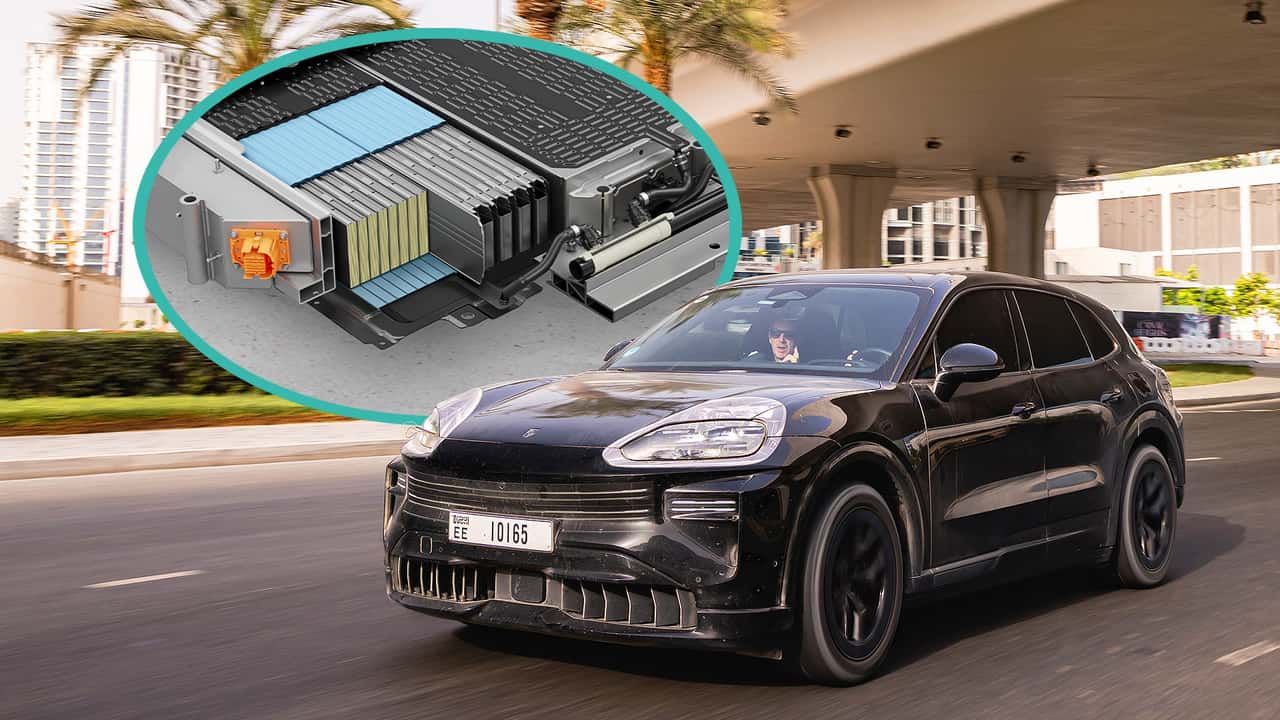
Photo by: Ralph Hermens
Chris Perkins 
By: Chris Perkins
Sep 30, 2025 at 8:26am ET
Add InsideEVs as a preferred source in Google
- (https://twitter.com/intent/tweet?url=https%3A%2F%2Finsideevs.com%2Fnews%2F774188%2Fporsche-cayenne-electric-battery%2F&text=The%20Porsche%20Cayenne%20Electric%E2%80%99s%20Biggest%20Surprise%3F%20Its%20Battery&via=InsideEVs)
- copy
Share
Comment
Porsche’s long-running engineering philosophy is one of evolution over revolution. This is, after all, a company that has mounted a flat-six engine in the rear of its flagship sports car for 77 years now. But, Marco Schmerbeck, head of the energy system for the new Porsche Cayenne Electric, thinks the battery is a bigger step than the Porsche norm.
“It’s not a slight evolution coming from the Taycan and the Macan, it’s more of a revolution,” Schmerbeck tells InsideEVs at an engineering preview for the Cayenne Electric in Leipzig, Germany. “We’ve learned so much over the years.”
The Cayenne is the first Porsche EV battery to do away with a traditional frame, instead mounting individual modules directly to the car’s body.
Schmerbeck likens the old way to putting a box in a box—cells inside modules, modules inside a larger pack.
Gallery: Porsche Cayenne Electric (Technical Workshop)

99




Source: Porsche
In ditching the frame, Porsche saves weight over a comparable battery pack. There's also an increase in energy density, because more of the space of the pack is dedicated to the cells.
It’s also simpler to make, as this design requires fewer fasteners. It should offer easier repairability, because the modules can be dropped out of the car from underneath, after you remove the fiberglass underbody panel. Each module can be individually replaced.
Porsche Cayenne Electric: Module in Detail
Photo by: InsideEVs
Porsche Cayenne Electric: The modules are individually cooled from above and below
Photo by: Porsche
Porsche Cayenne Electric: It's easy to see how the cells are located in the battery
Photo by: Porsche
Schmerbeck typically references the Taycan’s battery as the best point of comparison for the new Cayenne Electric’s pack as both use pouch cells. (The Macan Electric—which rides on the same Volkswagen Group Premium Platform Electric as the Cayenne—uses prismatic cells and a more traditional frame design.)
In terms of energy density, the Cayenne Electric’s battery pack is 103 liters smaller than the Taycan’s, but has 167 liters of usable capacity compared with 162 liters for the electric sedan. The gross capacity is 113 kWh, while the net is 108 kWh.
Porsche Cayenne Electric: chassis with battery and drive
Photo by: Porsche
The Cayenne’s cells come from LG Chem. They use silicon-graphite anodes and nickel-manganese-cobalt-aluminum cathodes. Porsche says the silicon helps with fast charging, and since the Cayenne is capable of 400 kilowatts at its peak, it should be able to add 186 miles of WLTP range in 10 minutes of fast-charging.
There are also a lot fewer cells than in the Taycan—192 of them, arranged into six modules rather than 384 cells arranged into 32 modules. Each of those modules is directly cooled by plates glued to the top and bottom. The latticework of the cooling channels gets more complicated as you move from side to side, to compensate for water heating up across the battery surface.
Porsche Cayenne Electric at the technical workshop in Leipzig
Photo by: InsideEVs
From what we learned at Porsche’s preview event for the Cayenne Electric, the battery seems like perhaps the biggest innovation. But Porsche took a lot of smaller steps to boost efficiency. Moving the fans from behind to in front of the radiators upped their efficiency by 15%, but it required a lot of detailed changes to their design.
In the Turbo model, an oil-cooled rear motor allows for huge continuous power output, but also contributes to the Cayenne’s 600-kW brake regeneration capability. (The Taycan manages 400 kW.)
Porsche Cayenne Electric at the Porsche Experience Center in Leipzig
Photo by: Porsche
Even two of the high-voltage cables attached to the DC charge port got attention. They’re not really cables as you know them—they’re rigid metal pieces that are painted the same orange as any other high-voltage cables. Schmerbeck says going to this rigid metal cable helps reduce thermal losses when charging.
Porsche Cayenne Electric: Thermal Management
Photo by: InsideEVs
It’s a lot of little things that add up to quite a lot. Schmerbeck expects that the Cayenne Electric should be more efficient than the Macan Electric, despite being a larger vehicle. Porsche quotes a 373-mile range for the Cayenne Electric, and though that’s on the optimistic European WLTP range cycle, the automaker’s electric cars typically provide great real-world range.
What do you think?
View
Comments
What’s remarkable is how much progress Porsche has made in the six years since the Taycan hit the market. The Cayenne could be its best EV yet, and that’s saying something.
Contact the author: chris.perkins@motor1.com
More Cayenne Electric
The Porsche Cayenne Electric's 'Flow Display' Is A Wild-Looking Curved Screen
The Porsche Cayenne EV Skipped An Entire Prototype Stage Thanks To AI
The Porsche Cayenne Electric Will Charge Wirelessly In Your Garage
The Porsche Cayenne Electric Will Be A Charging Monster
We want your opinion!
What would you like to see on Insideevs.com?
Take our 3 minute survey.
- The InsideEVs team
Share this Story
- (https://twitter.com/intent/tweet?url=https%3A%2F%2Finsideevs.com%2Fnews%2F774188%2Fporsche-cayenne-electric-battery%2F&text=The%20Porsche%20Cayenne%20Electric%E2%80%99s%20Biggest%20Surprise%3F%20Its%20Battery&via=InsideEVs)
- copy
GO TO COMMENTS
(
)
Got a tip for us? Email: tips@insideevs.com
View all comments ( )
Trending
Tesla Opens Self-Driving Cybercab Orders To 'Select Customers' At $29,990
Solid-State Cells Can Make The U.S. Competitive In Batteries Again: CEO
I Took A Rivian R2 On A Camping Trip To The Middle Of The Desert
Google’s Gemini AI Assistant Now Works On Apple CarPlay
Latest Stories
- Tesla Opens Self-Driving Cybercab Orders To 'Select Customers' At $29,990 Nov 13 - News -
- Do EVs Wear Tires Faster? Here's What The Studies Show Nov 13 - Features -
- The VW ID. Buzz Is Getting A New Job As A Robotaxi Nov 13 - News -
- Audi A4 EV Delayed Amid VW Group Financial Troubles: Report Nov 13 - News -
- Tesla Just Killed Its Cheapest All-Wheel-Drive Model Y Nov 13 - News -
- A Record Number Of Uber Miles Are Happening In EVs Nov 13 - News -
- Slate Is Selling A $30 'Screenless GPS' For Its Low-Tech Truck Nov 12 - News -
RECOMMENDED FOR YOU
The Electric Porsche Cayenne Just Torched The V8-Powered Audi RS Q8
Tesla Opens Self-Driving Cybercab Orders To 'Select Customers' At $29,990
The Best EV Lease And Finance Deals In November 2026
Do EVs Wear Tires Faster? Here's What The Studies Show
I Drove The 2026 Porsche Taycan 4. It Proves EVs Don't Need 1,000 Horsepower To Be A Blast
The VW ID. Buzz Is Getting A New Job As A Robotaxi
Solid-State Cells Can Make The U.S. Competitive In Batteries Again: CEO