Home
Porsche
News
The Porsche Cayenne Electric Will Be A Charging Monster
The upcoming electric Cayenne is shaping up to be one of the fastest-charging EVs on the market.
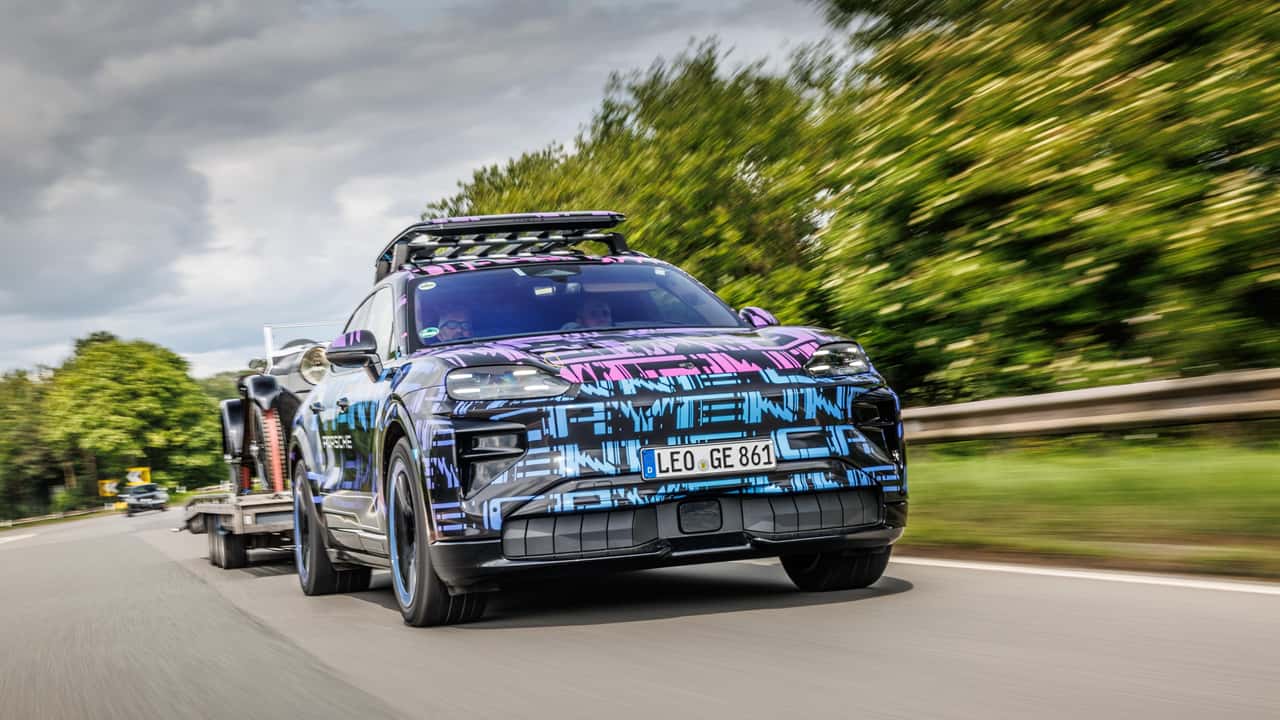
Photo by: Porsche
Iulian Dnistran 
By: Iulian Dnistran
Aug 27, 2025 at 9:20am ET
Add InsideEVs as a preferred source in Google
- (https://twitter.com/intent/tweet?url=https%3A%2F%2Finsideevs.com%2Fnews%2F770251%2Fporsche-cayenne-ev-charging-battery-specs%2F&text=The%20Porsche%20Cayenne%20Electric%20Will%20Be%20A%20Charging%20Monster&via=InsideEVs)
- copy
Share
Comment
- Porsche is stuffing the first-ever electric Cayenne with the latest and greatest in battery and charging technology.
- As a result, the upcoming battery-powered SUV will be one of the fastest-charging EVs in the world.
- Thanks to a battery capacity of over 100 kilowatt-hours, the driving range will be more than adequate, too.
Porsche is hard at work putting the finishing touches on the first-ever electric Cayenne. It’s a big deal for the German brand, as the big SUV is one of its best-selling vehicles, so it has to be as close to perfect as possible.
There’s still a lot we don’t know about the electric Porsche Cayenne, but now that the first prototype test drives are done and dusted, we have a better idea of what the flagship electric SUV will be capable of.

Photo by: Porsche
According to Autocar’s Greg Kable, who drove an unfinished prototype of the battery-powered Cayenne in Spain, Porsche is giving this thing everything it's got. Based on the same 800–volt Premium Platform Electric architecture that underpins the Porsche Macan electric and the Audi Q6 E-Tron, the upcoming zero-emissions Cayenne will be powered by a 108-kilowatt-hour (usable) battery pack with LG-supplied pouch cells.
Depending on the powertrain configuration, the driving range is expected to be over 373 miles (600 kilometers) on the WLTP test cycle, while the maximum charging power will peak at an impressive 400 kilowatts. As a result, a 10% to 80% recharge will take just 16 minutes under optimal conditions, provided you find a powerful enough DC fast charger.
By comparison, the Lucid Air Grand Touring, which is one of the fastest-charging EVs on the market today thanks to its 900V+ battery pack, tops out at 300 kW. Meanwhile, the Lucid Gravity SUV matches the Cayenne’s 400 kW maximum power input, but the American-made EV needs a 1,000V charger to achieve its peak.
Two charging ports come as standard on the Cayenne EV, just like on the Taycan, only this time they’re at the rear of the car instead of the front. This should make charging easier at stations with short cables because the driver can plug in on either side of the car without having to double park. (Only one is a DC fast-charging port, however.)
More Porsche Stories
'Not Economically Viable': Porsche Cancels Plans For In-House Battery Production
The Electric Porsche Macan Gets Many Things Right
Porsche Macan EV Highway Range Test: Here's The Difference 10 MPH Makes
Tested: The 2025 Porsche Taycan Is Still A Fast-Charging Demon
Three versions are in the works, all with dual permanent magnet motors–one at the front and one at the rear–and a two-speed gearbox at the rear. The front motor is made by Bosch, while the rear unit was developed and is produced in-house by Porsche. In other words, the electric Cayenne will be all-wheel drive, no matter the version.
The base model is claimed to deliver a combined 400 horsepower, followed by the Cayenne S with 600 hp and the Cayenne Turbo with 805 hp. Size-wise, the battery-powered SUV is 196 inches long (4,979 millimeters), which is 1.9 inches (49 mm) longer than the gas-powered Cayenne. Meanwhile, the EV’s wheelbase is 118.9 in (3,020 mm), 1.3 in (35 mm) longer than the combustion model.
Gallery: Porsche Cayenne Electric
11


Source: Porsche
Air suspension and twin-valve dampers are part of the package, and the car will automatically lower its ride height by 10 mm above 44 miles per hour (20 mph in Sport Plus Mode) and by 30 mm above 84 mph. There’s also a dedicated Off-Road mode with multiple sub-modes. In its extended position, the air suspension offers a total of 9.6 in (245 mm) of ground clearance.
What do you think?
View
Comments
Despite its roughly 6,000-pound curb weight, the most powerful Cayenne—the Turbo—will accelerate from zero to 60 mph in less than three seconds and reach a top speed of over 155 mph.
Unlike the electric Macan, which is slowly replacing its gas-powered sibling, the electric Cayenne will be sold alongside the combustion model for years to come. Deliveries of the Cayenne EV are expected to begin next year, with the gas model slated to get another facelift around the same time.

Stay informed with our newsletter every weekday
back
Subscribe For more info, read our Privacy Policy & Terms of Use.
We want your opinion!
What would you like to see on Insideevs.com?
Take our 3 minute survey.
- The InsideEVs team
Share this Story
- (https://twitter.com/intent/tweet?url=https%3A%2F%2Finsideevs.com%2Fnews%2F770251%2Fporsche-cayenne-ev-charging-battery-specs%2F&text=The%20Porsche%20Cayenne%20Electric%20Will%20Be%20A%20Charging%20Monster&via=InsideEVs)
- copy
GO TO COMMENTS
(
)
Got a tip for us? Email: tips@insideevs.com
View all comments ( )
Trending
‘We’re Moving Really Fast’: Ionna CEO On 500 kW EV Chargers And Flagship New Location
Every EV Motor Type Explained: They Aren't All The Same
I Tried Mercedes' Answer To Tesla FSD. Here's How It Went
Tesla Model 3 Maintenance Guide: What Needs Servicing And What Doesn't
Latest Stories
- Ford Just Started Fathom LFP Battery Production In Michigan. It's A Big Deal Nov 18 - Battery Tech -
- This GM EV1 Lives After A Painstaking Restoration Nov 18 - News -
- ‘We’re Moving Really Fast’: Ionna CEO On 500 kW EV Chargers And Flagship New Location Nov 18 - Charging -
- BMW's First U.S.-Made EV Is Now Rolling Off The Assembly Line Nov 18 - Manufacturing / Production -
- EV Owners Aren’t Worried About Their Batteries. They’re Worried About Myths Nov 18 - News -
- The Polestar 4 Is Getting Vehicle-To-Load, But The U.S. And Canada Are Left Out Nov 18 - Software -
- Waymo Pulls Its Robotaxis Off All U.S. Highways After California Ban Nov 18 - Autonomous Vehicles -
RECOMMENDED FOR YOU
BMW’s iX5 Beat The Lucid Gravity On Highway Range. Not On Efficiency
Ford Just Started Fathom LFP Battery Production In Michigan. It's A Big Deal
The Best EV Lease And Finance Deals In November 2026
‘We’re Moving Really Fast’: Ionna CEO On 500 kW EV Chargers And Flagship New Location
This GM EV1 Lives After A Painstaking Restoration
BMW's First U.S.-Made EV Is Now Rolling Off The Assembly Line
EV Owners Aren’t Worried About Their Batteries. They’re Worried About Myths