Home
News
Charging
This Tesla Supercharger Extension Cable May Look Perfect, But It Isn't Ready For Prime Time: Expert
It’s the first commercially available NACS to CCS1 extension cord, but as Tom Moloughny found out, there are some issues with it.

Photo by: State Of Charge
Iulian Dnistran 
By: Iulian Dnistran
Aug 24, 2025 at 8:00am ET
Add InsideEVs as a preferred source in Google
- (https://twitter.com/intent/tweet?url=https%3A%2F%2Finsideevs.com%2Fnews%2F769660%2Ffast-charger-extension-cable-adapter%2F&text=This%20Tesla%20Supercharger%20Extension%20Cable%20May%20Look%20Perfect%2C%20But%20It%20Isn%27t%20Ready%20For%20Prime%20Time%3A%20Expert&via=InsideEVs)
- copy
Share
Comment
- More and more non-Tesla EVs can now charge at Tesla Superchargers, and many of them need charging adapters.
- But for some EVs like the Rivian R1T, even with a NACS to CCS1 adapter at hand, it’s still hard to plug in because most Supercharger stalls have short cables.
- Now, a company called Hansshow is selling a 5-foot extension cable that promises to fix both problems at once. However, you should do your research before paying $600.
Having access to Tesla Superchargers as a non-Tesla owner is quite good, as Tesla managed to install a DC fast charger just about everywhere you'd want to drive in the United States. But as some EV drivers know, it’s not always easy to use a Supercharger, especially if you happen to drive an EV like the Rivian R1S or Ford F-150 Lightning.
Leaving aside the fact that you’ll need an NACS to CCS1 adapter, the Supercharger cable might not reach the charge port many popular EVs, including the Chevy Blazer EV and the aforementioned trucks. The most popular stall version, known as V3, was designed for Tesla EVs, which have the charge port on the rear left, while many American electric pickups and SUVs have their ports on the front left side.
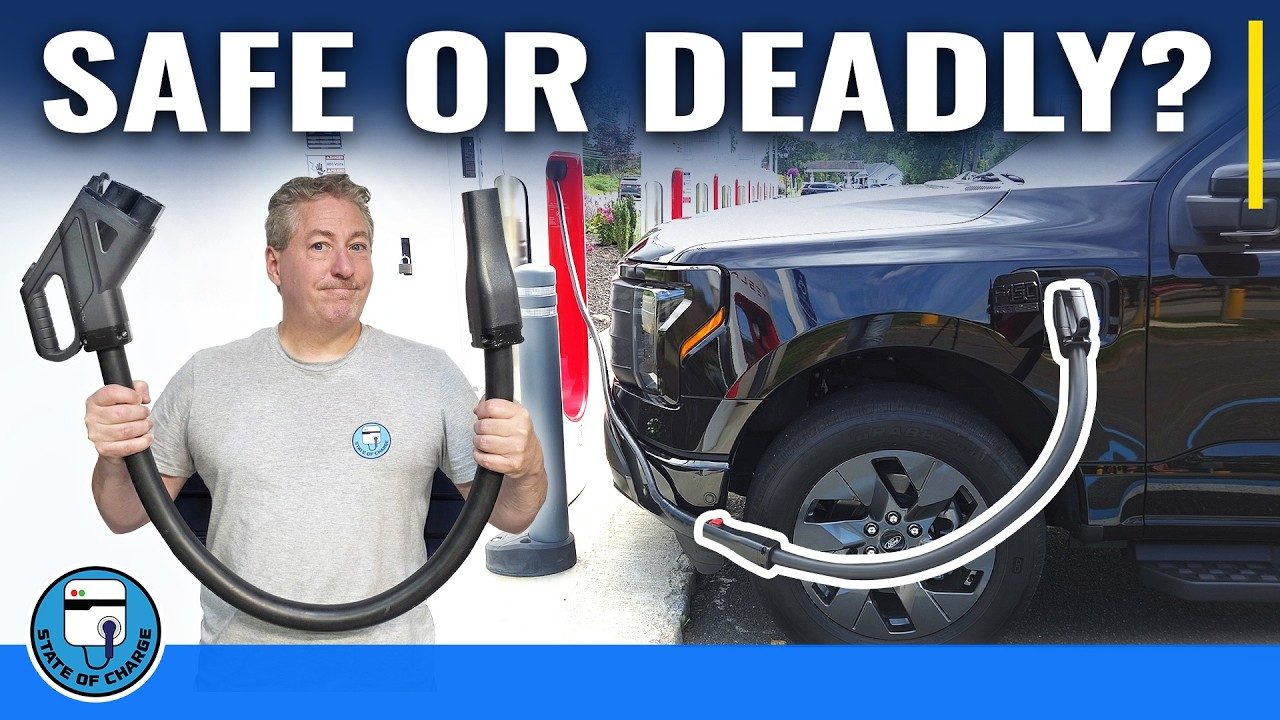
Thankfully, there’s a company out there that is trying to fix two issues with one product. Hannshow’s five-foot extension cable also doubles as a NACS to CCS1 adapter, so it should come in handy for owners of EVs that came with a CCS1 inlet from the factory–like the Gen1 Rivian R1S and R1T, as well as the Ford F-150 Lightning.
That said, the $600 product has some flaws, as InsideEVs contributor and charging expert Tom Moloughney found out during his review of the product. Put simply, he wouldn't recommend it as a safe option.
Specs-wise, the extension cable has two thermal sensors inside the connectors, so when the temperature hits 185 degrees Fahrenheit (85 degrees Celsius), the charging session stops automatically.
Furthermore, the charging can be ended by pressing the button on the CCS1 connector, or you can stop the session from the Tesla app. That said, there’s another release button on the NACS connector, which does just that–it only releases the extension cable from the NACS charging cable. It doesn’t stop the charging session, and that’s a big problem because one could inadvertently remove the NACS part first while charging, and that could create a big electrical arc, as power would continue to flow through the charging cable.
More Stuff Like This
 Don’t Forget: Many DC Fast Charging Adapters Are Technically Prohibited
This Tesla Supercharger Extension Cord Could Be A Game-Changer
Tesla Cybertruck Engineer: Don’t Even Think About Using Supercharger Extension Cords
Tesla Supercharger Extension Cable Maker Addresses Cybertruck Engineer's Warning
For what it’s worth, the company says in the instructions that users should always stop the charging session first by pressing the button on the CCS1 handle or through the station’s app, and then remove the extension cable. But as InsideEVs contributor Tom Moloughney rightly puts it, people don’t read the instructions manual. It would be much safer if the release button on the NACS end of the extension cord also stopped the charging session.
That’s not the only problem with the $600 cable, though. According to Hansshow’s website, the product is rated for a maximum of 250 amps and 1,000 volts, resulting in a maximum power of 250 kilowatts. The problem is that a lot of EVs on the market will ask for a lot more than 250 amps–some require over 500 amps for short stints.
This means that the extension cable will not function as expected in some scenarios. At least that’s what we found out during our testing. When topping up a Ford F-150 Lightning at a Tesla Supercharger, going from 10% to 50% took 30 minutes using the extension cord. When using a certified NACS to CCS1 adapter during an identical charging session, it took 24 minutes.

Stay informed with our newsletter every weekday
back
Subscribe For more info, read our Privacy Policy & Terms of Use.
The same extension cable was used to charge a Gen1 Rivian R1S at a different Tesla Supercharger. After plugging in with a dead battery, the car stopped charging after just a couple of minutes, saying the cable was too hot. After unplugging, waiting for 15 minutes and plugging back in, the car accepted a charge for just one minute before ending the session again.
The Ford F-150 Lightning, however, accepted a charge with the same extension cable at the same station. After changing stations, the Rivian R1S charged from 10% to 34% before stopping again. This time, though, there was no error; it just refused to charge, even after unplugging and replugging.
It’s worth noting that with a regular NACS to CCS1 adapter, the same R1S went from 10% to 60% in 26 minutes at the same location.
Hannshow’s NACS to CCS1 extension cable is the only product of its kind that’s currently available for sale. A2Z, another company that makes charging adapters, has a NACS to NACS extension cable, but that’s not on sale yet, with the company saying it expects the first units to ship in the last quarter.
What do you think?
View
Comments
All this being said, there’s another issue that EV owners should be aware of. If anything were to go wrong during a charging session, carmakers might not honor the car’s warranty if anything other than the manufacturer-recommended charging adapter was used.
The product is out there, and it can be used, but there are issues that need to be considered before you plug one in. Make sure to look into safe operation, and consult with safety and charging experts when necessary.
We want your opinion!
What would you like to see on Insideevs.com?
Take our 3 minute survey.
- The InsideEVs team
Share this Story
- (https://twitter.com/intent/tweet?url=https%3A%2F%2Finsideevs.com%2Fnews%2F769660%2Ffast-charger-extension-cable-adapter%2F&text=This%20Tesla%20Supercharger%20Extension%20Cable%20May%20Look%20Perfect%2C%20But%20It%20Isn%27t%20Ready%20For%20Prime%20Time%3A%20Expert&via=InsideEVs)
- copy
GO TO COMMENTS
(
)
Got a tip for us? Email: tips@insideevs.com
View all comments ( )
Trending
‘We’re Moving Really Fast’: Ionna CEO On 500 kW EV Chargers And Flagship New Location
Every EV Motor Type Explained: They Aren't All The Same
I Tried Mercedes' Answer To Tesla FSD. Here's How It Went
Tesla Model 3 Maintenance Guide: What Needs Servicing And What Doesn't
Latest Stories
- The BMW i3 Has The Nurburgring Skills To Match Its Impressive Range Nov 18 - News -
- Kia Made Its First EV 40 Years Ago. It Shows How Far Electric Cars Have Come Nov 18 - News -
- Ford Just Started Fathom LFP Battery Production In Michigan. It's A Big Deal Nov 18 - Battery Tech -
- This GM EV1 Lives After A Painstaking Restoration Nov 18 - News -
- ‘We’re Moving Really Fast’: Ionna CEO On 500 kW EV Chargers And Flagship New Location Nov 18 - Charging -
- BMW's First U.S.-Made EV Is Now Rolling Off The Assembly Line Nov 18 - Manufacturing / Production -
- EV Owners Aren’t Worried About Their Batteries. They’re Worried About Myths Nov 18 - News -
RECOMMENDED FOR YOU
‘We’re Moving Really Fast’: Ionna CEO On 500 kW EV Chargers And Flagship New Location
The BMW i3 Has The Nurburgring Skills To Match Its Impressive Range
Chevy, GMC, and Cadillac EV Owners Can Now Plug And Charge At Electrify America
Kia Made Its First EV 40 Years Ago. It Shows How Far Electric Cars Have Come
Tesla Drivers Can Now Plug In And Charge Automatically at Ionna Stations
Ford Just Started Fathom LFP Battery Production In Michigan. It's A Big Deal
BYD's Futuristic EV Charger Can Run On Sunshine And Batteries