Home
News
Range / Efficiency
You May Reconsider Buying A Plug-In Hybrid After Watching This
Testing the efficiency of three versions of the same car had some pretty interesting results.

Photo by: CarWow
Andrei Nedelea 
By: Andrei Nedelea
Aug 15, 2025 at 1:00pm ET
Add InsideEVs as a preferred source in Google
- (https://twitter.com/intent/tweet?url=https%3A%2F%2Finsideevs.com%2Fnews%2F768520%2Fgas-phev-ev-compared-efficiency%2F&text=You%20May%20Reconsider%20Buying%20A%20Plug-In%20Hybrid%20After%20Watching%20This&via=InsideEVs)
- copy
Share
Comment
- Carwow tested the efficiency of a BMW 520i, 530e and i5 with interesting results.
- The 520i proved more efficient than a 530e with an empty battery.
- Plug-in hybrids should only be bought by people who know they can commit to charging them regularly.
Plug-in hybrids promise to offer the advantages of both combustion cars and electric vehicles combined into one. They have dozens of miles of electric range, as well as the versatility of starting up their combustion engines for added range and performance. They have ridiculously low claimed fuel economy numbers, but you can only come close to matching them if you never allow their batteries to go flat.
When a PHEV’s battery state of charge drops below the point where it can propel the car purely electrically, the gas engine takes full propulsion duty.
However, in this situation, it not only has to propel the car, but it also has to power a generator to put juice back in the battery, which means it will use more fuel than if it only had to move the car.
That’s why there’s a significant difference between the efficiency numbers of PHEVs running with and without juice in their batteries. Running a PHEV with its battery empty all the time will result in it using more fuel than if the vehicle had just the combustion engine without the electrification.
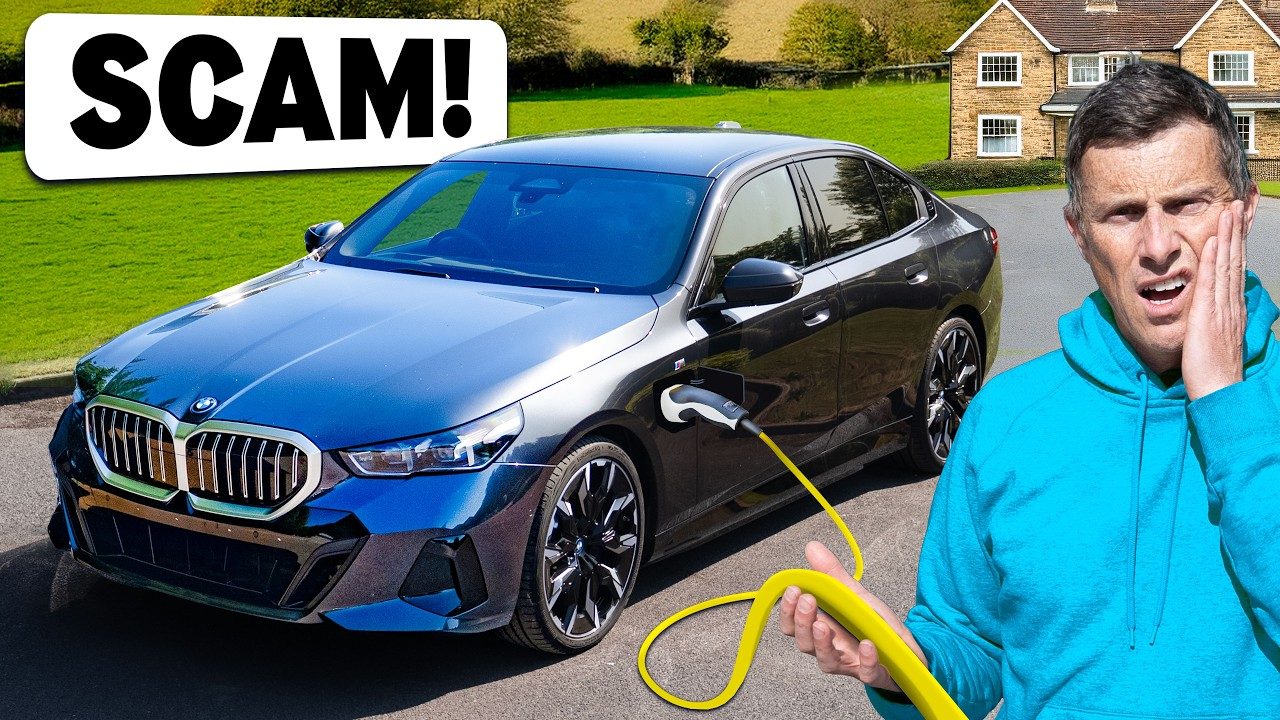
This was proven in a recent Carwow video, which pits three versions of the BMW 5 Series against one another in a range and efficiency challenge. They compared a 520i, a 530e and an i5 on a set route, measuring various parameters and seeing how close they all came to matching their manufacturer-claimed numbers.

Get the best news, reviews, columns, and more delivered straight to your inbox.
back
Subscribe For more info, read our Privacy Policy & Terms of Use.
There’s a bit of weirdness and inconsistency in how the video is structured, but by the end of the route, the 520i proved more efficient than the 530e. Both have the same four-cylinder turbo engine, but in the 530e, it is aided by an electric motor squeezed into the gearbox, which draws electricity from a 19.7-kilowatt-hour battery pack.
Now, sure, it does provide over 60 miles of pure electric driving (which it almost matched in real-world driving in the video), but it’s also considerably heavier than the 520i, which was just a mild hybrid.
The 530e’s extra heft makes it less enjoyable to drive, since weight is supposed to be the enemy of all things holy to a driving enthusiast. Interestingly, when they tested the braking performance of all three 5 Series variants, it was the PHEV that stopped in the shortest distance.
More On Plug-In Hybrids
 Plug-In Hybrids Now Have More Problems Than EVs Do: J.D. Power
The Future Of Plug-In Hybrids: Barely Using Any Gas At All
The Mercedes-AMG E53 Plug-In Hybrid: We Expected More
Used Volvo V90 PHEV Ownership Update: Costs, Efficiency And Annoyances
Nissan's Next-Gen Hybrids Are Actually EREVs
Plug-In Hybrids Are Here. But Buyers Aren't Yet Convinced
Its superior braking performance may have come courtesy of its ability to blend both regenerative braking from its electric motor and the power of the friction brakes. The i5 can do the same, but it has even more mass to bring to a halt. Even so, the fully electric i5, which we've tested in several versions, including the M60 Touring, would be the one we would pick out of the three.
What do you think?
View
Comments
We’ve been saying for years that while PHEVs sound excellent on paper, some claiming upward of 235 mpg, if you don’t commit to charging them regularly (daily, if you have a big commute), they may not be worth buying. For most drivers, a normal non-plug-in hybrid is a much safer bet since it brings actual fuel efficiency improvements over a comparable non-hybrid gas car without the driver having to make any adjustments.
Going for a full EV also makes sense since EVs have much bigger batteries and don’t need to be plugged in as frequently as PHEVs do, and they charge faster too.
We want your opinion!
What would you like to see on Insideevs.com?
Take our 3 minute survey.
- The InsideEVs team
Share this Story
- (https://twitter.com/intent/tweet?url=https%3A%2F%2Finsideevs.com%2Fnews%2F768520%2Fgas-phev-ev-compared-efficiency%2F&text=You%20May%20Reconsider%20Buying%20A%20Plug-In%20Hybrid%20After%20Watching%20This&via=InsideEVs)
- copy
GO TO COMMENTS
(
)
Got a tip for us? Email: tips@insideevs.com
View all comments ( )
Trending
Kia EV3 Lease Deals Are Here, And It’s Cheaper Than The Chevy Bolt And Nissan Leaf
I Let Android Auto Plan My EV Roadtrip. Here’s How It Worked
This Chevy Bolt Has 470,000 Miles. Here’s How Much A New Battery Was
Here's What It's Like To Take Delivery Of A Rivian R2
latest articles
- How Much Range Do EVs Lose When Parked? (And How to Stop It) Oct 20 - EV 101 -
- This Chinese EV Is Now Made In Europe. More Are Coming Oct 20 - News -
- GM Is Closing Its Detroit EV Battery Plant Oct 20 - Industry -
- The 2027 Lexus NX Plug-In Hybrid Gets A Bigger Battery And Fast Charging Oct 20 - Official -
- Kia EV3 Lease Deals Are Here, And It’s Cheaper Than The Chevy Bolt And Nissan Leaf Oct 20 - Pricing -
- Here's What It's Like To Take Delivery Of A Rivian R2 Oct 19 - News -
- Used EVs Hit A Record Share Of Overall Used Car Sales In September Oct 19 - Sales -
RECOMMENDED FOR YOU
2027 Volvo EX60 Blows Past EPA Rating In Real-World Range Test
How Much Range Do EVs Lose When Parked? (And How to Stop It)
A BMW i3 EV Went 753 Miles On A Single Charge. Its Energy Consumption Was Astonishing
This Chinese EV Is Now Made In Europe. More Are Coming
The Longest-Range EVs You Can Buy In 2026
GM Is Closing Its Detroit EV Battery Plant
The Jeep Recon EV Went Just 160 Miles In A Highway Range Test