Home
News
Battery Tech
No Anode, No Problem: The Battery Breakthrough That May Enable 500-Mile EVs
Battery start-up QuantumScape believes ditching the anode can unlock big improvements in EVs, but challenges persist.
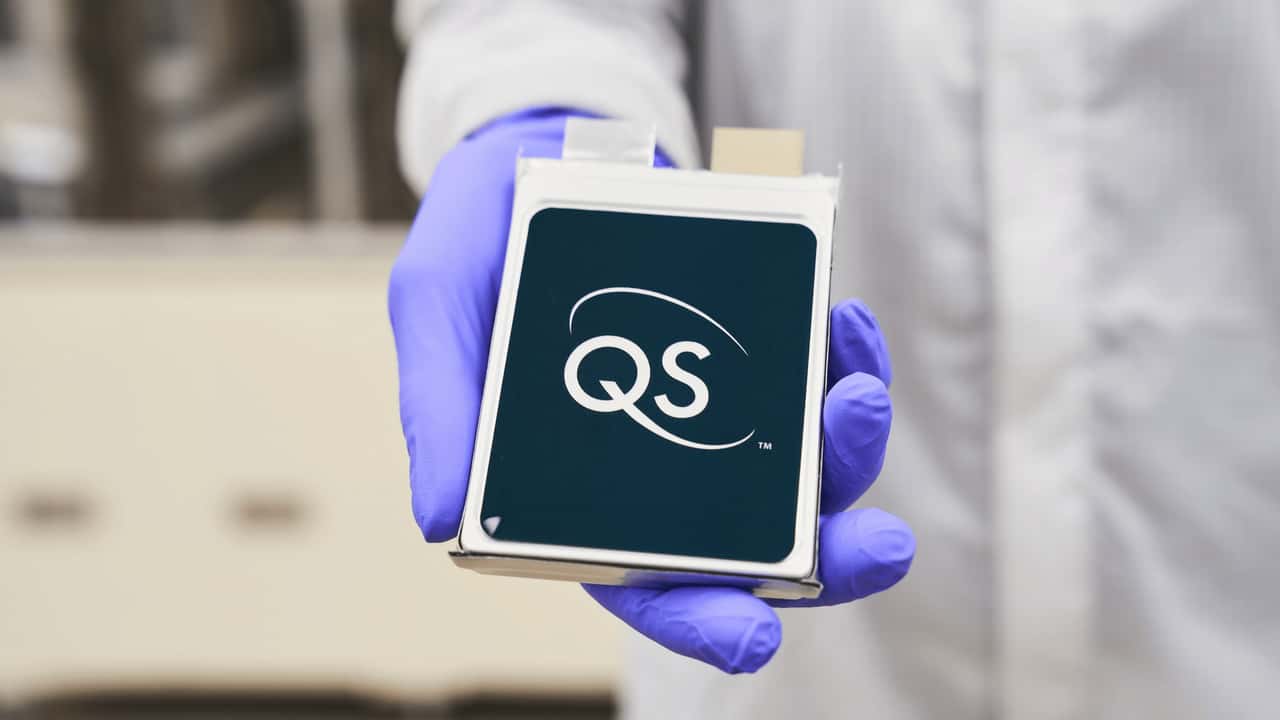
Photo by: QuantumScape
Suvrat Kothari 
By: Suvrat Kothari
Apr 1, 2025 at 1:30pm ET
Add InsideEVs as a preferred source in Google
- (https://twitter.com/intent/tweet?url=https%3A%2F%2Finsideevs.com%2Fnews%2F755188%2Fanode-free-ev-batteries-quantumscape%2F&text=No%20Anode%2C%20No%20Problem%3A%20The%20Battery%20Breakthrough%20That%20May%20Enable%20500-Mile%20EVs&via=InsideEVs)
- copy
Share
Comment
A lithium-ion battery may have fewer parts than a combustion engine, but it's no less complex. It involves an intricate interplay of materials that influences an electric vehicle’s range, charging speed, performance and lifespan. Battery makers are racing to optimize all of the above, with chemistries that can minimize the trade-offs. One of the promising contenders is the anode-free solid-state lithium-metal battery.
At least one battery executive believes that this chemistry will enable the true “no compromises vehicle”, where driving range, charging times, safety and lifespan are all impressive. It sounds great on paper, but for the technology to truly come out of the lab and onto EVs that customers can buy, several challenges are yet to be solved.
“If you want to make a big step change in cost, energy per mass and energy per volume, the biggest change you could make is to eliminate the anode,” Tim Holme, the co-founder and chief technology officer of battery start-up QuantumScape told InsideEVs.

Photo by: QuantumScape
Key components in a traditional lithium-ion battery include an anode, electrolyte, separator and cathode. They all work together to shuttle electrons between an EV’s charge and discharge cycles. The anode is reportedly one of the dirtiest components, both in terms of environmental impact and manufacturing complexity.
It’s typically made from graphite—a stable, long-lasting material but one that limits fast charging and energy density. Processing graphite requires toxic solvents and China controls the vast majority of its supply chain. We’re also seeing more silicon usage in anodes, but those are expensive and their cycle life and stability isn’t the best, according to QuantumScape. Companies working on that technology say that they're improving stability and long-term durability.
Anodes are also part of the reason why EV batteries are so heavy. Holme explained that the anode comprises a thick layer of carbon and takes up plenty of volume and mass in a cell. Its processing and production is also energy intensive, releasing considerable CO2 emissions.
Now QuantumScape is one of several battery start-ups trying to ditch the traditional methods of incorporating anodes. The others include Factorial, Our Next Energy and Ensurge Micropower who are also developing their own versions of anode-less cells.
QuantumScape is developing a lithium-metal battery where the anode can be formed “in situ.” It is created directly within the battery rather than being inserted as a separate component. This is significant because normally lithium-ion batteries use a pre-formed anode, usually made using graphite and/or silicon. Lithium-metal batteries can start with just a cathode, electrolyte and separator.
During the first charge, lithium ions deposit onto the current collector, forming the lithium-metal anode. This simplifies manufacturing, reduces costs and improves energy density. QuantumScape claims an EV with 350 miles of range using typical cells can drive between 400-500 miles using its solid-state lithium-metal cells. Though as we'll discuss in the density section, this comparison doesn't seem to be with densest lithium-ion batteries we have today.
Photo by: QuantumScape
“Lithium metal is the best anode. It's better than graphite and better than silicon,” Holme said. “Solid-state plus lithium metal makes for the best battery. There’s no technical trade-off. But it’s an engineering challenge,” he added. One of those challenges include preventing the growth of dendrites, which are sharp metal structures that can grow inside the battery and ruin it.
Daniel Parr, a technology analyst at U.K. based research firm IDTechEx wrote in a note that lithium metal batteries have been historically challenging to develop due to this issue, as dendrite formation causes early battery degradation and limits cycle life.
QuantumScape's solution to that is a proprietary solid-state separator made from a ceramic which prevents dendrites, the company claims. The electrolyte is made from an organic liquid whereas the cathode can be made using nickel, iron or both, Holme said.
“Iron is of course cheaper, but lower energy density and nickel is higher energy density, but more expensive,” Holme said. “Our plan is to offer both platforms to our customers and let them choose.”
The start-up’s QSE-5 cell uses this novel chemistry. The first two letters represent the company, “E” stands for energy and the number denotes five milliamp-hours of capacity, similar to the capacity of a Tesla 2170 cell that's used in certain versions of the Model Y, among other products.
The QSE-5 cell has an energy density of 305 watt-hours per kilogram, which seems only marginally better than Tesla’s 4680 NMC cells used in the Cybertruck and the Model Y. The 4680 is estimated to have an energy density of 272-296 wh/kg. Factorial's all-solid-state Solstice battery is claimed to deliver an energy density of 450 wh/kg. So for a solid-state, experimental battery, the QSE-5's density is on the low end.
Nonetheless, the benefits are notable, the start-up claims. Lifespan improves by eliminating “capacity fade” that results from the chemical reactions between the anode and the electrolyte. Safety is better because the ceramic separator is claimed to be non-combustible and stable even under extreme temperature loads.
In case of a crash, an EV with such a battery is less likely to blow up. (EV fires are statistically rarer than gas cars, but in the rare instances when they do occur, they’re hard to extinguish.)
Photo by: QuantumScape
QuantumScape has already shipped "B-samples" of its new battery to automakers for testing and plans to send more this year. B-samples are near-production battery prototype used for more advanced testing, such as performance validation, safety assessments and integration into EVs.
One of QuantumScape’s clients is PowerCo SE, a fully-owned battery subsidiary of the Volkswagen Group. “We've licensed them the technology and we’re working together to deploy it,” Holmes said. “They’re building gigafactories in Spain, Germany and Canada and we'll be working with them to put it into production.”
Under the non-exclusive licensing agreement, PowerCo can produce up to 40 gigawatt hours of batteries using QuantumScape's technology, with an option to expand to 80 gWh, which would be enough to produce 1 million EVs annually.
When asked about the costs involved compared to current lithium-ion batteries, Holmes compared the development of solid-state cells to that of SpaceX’s disruption of the rocket industry.
“If you look at the first SpaceX rocket compared to what NASA did at the time, it wouldn't be as [cost] competitive,” he said. “As they have improved, they have brought down SpaceX costs to orders of magnitude below what NASA was operating at.”
Translation: It's going to be more expensive than a traditional battery, at least at first.
What do you think?
View
Comments
“If we also get on the learning curve, ramp up our volumes, come down in costs, we can be competitive and even beat lithium-ion in time,” he added.
Have a tip? Contact the author: suvrat.kothari@insideevs.com
Related Stories
Two More Chinese Companies Announce 'Megawatt' EV Charging
Don’t Want A Tesla Model Y? Here Are Your Best Alternatives In Europe
Chevy Equinox EV 20,000-Mile Review: Great Family Car, Buggy Software
Trump 'Couldn't Care Less' About Price Hikes As Tariffs Threaten EV Boom
We want your opinion!
What would you like to see on Insideevs.com?
Take our 3 minute survey.
- The InsideEVs team
Share this Story
- (https://twitter.com/intent/tweet?url=https%3A%2F%2Finsideevs.com%2Fnews%2F755188%2Fanode-free-ev-batteries-quantumscape%2F&text=No%20Anode%2C%20No%20Problem%3A%20The%20Battery%20Breakthrough%20That%20May%20Enable%20500-Mile%20EVs&via=InsideEVs)
- copy
GO TO COMMENTS
(
)
Got a tip for us? Email: tips@insideevs.com
View all comments ( )
Trending
Lucid's $50,000 Tesla Model Y Rival Is Getting Closer To Production. Here's The Latest
Tesla Is Squeezing More Money Out Of The Cybertruck Before It Dies
This BMW i3 Drove 3,658 Miles. It Needed Less Than 3 Hours Of Charging
Rivian's New Robots Will Initially Handle 20% Of Factory Tasks. The Goal Is 80%, CEO Says
latest articles
- Tesla Extends Cybertruck Production Run To Work Through Order Backlog Nov 11 - News -
- The AI Boom Is Making Ordinary Car Parts Harder To Get, Rivian Says Nov 11 - News -
- The Best Hybrid SUVs To Buy In 2026 Nov 11 - Buying Advice -
- This BMW i3 Drove 3,658 Miles. It Needed Less Than 3 Hours Of Charging Nov 11 - Range / Efficiency -
- Tesla Is Squeezing More Money Out Of The Cybertruck Before It Dies Nov 11 - News -
- Rivian's New Robots Will Initially Handle 20% Of Factory Tasks. The Goal Is 80%, CEO Says Nov 11 - Manufacturing / Production -
- This New Electric Paver Can Lay Down 1,200 Tonnes Of Asphalt A Day Nov 11 - News -
RECOMMENDED FOR YOU
Ford Tested 36,000 Mustang Mach-E Batteries. Here’s How They Held Up After 100,000 Miles
Tesla Extends Cybertruck Production Run To Work Through Order Backlog
China Has An Iron Grip On EV Batteries. Here's America’s Plan To Break It
The AI Boom Is Making Ordinary Car Parts Harder To Get, Rivian Says
Mercedes Wants To Rethink EV Batteries With This Clever New Technology
The Best Hybrid SUVs To Buy In 2026
The Tesla Model Y's Structural Battery Was Nearly Impossible To Repair. The Cybercab Fixes That