
Mercedes' Answer To Tesla FSD Requires Hands On The Wheel. Does That Make It Better Or Worse?
The decision was a philosophical one, Mercedes executives claim. But was it the right one? FSD users are skeptical.

Having your commute involve a scenic canyon road would probably be a dream for many, but for Lucian Capellaro, his daily drive through Laurel Canyon from the San Fernando Valley to Los Angeles’ west end is a tedious, never-ending nightmare.
Not surprisingly, he started listening with great interest as co-workers started extolling the virtues of their Teslas’ Full Self-Driving feature. They would just enter a destination and the car would get them there. It sounded like a godsend, but he wasn’t sold. Quite simply, he’d rather own something other than a Tesla–as much for car-related reasons such as design, interior quality and body style as anything political.
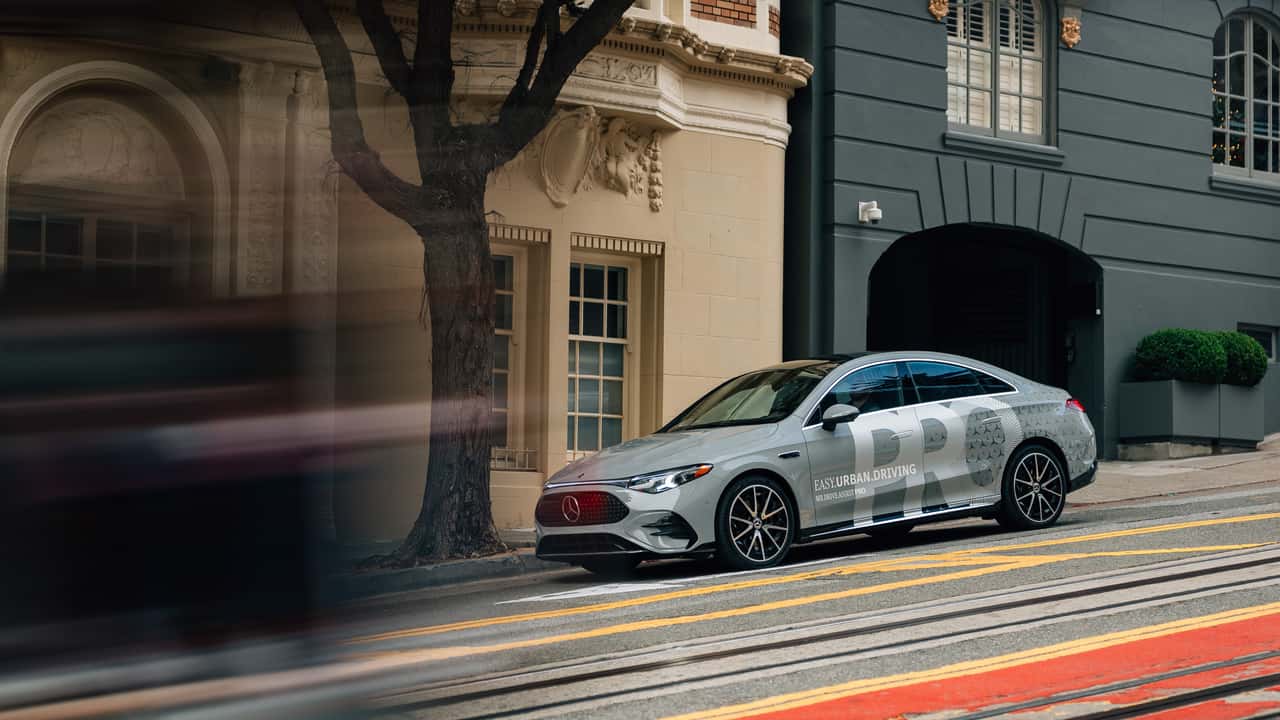
Mercedes might soon be offering an alternative for him. Its MB.Drive Assist Pro point-to-point automated driving system is set to be added to a large number of the brand’s electric and internal combustion vehicles early next year. Already-purchased eligible vehicles will be able to add it via an over-the-air update.
Gallery: Mercedes MB.Drive Assist Pro Prototype Drive


As with Tesla’s Full Sell-Driving (Supervised) feature, MB.Drive Assist Pro allows drivers to enter in a destination and the car will drive them there and park. There is one main difference, however. Like FSD, the Mercedes system operates hands-free on controlled access highways. Unlike FSD, the system requires you to keep a hand on the wheel when on surface streets.
This functionality isn’t necessarily a sign of its inferiority, but rather a philosophical one. Mercedes is adhering to a strict interpretation of autonomous driving “levels” as defined by the Society of Automotive Engineers (SAE). MB.Drive Assist Pro, like FSD (Supervised), is considered a Level 2 system (or “Level 2 Plus Plus” as Mercedes calls it) that must be supervised by the driver. Being able to watch a movie or read a book while the car drives in certain conditions are hallmarks of a Level 3 system.
“There is a very important borderline between the levels,” Mercedes Chief Technology Officer Jörg Burzer told InsideEVs. “That borderline is that with Level 2 Plus Plus, you are responsible. At Level 3, the machine, the car, the software stack, is responsible.”
Drive Assist Pro is coming to models like the new Mercedes CLA.
He said that while controlled-access highways present fewer variables for a Level 2 system to handle, surface streets are far more chaotic and complex. As such, Mercedes requires the driver to keep a hand on the wheel when off a highway.
It’s decision that seems logical to Capallero, who, it must be said, is a motorcycle rider and not exactly risk-averse.
“Think about the reaction time it must be for someone to take their hands from off the wheel to on the wheel,” he said. “I’d view my hand on the wheel as lessening the seconds of reaction time to something crazy happening.”
Burzer said that customer research indicates European drivers tend to agree with Capellaro.
Related Stories
“In the city, they like to have something, some regulation or some requirement that you have to have a hand on the wheel,” Burzer said, but then added “I don’t know about U.S. customers yet.”
Indeed, when asked directly why someone would want the Mercedes system when Tesla allows them to have their hands off the wheel on surface streets, Burzer didn’t really have an answer. He kept coming back to regulations and the SAE levels of autonomy.
“The big question is when is level 3 coming?” he insisted. “Because then you can the hands off (anywhere).”
The thing is, many Tesla FSD users would probably say that their cars are already there. They, like perhaps Tesla itself, don’t seem to share Mercedes’ philosophical need to strictly adhere to definitions concocted by the Society of Automotive Engineers. They’re going by what their cars are actually doing.
Antonio Hidalgo is another L.A. area resident. He uses FSD all the time—not just when commuting—and admits that when he’s wearing a hat and sunglasses he’s actually been able to take a nap while driving. He says the only system flaws he notices now involve parking.
As Mercedes launches its FSD rival, Tesla's system is expanding to Europe.
“If the (Mercedes system) worked the same but I had to keep my hand on the wheel …” Hidalgo said before thoughtfully contemplating his answer. “You know, I probably wouldn’t (make the switch). I mean, I think I would be interested in having a nicer car with a better interior. But no.”
Mharlon Barrientos uses FSD during his commute in Indianapolis. Although he said it took a while to trust FSD on surface streets (he’d usually “hover” a hand on the wheel just in case), system updates and experience has him fully hands off now.
“Having a hand on the wheel as a requirement would be a bit of a step back to the feel of full autonomous driving that I’ve gotten used,” Barrientos said, noting that he’s had his Model Y long enough that the system originally required a hand to be on the wheel.
Mercedes MB.Drive Assist Pro uses a variety of cameras and radars to perceive its environment.
Mercedes would be quick to argue that MB.Drive Assist Pro has advantages over FSD (Supervised) in that it doesn’t just rely upon cameras to sense obstacles as Tesla does, but also features five radar sensors and 12 ultrasonic sensors to deliver raw data to the car’s Nvidia-powered computer.
“Different sensor inputs increases performance and safety,” said Christoph von Hugo, Mercedes’ Head of Active Safety. Among other vailed references to what he seems to see as Tesla’s insufficient approach, he added that “Relying on one just is not enough.”
He added that Mercedes won’t even ascend to Level 3 capability without adding LiDAR on top of the cameras, radar and ultrasonic sensors. (Notably, Mercedes briefly did offer a Level 3 system in the U.S., but it's been phased out.)
Barrientos isn’t so sure that would be a compelling pitch, be it to him or others.
“I honestly haven’t even thought about the tech behind it, so I’m not so sure knowing that there’s radar and ultra-sonic sensors (on the window sticker) would be a huge selling point,” Barrientos said. Videos or written reviews might make him receptive to any possible performance advantages, but “Just like the Tesla system, I think it would take me some mileage on both highway and streets to gain a trust for the system to know it’ll handle either situation well.”
He also indicated that he’s not married to Tesla or FSD. Not every Tesla owner is a die-hard.
“The hands-on requirement in the city would not be enough to sway me off of the car provided I like the rest of the car,” Barrientos said. “While I like the functionality of FSD, it’s still a bit further down the list of what I look for in a car. Functionality, comfort, value … I still like to feel the mechanics and have the feel of actually driving a car.”
Capellero is pretty much on the same page. Never mind Tesla FSD, he’s wondered how much of a difference the Mercedes system would be compared to driving his wife’s BMW i4, which has adaptive cruise control and hands-free highway driving assist at low, traffic jam speeds.

“I guess I’d just have to experience (MB.Drive Assist Pro) for myself, but if it can navigate all the craziness that is Laurel Canyon through Hollywood, and it is literally just my hand resting on the wheel, and that’s it, then sure,” he said. “The fact that it’s truly point-to-point, then yes, that sounds super appealing.”
Of course, the real question is whether MB.Drive Assist Pro really performs as well as Tesla FSD, albeit with its token hand-on-the-wheel requirement? Although InsideEVs found it promising back in January during a passenger-seat ride in San Francisco, a full review will be coming soon. Is keeping a hand on the wheel really for the best? Is it a big deal? Stay tuned for the answers.
James Riswick has been testing and reviewing cars since 2004, serving as an editor at Edmunds and Autoblog, and contributing to Auto Express, CarGurus, Capital One Auto Navigator, ArsTechnica, and Hagerty. A proud Canadian originally from Toronto, he currently lives outside Los Angeles after stints in Oregon and Indiana. He owns a 1998 BMW Z3, a 2013 Mercedes E350 Wagon and a Cadillac Optiq because his wife would rather drive something from this decade.
RECOMMENDED FOR YOU
Mercedes Wants To Rethink EV Batteries With This Clever New Technology
This New EV Motor Spins To 30,000 RPM. It’s Designed For Normal Cars
Mercedes-Benz Is Giving Up On Its EV Charging Network In Europe
Ford Tested 36,000 Mustang Mach-E Batteries. Here’s How They Held Up After 100,000 Miles
AMG’s New Electric SUV Has 1,153 HP. The Charging Specs Are Even Wilder
Hyundai Is Recalling Nearly 30,000 Kona EVs Because Their Airbags May Not Deploy
I Drove Mercedes’ New EV With A Silicon Anode Battery. The Future Is Here