
Why Did The Electric Range Rover Take So Long? A Lot Of Reasons
Getting its first EV right wasn't easy, but it was important.
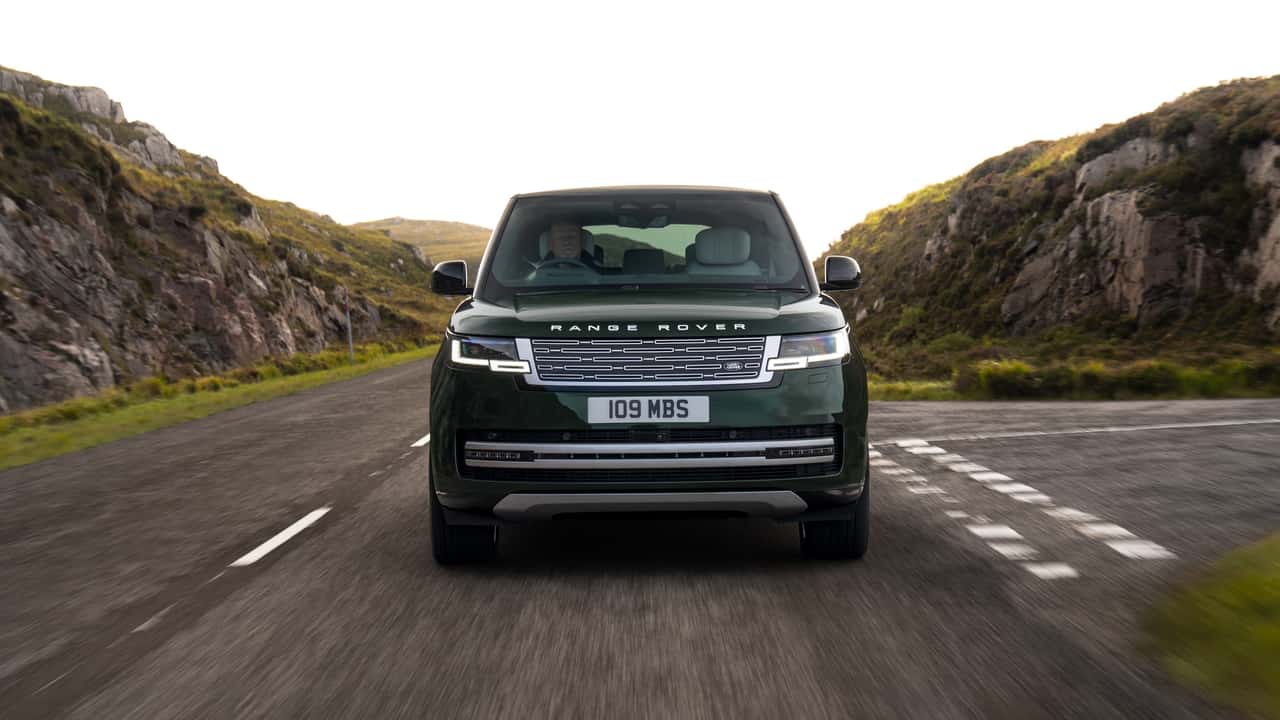

A fully battery-powered Range Rover was first promised to consumers at least five years ago, when Jaguar Land Rover (JLR) revealed its “Reimagined Strategy,” in which it vowed to electrify every product in its lineup. But while promises of an imminent release date for this electric vehicle have been frequent during the past half-decade, it only just made it into our hands. And while it’s a quality product, these delays have had me scratching my head. So, when I met up with the Land Rover development team in Scotland this week, I asked point blank what went wrong.
Turns out, plenty. The main issue, according to program chief Simon Fairbrother, derived from creating a propulsion system that would meet the desired attributes. “When we set out, we were going to have an induction motor at the front,” he says. The benefit of such a system is that the forward unit can be disconnected in ordinary on-road driving when all-wheel-drive capabilities are not needed, improving efficiency and range. It can then be re-coupled when additional traction is necessary.

The Range Rover Electric can ford through three feet of water.
But during testing, especially high-temperature testing, such a setup couldn’t deliver the desired, consistent Range Rover off-road capability. “It was getting too hot, and we were having to back off the power,” Fairbrother says. This was unacceptable to the development team, sending them back to the proverbial drawing board.
Fortunately, the brand had developed a more robust permanent magnet motor setup for the rear drive unit. So its solution was to simply replicate that system for the front axle. Of course this meant that the brand had to go back and strenuously model and test and validate this setup as well. “To make sure that we weren't exposing ourselves to another, I wouldn't say error state, but potential compromise,” Faribrother says.
Compromise is not exactly in the Range Rover vocabulary. The model is not just a flagship for Land Rover, but a venerable benchmark for the ultra-adept luxury SUV category, which it helped to invent back in 1970. This meant that, in addition to sporting supreme and reproducible off-road capabilities, the new electric version had to maintain a relaxing “magic carpet” driving style on-road, and a refined spacious cabin with a command driving position.
“These are the things our customers have told us they want,” says Rachel Hogg, Range Rover product manager. “And it's been so important that we deliver on that promise, that we felt like we had to get it right and not just rush to the market with something that wasn't right for the brand.”
Fording depth in the new EV thus remains the same as in the gas-powered Range. As are angles of ascent and descent. But the big rear motor means that the Range Rover Electric can’t accommodate a seven-seat variant, like its long wheelbase petroleate brother can. In addition, according to Fairbrother, the EV incorporates a minimal reduction in departure angle, due to the existence of a new aero-enhancing rear diffuser. There is also a small diminution of ground clearance and break-over angles—though these, Fairbrother claims, are at least partially mitigated for.
“We've got a completely flat floor. And because we've got the integrity of the battery pack, in some respects, having that completely flat floor compensates for the fact that you've got slightly less ground clearance, because you can slide over, almost sledge, over some of those obstacles,” he says. I imagine the noise of the bottom of the cells’ housing scraping on a boulder, and it’s like nails on a chalkboard. Then again, there’s plenty of vulnerable metal to grind on under a gas-powered Range as well.
Despite the Trump administration’s consistently wrong-minded and retrograde policies toward accepted science around climate change and the benefits of vehicle electrification, Land Rover has seen huge interest in its new EV from the North American market. Though, according to Fairbrother, it is concentrated in areas of the country that are less supportive of the current regime, including New York, California, Oregon, and Washington. “We've got over 80,000, genuine expressions of interest,” Fairbrother says, “and a surprising majority are in the United States.”
Hogg says that, of this global waiting list, around 20% of its members already own an EV. She also notes that about 70% of these people are new to the Land Rover brand, demonstrating a hugely incremental arena for growth. And she believes that fully electric vehicles will eventually constitute 10-20% of overall Range Rover sales. Though, as a caveat, she says that the brand “would need a crystal ball to be able to predict that accurately.” This is something that it sadly lacks.
This uncertainty is why Land Rover remains steadfast in its belief in its powertrain-agnostic “Flex Architecture,” program which allows it to accommodate ICE, mild-hybrid, PHEV, and BEV propulsion systems within the same platform and design. “All of the vehicles are built down the same line in Solihull. So, we can flex to that demand, to how the global market's doing, within weeks or months,” Hogg says.
Perhaps the most intriguing detail the team revealed concerns the rationale through which many of Land Rover’s high-net-worth potential clients were drawn to electrification. It turns out that they are compelled by the prospect of an electric Range Rover not solely because they cherish its zero tailpipe emissions bona fides, its resolute off-road chops, or its luxurious interiors. It’s “because they hate going to gas stations,” Fairbrother says. This is not because these locales are unctuous and smelly, he notes, but because this cohort feels vulnerable, at risk of attack, in such public spaces.
“So, one of the benefits of the electric Range Rover, is that they can have the ecosystem at home to be able to charge it,” he says. “So, it just helps reassure those people, provides this added element of feeling safe.” Of course, to capitalize on this captive market, Land Rover will be offering a branded home charger solution for buyers of this and future models. What all of this says about our country, and the growing divide between the haves and have-nots, we will leave to you to decode.
Gallery: 2027 Land Rover Range Rover Electric: First Drive
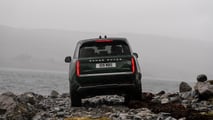
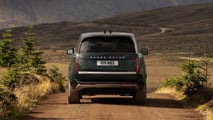
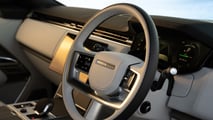
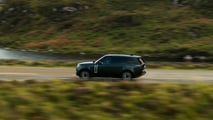
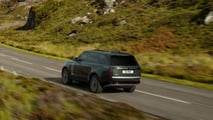
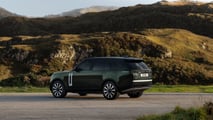
Now that Land Rover has released its first EV, it begs the question of what this signifies for the marque’s future electric products. Hogg and Fairbrother point out that the Range Rover Sport EV is currently launching in other markets, globally, and will likely come to the States next year. And they both remind me that the brand has already confirmed that it will release the jacked-up-wagon-esque five-door Range Rover GT as an EV next year. Though they are quick to note that it will also be built on a flexible architecture, capable of accommodating gas and hybrid variants.
When asked if these, or other forthcoming Land Rover vehicles, will share any componentry with the 2027 Type 01 from stablemate Jaguar, Fairbrother says, flatly, “Yes.” Though when asked to elaborate, he demurs. “Obviously we're all part and parcel of the same company,” he says. “There are components that are shared. But the propulsion system that we have in this car is bespoke to Range Rover to deliver all of the Range Rover attributes. Type 01 has got a completely different set of requirements.”
The Range Rover Electric shares some components with the Jaguar Type 01, though the company isn't saying which ones.
Their response is similar, though marginally more forthcoming, when I ask about the probability of higher-output iterations of current or forthcoming Land Rover electric vehicles, akin to the brand’s souped-up SV or Octa nameplates.
“I think it's fairly normal that we'd always be looking to do those sorts of research and development products,” Hogg says. Fairbrother grins tightly. “We never stop developing,” he says.
Related Stories
RECOMMENDED FOR YOU
Want The Best Range Rover? Get The Electric One: First Drive
2026 Lexus ES 350e Review: Why This Is Toyota’s Best EV Yet
The Range Rover Sport Electric Is Here To Take On The Lucid Gravity
Kia Plans To Take On Affordable Chinese EVs In Canada With Its Sub-$40K EV3
‘Propulsion-Agnostic’: GM Wants To Bring Tesla-Style Software Features To Its Gas SUVs, Too
I Drove The Electric BMW X5. It Makes The Gas Version A Tough Sell.
Chinese And European Car Companies Both Brought Their A-Game To The Paris Auto Show