Home
Land Rover
Range Rover Electric
Reviews
Want The Best Range Rover? Get The Electric One: First Drive
The electric model is powerful, elegant, and capable. And it doesn't even cost more than the gas model.
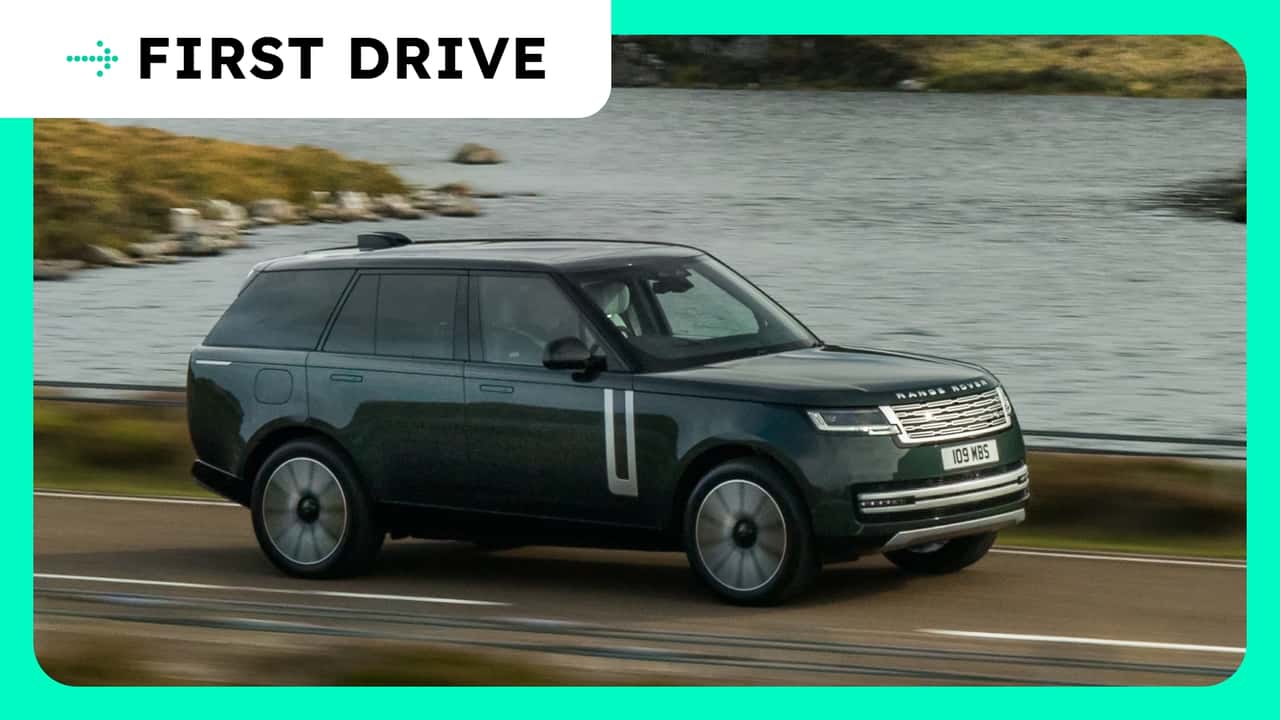
Photo by: Land Rover
Brett Berk 
By: Brett Berk
Oct 22, at 3:08pm ET
Add InsideEVs as a preferred source in Google
- (https://twitter.com/intent/tweet?url=https%3A%2F%2Finsideevs.com%2Freviews%2F812974%2Frange-rover-electric-first-drive%2F&text=Want%20The%20Best%20Range%20Rover%3F%20Get%20The%20Electric%20One%3A%20First%20Drive&via=InsideEVs)
- copy
Share
Comment
After descending the long muddy ruts toward the frigid Loch, plodding along the seaweed- and lichen-strewn beach, crossing between rows of stacked quartzite and limestone cairns, and plowing through a loose graveyard of ancient coastal rocks, I came to the stream crossing. It was a perfect Scottish autumn afternoon, which meant it was 47 degrees and pissing rain. The buttery soft faux-leather of the seat, steering wheel, and armrests were heated enough to scotch an egg. The same couldn’t be said for the spotter on the near side of the shore, who had clearly been standing in the squall for some time, awaiting our arrival.
“Is it quite toasty in there?” he brogued when I opened the window. I felt terrible about the prospect of responding honestly, so I just shrugged, but the heat exhaling through the open double-pained glass provided a clear answer.

Photo by: Land Rover
“Just stay on the path and stay steady on the throttle,” he said. And I was off. The cold water was deep enough to swamp the front “off-road” camera, and I briefly glimpsed a sub-aquatic view of the tannic river on the center console display, as if through a scuba mask.
This all occurred not only in a Range Rover—among the contemporary vehicle brands considered most prone to voltaic glitching—it was the all-new $140,000 Range Rover Electric. Shockingly, even with its 800-volt 118.5kWh battery fully submerged, nothing fritzed out. With my foot pressed on the accelerator, it crept along the seabed, wading through three feet of pure Caledonian brackishness, and led me out onto the other shore. Even more shockingly, unlike in other Range Rovers I’ve off-roaded or forded, it accomplished all of this with just a simple twirl of the modal control dial to Wade. No need to shift into neutral, switch into low, lock the diffs, or any of that mechanical nonsense.
Photo by: Land Rover
This is because Land Rover’s first-ever battery-powered ultra-luxury SUV obviates translations between power source and drivetrain. The software controlling the inverter in the electric drive unit (EDU), which processes electron delivery to the twin 260 kw front and rear permanent magnet motors, does it all single-handedly, allowing the truck’s integrated traction management system to operate a startling 100-times more quickly than in the internal combustion version of the world’s most venerable luxury sport ute. At every step of my off-road journey, it knew exactly what to do, and did it, before I knew exactly what was happening, and often well before I cared.
This is, of course, the promise of a Range Rover, and has been since 1970, when it invented the category of high-class all-wheel-drive truckster it continues to dominate: the capacity, whether utilized or not by its well-heeled owners, for elegant, effortless, all-terrain, all-weather dominance. It delights me, as the masochistic owner of a less-than-stellar 1990 iteration of the model, and regular chronicler of the brand, that the RREV might just be the best Range Rover, ever. Because it does everything a Range Rover should do, but better.
Photo by: Land Rover
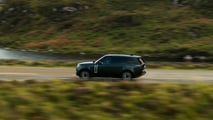
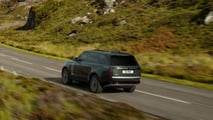
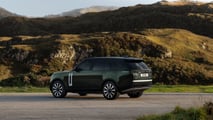
There is no special badging that distinguishes the Electric from its gas- or hybrid-powered brethren, just some covert aerodynamic add-ons—a “grille” up front and diffuser out back—and a lack of tailpipes. But if you get inside and start it up, you can immediately sense the core differentiator. Or, not sense it. A Range Rover is, by definition, a cocoon, meant to insulate its occupants from incursions of things like undesirable meteorology, challenging roadway surfaces, lesser vehicles, and the generally noisome workings of the outside world and its occupants.
Petroleum-sipping Ranges allow anywhere from “some” to “raucous amounts” of engine noise to intrude on this isolation, depending upon the trim, if only to remind the people inside of their ability to outrun any meddlesome disturbances. The Electric ups the ante on this swaddling. Land Rover claims a 7-decibel reduction in noise under hard acceleration—and remember that the decibel scale is logarithmic, meaning every 10 db equates to a doubling in loudness. The difference is even more noticeable from outside, where its powertrain has fallen silent. All this whilst its 542 hp and 627 lb-ft of torque dispatches 0-60 runs in the same 4.3 seconds as its basic V8-endowed sibling.
Photo by: Land Rover
This silence was most appreciated, and golden, when sloshing through the remote, brooding, and muddy Scottish wilderness. Pheasants and grouse barely fluttered from our path, offering exquisite opportunities to examine their complex plumage. Flocks of sheep grazing on roadside heather, used to the dieseling of local vintage Defenders and Discoveries, acted dumbfounded by our tranquil whir, drawing close enough to risk becoming sweaters or mutton. I could practically hear the rustling autumn leaves shedding from the birch branches overhead.
This quietude meant that, despite the vehicle’s three-plus-ton mass—about 300 lbs more than the heaviest gasser Range—I felt as though I was treading lighter on the earth. Even more thankfully, the Electric did not emit, through its internal speakers, any of that gargly sci-fi soundtrack endemic to many upscale EVs, except under hard acceleration in Dynamic mode. Instead, active noise cancellation works to mitigate against irksome sound, making the interior even more hushed. Other brands please take note: If one of the core benefits of an electric vehicle is to allow its occupants to cherish the silence, please allow us to cherish that silence, in silence.
Photo by: Land Rover
This Range can also be credited with a superiorly wafting “magic carpet” ride compared to its peers in the Land Rover lineup. Hat tip to its twin-chamber air suspension. Though these magical dampers share billing with the big battery pack in the floor, and the additional torsional rigidity and lowered center of gravity it provides. The brand claims that these boosted struts respond 60% more quickly to inputs than those in the ICE version, working hard to absorb road imperfections. Still, there is no masking mass, and on Northern Scotland’s undulating and often broken one-lane tracks, I found the Comfort setting too pillowy for my taste. Spinning the response controller to Dynamic helped firm up the rebound to a less excitable level.
Also notable, when this Rangey ventures off-road, its powertrain provides a layer of automatic support that must be requested of other iterations. Clicking the shifter down once from D still activates an S mode, as it does in gas versions, but here, S stands for “Single Pedal.” This regenerative braking feature provided very useful mediating downhill speed when I was slipping along a steep hillside in the the Scottish slop. In fact, if given enough leeway, it will even bring the car to a surprisingly gentle “chauffeur” stop. It’s far less nauseating than the regen on some other EVs, and sports three additional levels of adjustment, including “off.”
Photo by: Land Rover
Of course, being an electric vehicle, this Range has a limited range—though its expected 333-mile certification from the EPA seems like a pretty solid number. Still, this means that it can’t carry extra jerry cans of potential energy like a gas version, so if you’re a dictator fleeing an unruly mob in Toyota Hiluxes, you may run out of juice before they do. Land Rover does claim that its 800-volt architecture means that the electric model is capable of charging its battery from 10‑80% in 22 minutes, or adding up to 125 miles in 10 minutes. So, if you’re in that situation, maybe get a good head start, and plan your route accordingly.
I ended my time in Scotland having covered around 450 miles in the RREV, on- and off-road. That was a lot of driving in a 36-hour window. But despite my exhaustion, I formed a powerful and almost exclusively positive opinion of the vehicle. There will be those who say that the lack of a gas-powered V8—a Range Rover tradition since its inception—and the inclusion of so much electronic gimcrackery make this Range less “engaging.” These traditionalists might decry this especially when off-roading, when they want to feel their own hand shaking, or slapping, the hand of their god in triumphing over the natural world.
Photo by: Land Rover
To this, I would say two things. First, only .05% of Range Rover owners will ever do .05% of the off-roading we managed to accomplish seamlessly in the EV. Second, the current gas-powered Range Rovers are also laden with technological gewgaws to support their triumphant bouldering and mudding and swimming chops, and have an order of magnitude more moving mechanical parts to wear and break down. Moreover, there’s not even a price penalty for selecting the electric version.
What do you think?
View
Comments
As a Range Rover Classic die-hard, this opinion might label me as a heretic. But after putting this vehicle to the test, I feel confident in stating that if you want the range-topping Range, the EV is the obvious choice.
Gallery: 2027 Land Rover Range Rover Electric: First Drive
31
Source: Land Rover
Brett Berk is a freelance automotive writer based in New York. He has driven and reviewed thousands of cars for Car and Driver and Road & Track, where he is a contributing editor. He has also written for Architectural Digest, Billboard, ELLE Decor, Esquire, GQ, Travel + Leisure and Vanity Fair.
Click here to see all articles with lists of the best EVs
We want your opinion!
What would you like to see on Insideevs.com?
Take our 3 minute survey.
- The InsideEVs team
Share this Story
- (https://twitter.com/intent/tweet?url=https%3A%2F%2Finsideevs.com%2Freviews%2F812974%2Frange-rover-electric-first-drive%2F&text=Want%20The%20Best%20Range%20Rover%3F%20Get%20The%20Electric%20One%3A%20First%20Drive&via=InsideEVs)
- copy
GO TO COMMENTS
(
)
Got a tip for us? Email: tips@insideevs.com
View all comments ( )
Trending
I Drove The Electric And Gas-Powered BMW X5. I Know Which One I'd Pick.
The 2027 Ford Mustang Mach-E Has More Range As Standard
GM's Next-Generation EV Platform Has 30% Less Wiring And 20% Less Battery
Can The BMW iX3 Take Down The Tesla Model Y L And Rivian R2?
latest articles
- Want The Best Range Rover? Get The Electric One: First Drive Oct 22 - First Drives -
- I Drove The Electric And Gas-Powered BMW X5. I Know Which One I'd Pick. Oct 22 - First Drives -
- The Ferrari Luce Officially Starts At $560,800 Oct 22 - News -
- The 2027 Ford Mustang Mach-E Has More Range As Standard Oct 22 - Official -
- BMW’s Electric M3 Had To First Win Over One Of Its Own Oct 22 - News -
- Seattle Is Installing Hundreds Of Curbside EV Chargers Oct 22 - Charging -
- Spotify’s First Native In-Car App Is Hitting Audi EVs First Oct 22 - Software -
RECOMMENDED FOR YOU
The Range Rover Sport Electric Is Here To Take On The Lucid Gravity
The Ferrari Luce Officially Starts At $560,800
I Drove The Electric And Gas-Powered BMW X5. I Know Which One I'd Pick.
The 2027 Ford Mustang Mach-E Has More Range As Standard
I Drove the $30,000 Kia EV3—And It Might Be the Best Value EV Yet
BMW’s Electric M3 Had To First Win Over One Of Its Own
I Drove The $138,000 Range Rover Electric Off-Road. It Was Exceptional