
I Tested New York City’s First Lamppost EV Charger. It’s A Game Changer
The solution to supercharge curbside EV charging might be right above your head.

Driving in New York City feels like a competitive sport. You're constantly dodging potholes, circling blocks for parking spots, watching the clock for street-cleaning rules, and snaking through some of the worst traffic in the country.
Yet New York remains stubbornly car-centric. It is also increasingly embracing electric vehicles and plug-in hybrids, whose combined registrations topped 81,000 in September.
That creates a huge problem. If you live in a suburban house with a garage, charging an EV can be relatively easy with a home charger. In New York, where many drivers live in apartments and park on the street, charging can be an entirely different challenge.
While new fast chargers keep opening across the five boroughs, the city's dense streets, high real-estate costs, and lengthy permitting processes put a limit on how quickly they can be built. And not every charging session needs to be at a high-powered station. For many city dwellers, the ideal charger is one they can plug into while they're doing something else for a few hours.
Gallery: Voltpost Air Lamppost EV Charger

That's where having more Level 2 charging curbside and in parking lots comes in. These chargers are significantly cheaper to use than fast chargers, and can top up an EV in roughly 6 to 8 hours depending on the battery size.
Unless you’re a rideshare driver requiring frequent fast charging, cars spend most of their time stationary anyway. Having more Level 2 plugs where cars sit for prolonged time periods is not only more cost efficient for owners, but also puts less stress on the battery while charging.
Several New York-based startups are now trying to build exactly that, including Voltpost. The company's idea is remarkably simple: Instead of building new stations, it turns infrastructure that's already sitting on the street, such as lampposts or utility poles, into an EV charger.
Voltpost recently installed NYC’s first lamppost charger, Voltpost Air, at the Bush Terminal Park in South Brooklyn. I went to try it for myself, and after spending an hour with it, I realized what a game changer the charger could be. If deployed at scale, it could supercharge the city’s EV ambitions.
Trying New York City’s First Lamppost EV Charger
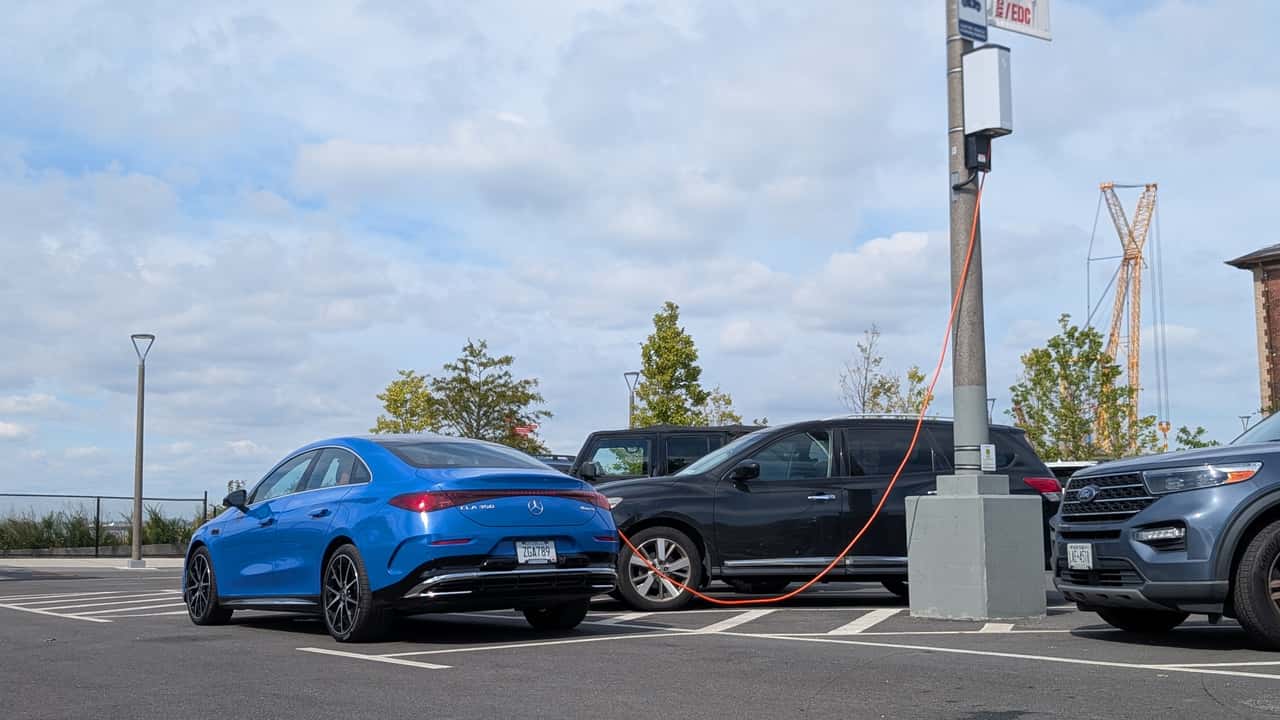
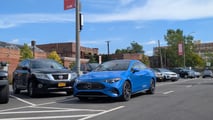
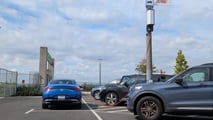
The charger sits about 10 feet up a streetlight pole, roughly at basketball-hoop height. Voltpost said this was to protect it from vandalism and flooding. Unsurprisingly, gas cars were parked on either side of it when I arrived. But the dispenser's 25-foot cable was long enough to reach the charge port on the Mercedes-Benz CLA 350 Electric I was driving without getting in the way of the cars around it.
Starting the session was simple. I scanned the QR code on the charger, and just two clicks later the cable automatically lowered itself from the pole. Once it was within reach, pressing a button on the handle extended the cable to the car.
I don't particularly like scanning QR codes and using apps every time I want to charge. A card reader remains the gold standard for truly frictionless charging. Even being able to remotely authorize it with an app beats needing a QR code every time.
But Voltpost's app was slick, and the connection was instantaneous. That's impressive because even some of the bigger fast-charging networks still haven't figured out how to make their apps work smoothly and quickly.
When I finished, I unplugged and the cable retracted back to the dispenser automatically. There was one small quirk, though: You need to let go of the handle gently. A sudden release can leave the cable dangling and banging against the pole while it’s returning to the dispenser. Otherwise, the experience was remarkably uneventful.
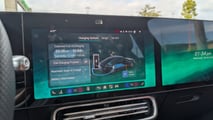
During the hour I spent at the charger, the CLA added about 30 miles of indicated range. That was enough to cover my round trip from my apartment and left me with roughly 20 miles of additional range, essentially taking care of my driving needs for the day.
That's exactly where chargers like this make the most sense. You don't need to sit around and wait for the car to charge. You park, plug in and go do something else.
Voltpost Air lamppost EV charger in Brooklyn, New York.
Parks, shopping centers, apartment buildings and office complexes are obvious candidates where this could work. The charger can quietly add miles while you're walking the dog, shopping groceries or catching up with friends.
I paid $0.39 per kilowatt-hour, which was considerably cheaper than the fast chargers in the area, where prices can exceed $0.60 per kWh. Although it was roughly in line with other public Level 2 chargers in the city.
The Case For Turning Streetlights Into EV Chargers
Voltpost said its lamppost installations solve several of the problems that make current curbside EV chargers inconvenient, like cables lying on the ground and stations occupying space where people walk.
For starters, the charger itself sits safely above the street, which helps protect it from flooding. And because the cable retracts automatically, drivers can't leave it on the ground, reducing wear and tear and keeping pedestrians from having to go around an obstacle.
But the bigger advantage is the speed and low cost of deployment, according to Luke Mairo, the COO and co-founder of Voltpost. Rather than digging up the sidewalk, laying new conduit and building a dedicated electrical connection, Voltpost can use existing poles and electrical infrastructure to get a charger into place.
“The main benefit of using pole mounted infrastructure is that we don't do construction and trenching work,” Mairo told me in an interview. This means “less permitting, significant reductions in the cost to install, and less disruption to the communities,” he added.
The Brooklyn charger doesn't share power with the lamppost it's mounted on. It draws power from a nearby building.
“We don't split the power to the light,” Mairo said. “With the conversion of street lights to LED, there's spare capacity on the grid. We can use the existing capacity at the distribution to bring new service through the grid to our lamppost locations,” he added.
That approach can reduce project costs by 70% and allow a charger to be installed in a matter of hours, with little or no construction or trenching. The charger supports both J1772 and Tesla-style J3400 connectors, and can deliver up to 9.6 kilowatts at 240 volts and 40 amps.
Voltpost opened its first lamppost charger in Chicago last year, followed by multiple installations in Detroit and New York. Another 26 lamppost chargers are coming to New York State as part of a program funded by the New York State Energy Research and Development Authority (NYSERDA). About 500 new chargers have been awarded across nine U.S. states in total.
Of course, putting a cable retraction system on a streetlight introduces another potential failure point. So I asked Mairo what happens when that mechanism inevitably encounters the real world, with its freezing winters, scorching summers, and thousands of charging sessions.
He pointed to the charger's UL certification and said the mechanism has been tested thousands of times across different climates and temperatures. It is rated to operate between -22 degrees Fahrenheit and 122F.
The true real world test, however, will be when drivers use them at scale. I can tell from experience that drivers in the city aren’t particularly gentle with charging equipment. I often come across broken plugs and cracked screens.
Voltpost said it monitors its chargers in real time and can address some problems remotely through software. If something requires a physical repair, the company can dispatch a local maintenance provider.
The State Of Curbside Charging In NYC
Voltpost isn't the only company trying to tap into existing electrical infrastructure to avoid costly and time-consuming utility upgrades.
Another New York startup, It’s Electric, is planning to expand with sleek curbside chargers that draw spare capacity from residential and commercial buildings. Drivers bring their own charging cables—which the company also provides—so there are no cables dangling across sidewalks. After charging, you take the cable back with you, just like your iPhone charger.
It's Electric level 2 curbside EV charger.
The Gravity Charging Center in Times Square takes a similar approach on a much larger scale, using spare electricity from the block that the company claims is sufficient to power its 500 kW charging station.
The common thread here is that the startups aren’t exactly waiting around for the city to rebuild its streets to make them more EV friendly. They’re trying to work with the city’s existing infrastructure—and hopefully accelerate EV adoption in a more efficient way.
There is still a long way to go before chargers from companies like Voltpost and It’s Electric become a common sight across the U.S. And NYC remains far behind some other major global cities when it comes to curbside plugs.
London, for example, has more than 27,000 curbside chargers, many of which are also lamppost retrofits. So the lamppost idea isn't exactly groundbreaking.
Flo's curbside EV charger.
NYC’s current curbside charging network is also much smaller. The city has only 88 curbside chargers installed by Flo, and their towers and long cables can be visually intrusive on already crowded and chaotic streets.
But given the long lines at public fast-chargers in the city, it’s clear that demand is way more than supply. EVs now account for 8.3% of new vehicle registrations in the city, and some 600 additional curbside chargers are planned to be installed in the coming years.
The big question now is how quickly the city can get them up and make drivers’ lives easier.
Related Stories
RECOMMENDED FOR YOU
I Drove Mercedes’ New EV With A Silicon Anode Battery. The Future Is Here
‘Propulsion-Agnostic’: GM Wants To Bring Tesla-Style Software Features To Its Gas SUVs, Too
AMG’s New Electric SUV Has 1,153 HP. The Charging Specs Are Even Wilder
Want The Best Range Rover? Get The Electric One: First Drive
The Longest-Range EVs You Can Buy In 2026
I Drove The Electric And Gas-Powered BMW X5. I Know Which One I'd Pick.
1 In 4 New Mercedes Cars Sold Last Quarter Had A Plug