Home
Ford
Lightning
News
He Replaced The Battery In A Ford F-150 Lightning. Here's How Hard It Was
In some ways, it's a lot easier than swapping an engine. In other ways, it's harder.
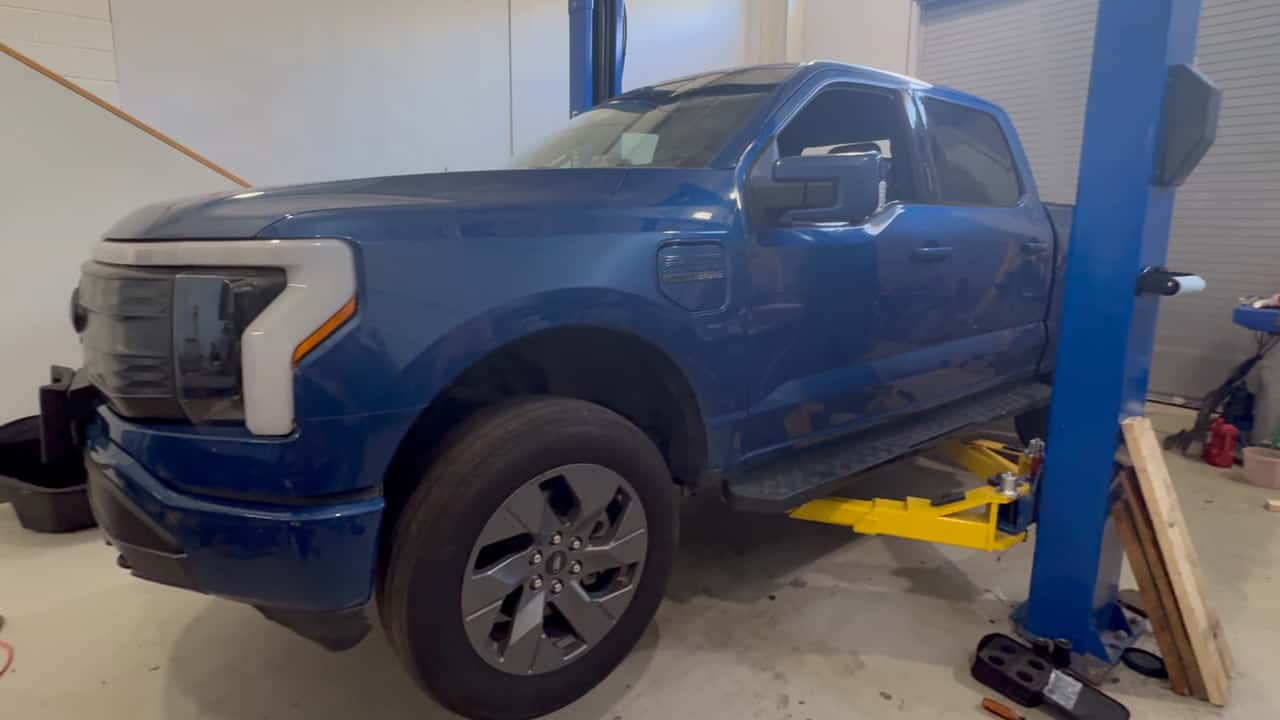
Photo by: Out Of Spec Renew
Nico DeMattia 
By: Nico DeMattia
Sep 17, at 2:44pm ET
Add InsideEVs as a preferred source in Google
- (https://twitter.com/intent/tweet?url=https%3A%2F%2Finsideevs.com%2Fnews%2F808681%2Fford-f150-lightning-battery-swap%2F&text=He%20Replaced%20The%20Battery%20In%20A%20Ford%20F-150%20Lightning.%20Here%27s%20How%20Hard%20It%20Was&via=InsideEVs)
- copy
Share
Comment
Battery swaps are likely going to become more and more common, as EVs get older and people start buying higher-mileage ones second-hand. It'll eventually become the new engine swap, and so many people will almost certainly try to DIY it, rather than have it done at a shop. But how hard is it to swap the battery on an EV, and is it easier or harder than swapping an engine? In this new video from Out of Spec Renew, you get to find out on a Ford F-150 Lightning whose battery failed after a whopping 234,000 miles.
Putting 234,000 miles on a car in three years is wild. Even if driven gently, that's a ton of driving in a short period of time, and will abuse even the toughest of cars. Just to hit that amount of mileage. It's a couple hundred miles per calendar day assuming no breaks, which means in the real world this truck probably saw a lot of DC fast charging. So no shade thrown at Ford for its battery failing. It was a valiant effort, and that battery has nothing to be ashamed of. Only one of the modules failed, too, so it wasn't a complete battery death. Fnding a single module that's unhealthy and swapping it out, though, is much harder than just replacing the entire battery. So that's what was done here.
Swapping a battery is interesting in an F-150 Lightning. In some ways, it's a lot easier than swapping an engine. In the case of the Ford, you put it up on a lift, drain the coolant, unplug the big high-voltage cables, and unbolt the sucker. The process is actually significantly easier than removing an engine, which has zillions of hoses and wires, its own mounts, and needs to be disconnected from the transmission... it's a lot of time and effort. The battery has no such connections, so it seems much, much easier. To a point, though.
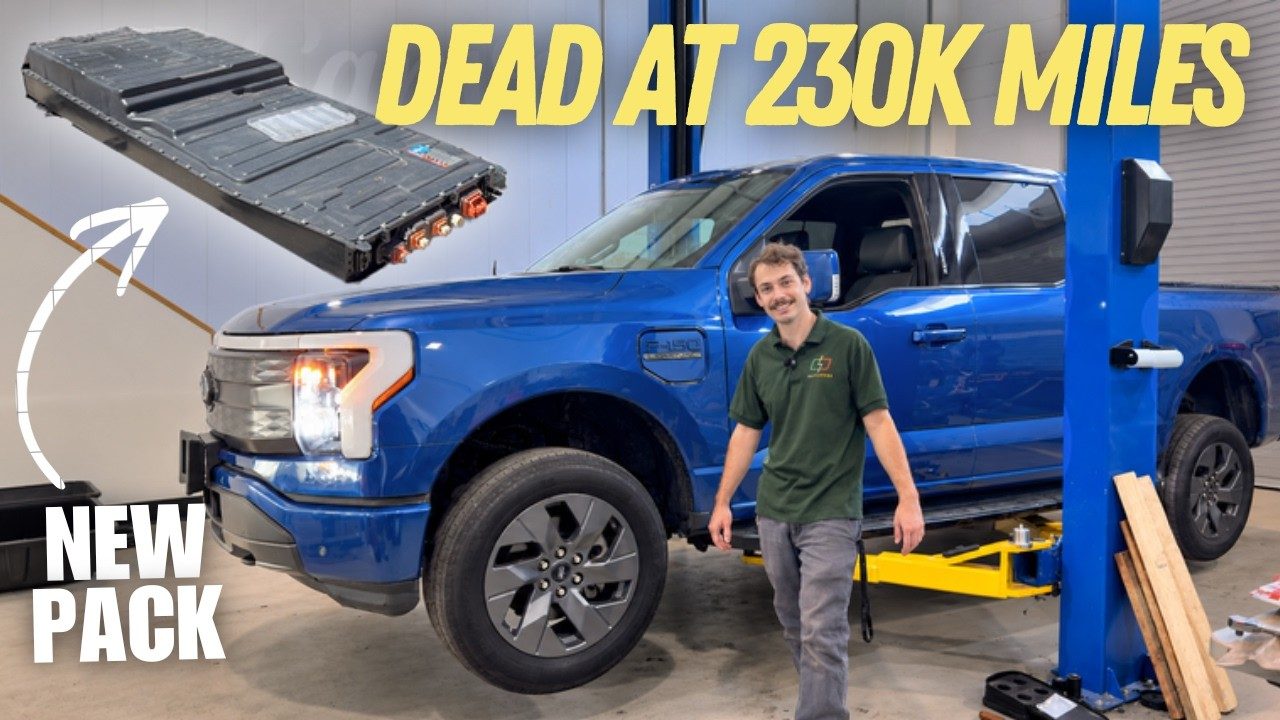
Battery packs are heavy. Much heavier than almost any road car engine. This F-150 Lightning's standard battery is a 98 kWh unit that weighs around 1,800 pounds by itself. So if you disconnect it thinking you can have a buddy hold it up, someone's getting turned into paste when it falls. So you'll need some sort of lift to bring it down, like the hydraulic scissor lift in this video. Even a smallish battery is heavy, like the Hyundai Ioniq 5's 63 kWh unit that weighs 815 pounds. Removing an EV battery pack needs to be done with professional-grade equipment that can handle that sort of weight.
Once it's safely out of the car, though, things are once again pretty simple. One of the connecters on the new battery was broken, and so was its coolant hose. So the mechanic needed to swap the old ones onto the new one, which was fairly simple. Taking the lid off the battery is easy, just time consuming, because there are approximately four billion bolts that hold it on (only a minor exaggeration). But it's no big deal, just slap some headphones on, get your cordless ratchet handy, and get to unbolting.
What do you think?
View
Comments
After that's done, the process is reversed. The new battery goes onto the scissor lift and put back in the battery. Coolant lines are hooked up, it's refilled with coolant, everything is plugged back in, and it's good to go. This truck had a 12-volt battery issue that needed mending as well, but other than that it was ready to get back on the road.
If the people or shop doing the battery swap have the equipment to safely handle the heavy batteries, it seems like a much easier job than swapping an engine. So there's hope in the future for buyers of old EVs, or even modders.
Here are some similar articles
 While You Stop For A 30-Minute Charge, Nio Just Swapped 1 Million EV Batteries In A Week
'Bit Of An Upgrade': This Tesla Had A Dead Battery. Then This Mechanic Swapped In A Better One
We want your opinion!
What would you like to see on Insideevs.com?
Take our 3 minute survey.
- The InsideEVs team
Share this Story
- (https://twitter.com/intent/tweet?url=https%3A%2F%2Finsideevs.com%2Fnews%2F808681%2Fford-f150-lightning-battery-swap%2F&text=He%20Replaced%20The%20Battery%20In%20A%20Ford%20F-150%20Lightning.%20Here%27s%20How%20Hard%20It%20Was&via=InsideEVs)
- copy
GO TO COMMENTS
(
)
Got a tip for us? Email: tips@insideevs.com
View all comments ( )
Trending
A Tesla Model Y Without A Steering Wheel Is Coming: Musk
Every EV Motor Type Explained: They Aren't All The Same
I Tried Mercedes' Answer To Tesla FSD. Here's How It Went
Tesla Model 3 Maintenance Guide: What Needs Servicing And What Doesn't
Latest Stories
- A Tesla Model Y Without A Steering Wheel Is Coming: Musk Nov 18 - News -
- The BMW i3 Has The Nurburgring Skills To Match Its Impressive Range Nov 18 - News -
- Kia Made Its First EV 40 Years Ago. It Shows How Far Electric Cars Have Come Nov 18 - News -
- Ford Just Started Fathom LFP Battery Production In Michigan. It's A Big Deal Nov 18 - Battery Tech -
- This GM EV1 Lives After A Painstaking Restoration Nov 18 - News -
- ‘We’re Moving Really Fast’: Ionna CEO On 500 kW EV Chargers And Flagship New Location Nov 18 - Charging -
- BMW's First U.S.-Made EV Is Now Rolling Off The Assembly Line Nov 18 - Manufacturing / Production -
RECOMMENDED FOR YOU
Ford Just Started Fathom LFP Battery Production In Michigan. It's A Big Deal
The BMW i3 Has The Nurburgring Skills To Match Its Impressive Range
The Best EV Lease And Finance Deals In November 2026
Kia Made Its First EV 40 Years Ago. It Shows How Far Electric Cars Have Come
Ford's Radical New EV Manufacturing Process Is Already Building Trucks
This GM EV1 Lives After A Painstaking Restoration
Ford Tested 36,000 Mustang Mach-E Batteries. Here’s How They Held Up After 100,000 Miles