
Watch Tesla FSD Navigate Denmark's Tightest, Toughest Street
Narrow cobbled streets, cyclists and cafe crowds make driving an impressive test of FSD’s capability, as well as its occupants’ nerves.
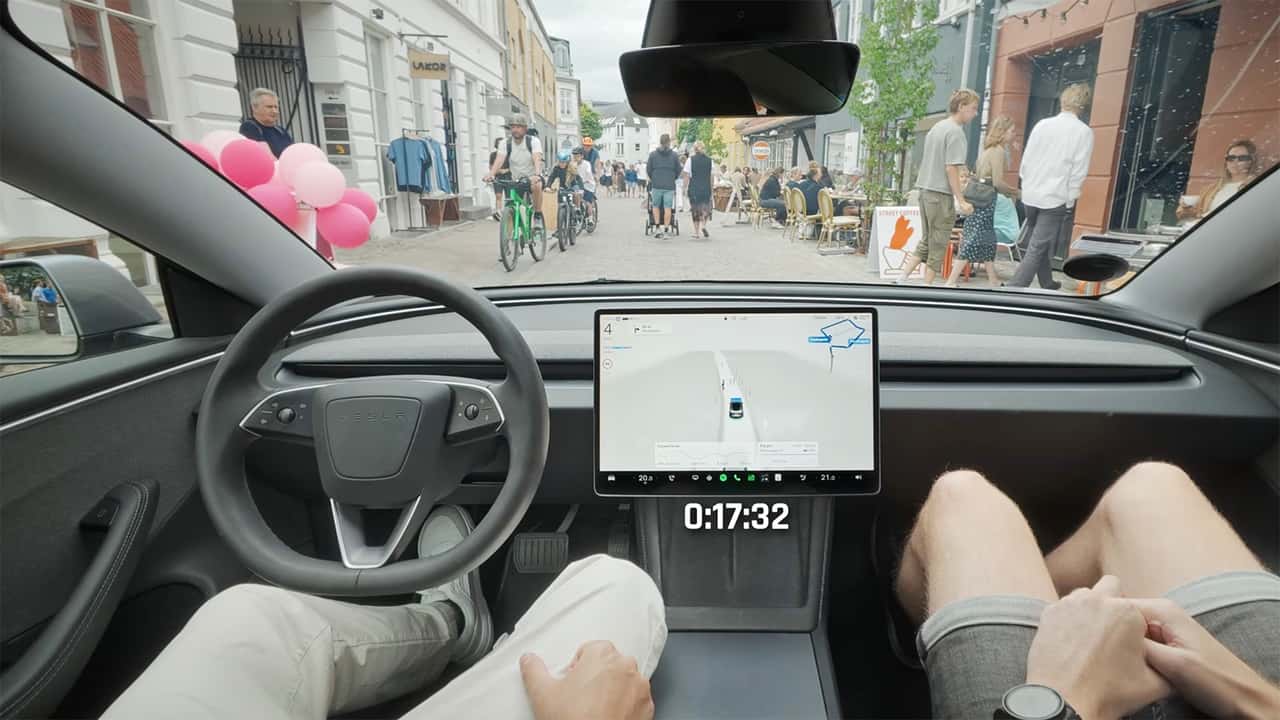

- Tesla FSD navigates narrow, crowded streets in Aarhus, where pedestrians and cyclists leave little room for cars.
- The drive shows impressive judgment in tight spaces, despite occasional hesitation and overly cautious speeds.
- Its only two mistakes were minor: failing to indicate around an obstacle and stopping too far from a traffic light.
Some streets make you question whether you should be driving down them, even when the signs clearly say that you can. This Tesla Full Self-Driving (Supervised) demonstration in Aarhus, Denmark, features plenty of those, with pedestrians, bicycles, and cafe customers making already tight streets feel even narrower.
The roughly 21-minute video uploaded by robot*irl follows an FSD drive into increasingly tight parts of the city center. As the occupants explain, cars are guests in these streets, so it’s perfectly okay for people to be walking in the middle of the road; getting through requires a lot of patience, as well as accurate steering.

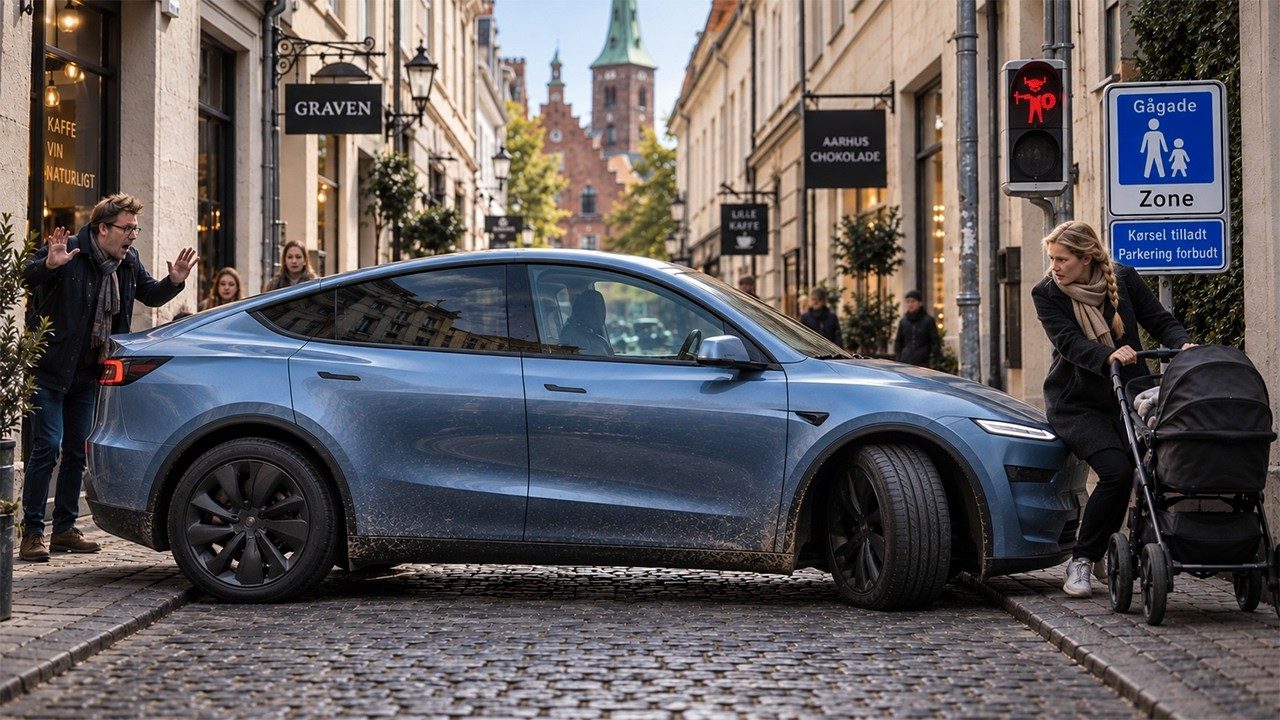
Seeing a car go down a narrow, cobbled lane without any human intervention is pretty impressive. Sure, it hesitates a couple of times and takes it a bit slower than a human would, but the driver never touched the controls once throughout the video. FSD handled an oncoming car, strollers parked on the side of the road, and people who walked straight into the Tesla’s path.
The car always waited for cyclists before turning or moving over into the oncoming lane, it inched past obstacles with remarkable precision, and even waited for a dog that crossed its path. At one particularly awkward encounter, an oncoming car and a stroller complicate an already narrow passage. The Tesla adjusts its position and works through the squeeze with ease in a situation that may have made some actual human drivers uneasy.
Later, it negotiates another narrow gap beside roadworks. Even the local who provided the Tesla for the test and is sitting in the passenger’s seat admitted that he hadn’t previously taken FSD through some of these streets. That doesn’t mean Tesla didn’t train FSD on similar situations, but it adds to the sense that this was an exploratory drive and an unusual situation for the car to react to.

The only two mistakes were pretty minor: it moved over with one wheel into the oncoming lane to avoid an obstacle and didn’t indicate, and in one instance it stopped a bit too far from the traffic lights. The fact that nothing more major than this happened on such a tricky drive is pretty impressive.
Watching FSD negotiate these packed narrow streets certainly inspires confidence. It still needs a human supervisor, though, and getting through a crowded Danish street is a different achievement from convincing regulators that occupants can take their eyes off the road. The timeline for eyes-off operation in Europe remains unclear, but it will likely be longer than in the United States.
Meanwhile, Tesla’s Cybercab has started carrying passengers in Texas, and early onboard videos all seem to show impressively uneventful and relaxing journeys. With no steering wheel or pedals, this is driverless operation: passengers can look away because supervising the car isn’t their job.
Making that experience seem ordinary is a meaningful achievement, even if a limited rollout in a geofenced area in Austin doesn’t establish readiness for every European street, even if it can do the Danish cafe crawl very well already.
RECOMMENDED FOR YOU

'A Weird Religious Stance:' GM Exec Says Ditching Radar For Self-Driving 'Ignores Physics'
How Cheap Chinese EVs Are Sneaking Around Europe's Tariffs
The Tesla Model Y's Structural Battery Was Nearly Impossible To Repair. The Cybercab Fixes That
GM Didn't Want Hybrids. Now It's Putting Them In Its Biggest SUVs: Report
This Cheap Tesla Model S With 135,000 Miles Has A Surprising Amount Of Range Left
ChargePoint’s New Charger Can Hit A Whopping 750 kW. That's Not Even Its Best Trick.
Tesla Designed The Cybercab To Use LFP Batteries In The Future