Home
News
Battery Tech
The World’s First Sodium-Ion Battery EV Is A Winter Range Monster
It’s the beginning of a “dual chemistry era” as sodium-ion batteries have overcome all hurdles to enter mass production.
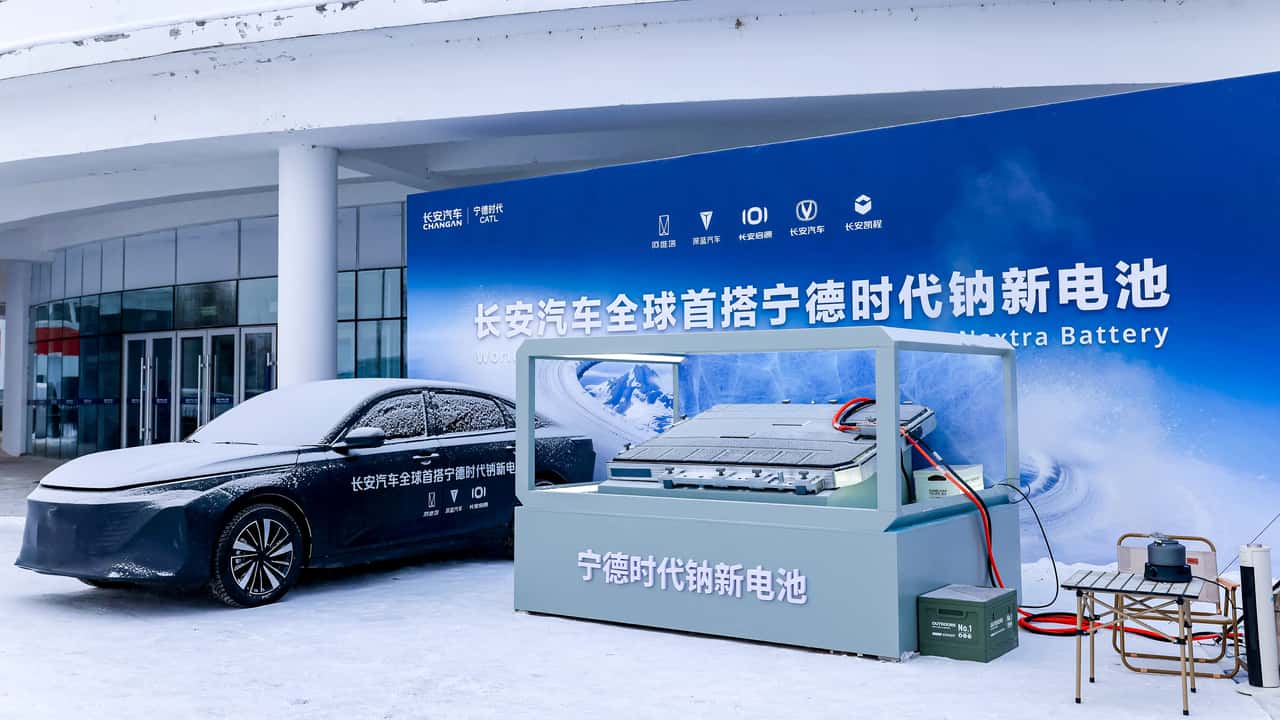
Photo by: CATL
Suvrat Kothari 
By: Suvrat Kothari
Feb 5, at 12:17pm ET
Add InsideEVs as a preferred source in Google
- (https://twitter.com/intent/tweet?url=https%3A%2F%2Finsideevs.com%2Fnews%2F786509%2Fcatl-changan-worlds-first-sodium-ion-battery-ev%2F&text=The%20World%E2%80%99s%20First%20Sodium-Ion%20Battery%20EV%20Is%20A%20Winter%20Range%20Monster&via=InsideEVs)
- copy
Share
Comment
- The Changan Nevo A06 is the world's first mass-produced car powered by a sodium-ion battery.
- It has a CLTC range of about 250 miles and can run with little to no range loss even in -40 degrees Fahrenheit.
- It's the start of a new "dual chemistry era," CATL said.
Chinese battery giant CATL and automaker Changan Automobile are preparing to put the world’s first passenger car powered by sodium-ion batteries on public roads by mid-2026. And if the launch is successful, it could usher in an era where electric vehicles present less of a fire risk and can better handle extreme temperatures.
The CATL Naxtra sodium-ion battery will debut in the Changan Nevo A06 sedan, delivering an estimated range of around 400 kilometers (249 miles) on the China Light-Duty Test Cycle. From there, the battery will roll out across Changan’s broader portfolio, including EVs from Avatr, Deepal, Qiyuan and Uni, the company said.
“The launch represents a major step in the industry’s transition toward a dual-chemistry ecosystem, where sodium-ion and lithium-ion batteries complement each other to meet diverse customer needs,” CATL said in a press release.

CATL Sodium Ion Battery
Photo by: CATL
It’s a meaningful step forward for the technology that’s rapidly emerging as an alternative to lithium-iron phosphate (LFP) batteries, which currently dominate China’s EV market. Studies show that sodium-ion batteries carry no risk of thermal runaway and are far less sensitive to extreme temperatures. Above all, sodium is significantly cheaper and far more abundant than lithium.
From an energy density standpoint, the Naxtra battery is competitive but not revolutionary. It delivers 175 watt-hours per kilogram of energy density, which is lower than nickel-rich chemistries but roughly on par with LFP. That makes it more suitable for low-cost and low-range EVs as well as stationary energy storage.
By using a cell-to-pack design, where individual cells are integrated directly into the battery pack instead of modules, CATL was able to extract 400 kilometers (249 miles) of range on the CTLC cycle.
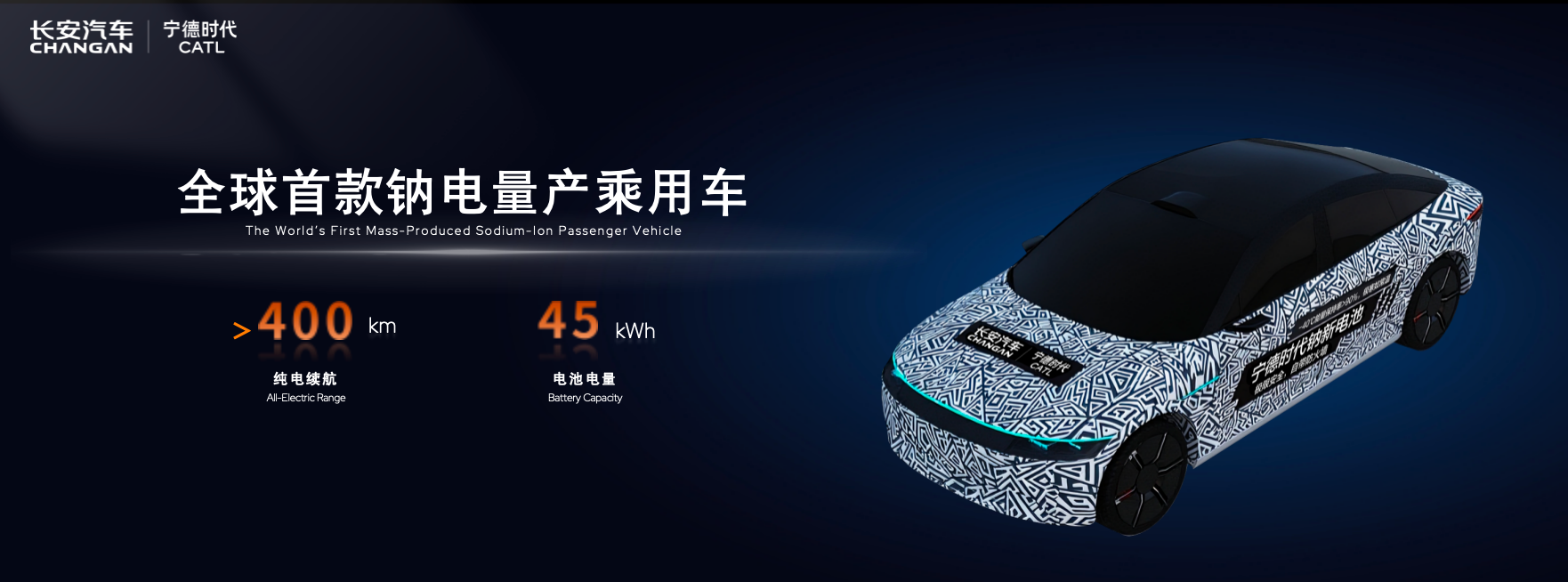
Photo by: Changan
But CATL says there’s plenty of room for improvement on the range front. As the sodium-ion supply chain matures, the company expects EV range to climb to 600 kilometers (373 miles), while extended-range EVs (EREVs) and hybrids could reach up to 400 kilometers (249 miles). That would cover more than half of the typical range requirements in China’s EV market, CATL claims.
Where the Naxtra battery really stands out, however, is cold-weather performance. CATL says its discharge power at -30 degrees Celsius (-22 degrees Fahrenheit) is three times higher than that of LFP batteries.
Unlike LFP or nickel-manganese-cobalt (NMC) packs, it reportedly avoids severe winter range loss, retaining more than 90% of its range at -40 degrees C (-40 degrees F). Power delivery is also said to remain stable at temperatures as low as -50 degrees C (-58 degrees F).

Stay informed with our newsletter every weekday
back
Subscribe For more info, read our Privacy Policy & Terms of Use.
What do you think?
View
Comments
As always, we’ll have to wait for independent testing for real-world results. But on paper, the technology looks genuinely compelling. While the Naxtra battery isn’t coming to the U.S., it could be especially valuable in places like the Midwest and the Northeast, where EV drivers routinely report steep range losses when temperatures plunge in winter.
While lithium-ion batteries aren’t going anywhere, it’s becoming increasingly clear that the future of EVs will be defined by multiple battery chemistries coexisting. That’s how internal combustion engines evolved over the years, giving drivers more options to be able to choose the battery technology that best fits their driving habits, power needs—and the climate they live in.
Contact the author: suvrat.kothari@insideevs.com.
Related Stories
Sodium-Ion Batteries Have Landed In America. Now Comes The Hard Part
General Motors Is Exploring Solid-State Batteries As EV Push Expands
CATL’s Sodium-Ion EV Battery Loves The Cold
CATL's New Sodium-Ion EV Battery Works In -40 Degree Cold
We want your opinion!
What would you like to see on Insideevs.com?
Take our 3 minute survey.
- The InsideEVs team
Share this Story
- (https://twitter.com/intent/tweet?url=https%3A%2F%2Finsideevs.com%2Fnews%2F786509%2Fcatl-changan-worlds-first-sodium-ion-battery-ev%2F&text=The%20World%E2%80%99s%20First%20Sodium-Ion%20Battery%20EV%20Is%20A%20Winter%20Range%20Monster&via=InsideEVs)
- copy
GO TO COMMENTS
(
)
Got a tip for us? Email: tips@insideevs.com
View all comments ( )
Trending
I’m Thankful For My Electric Car
Winter Weather Hits EV Range Hard. One Automaker Handles It Better Than Tesla
Here’s How To Make Your Holiday EV Road Trip Easier
These Are The Top 10 Black Friday EV Deals. Some Are $25,000 Off
Latest Stories
- A Used Cybertruck Is Selling A Month Faster Than A Ford F-150 Nov 26 - News -
- I’m Thankful For My Electric Car Nov 26 - Opinion -
- Volvo Is Bringing Humanoid Robots Into Its Factories. Here's When They'll Start Working Nov 26 - Manufacturing / Production -
- Ionna Slashes EV Charging Prices For Thanksgiving Nov 26 - Charging -
- Europe Gets This Tiny New Suzuki EV. It Makes A Mini Look Big Nov 25 - News -
- Audi Wants To Make Buttons That Deploy From Behind The Touch Screen Nov 25 - Technology -
- Electric Porsche Boxster Prototype Reviews Are Out. Here's What Critics Think Nov 25 - News -
RECOMMENDED FOR YOU
Ford Has A Dedicated Battery Abuse Team. It Obsesses Over How Cells Fail
A Used Cybertruck Is Selling A Month Faster Than A Ford F-150
Ford Just Started Fathom LFP Battery Production In Michigan. It's A Big Deal
I’m Thankful For My Electric Car
Solid-State Cells Can Make The U.S. Competitive In Batteries Again: CEO
Volvo Is Bringing Humanoid Robots Into Its Factories. Here's When They'll Start Working
Ford Tested 36,000 Mustang Mach-E Batteries. Here’s How They Held Up After 100,000 Miles