Home
Mercedes-Benz
News
Mercedes-Benz Is Putting This Hydrogen Electric Semi Truck Into Production
The NextGenH2 Truck is like an EREV with a hydrogen fuel cell that acts as a generator–minus the charging port.
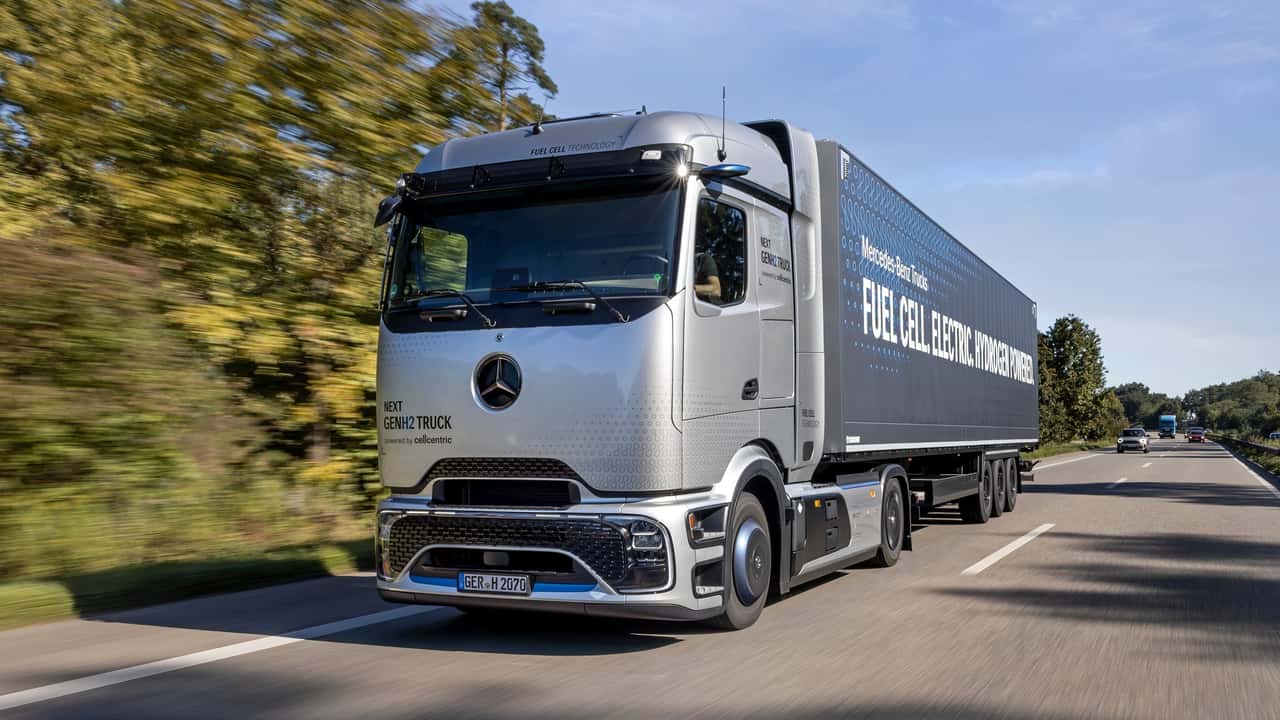
Photo by: Daimler Truck
Iulian Dnistran 
By: Iulian Dnistran
Jan 27, at 6:59am ET
Add InsideEVs as a preferred source in Google
- (https://twitter.com/intent/tweet?url=https%3A%2F%2Finsideevs.com%2Fnews%2F785575%2Fmercedes-hydrogen-electric-actros-truck-production%2F&text=Mercedes-Benz%20Is%20Putting%20This%20Hydrogen%20Electric%20Semi%20Truck%20Into%20Production&via=InsideEVs)
- copy
Share
Comment
- Daimler Truck will start manufacturing the Mercedes-Benz NextGenH2 Truck this year.
- The semi truck is powered by a latest-generation hydrogen fuel cell that sends power to an LFP battery.
- The semi truck can cover over 600 miles with a full tank of hydrogen, and refueling takes as little as 10 minutes.
The hydrogen dream is not dead yet, and Daimler Truck is doing its part to keep it alive by putting a big hydrogen fuel cell truck into production this year.
This is the Mercedes-Benz NextGenH2 Truck, which will start reaching customers in Europe at the end of this year, as part of a limited-series production run of 100 units. That’s not exactly record-breaking, but the technology that’s packed under the truck’s skin is quite interesting.

Photo by: Daimler Truck
Like all hydrogen fuel cell vehicles, this new truck has a battery that acts as a buffer between the energy source and the electric drive unit. Unlike similar builds, though, the NextGenH2 Truck has a massive 101-kilowatt-hour lithium-iron-phosphate battery pack that takes energy from the two fuel cells at the front and sends it to a pair of electric motors at the rear.
The electric axle is lifted straight from the production eActros 600 all-electric truck and is capable of delivering up to 496 horsepower (370 kilowatts). The same drive unit can also send power back to the battery using regenerative braking, lowering the fuel consumption.
The two fuel cell units are fitted under the cab, where the combustion engine would normally sit. They act as a twin system with a total output of 300 kW, and they’re pretty frugal when it comes to sipping hydrogen. In early customer trials with the previous-generation GenH2 Truck, fuel consumption averaged between 5.6 kilograms/100 kilometers and 8 kg/100 km with gross combined vehicle weights ranging between 16 and 34 tonnes. That makes for a total driving range of over 620 miles (1,000 km).
In other words, this is almost like an extended-range EV with a hydrogen fuel cell generator instead of a gas or diesel engine. However, it does not have a charging port, so it relies completely on the fuel cells and two tanks that can store up to 85 kg of liquid hydrogen.
Another thing that sets Mercedes-Benz’s hydrogen truck apart from other fuel cell vehicles is the fact that it uses liquid hydrogen instead of compressed gaseous hydrogen, as the ill-fated Toyota Mirai does. At -253°C, liquid hydrogen has a significantly higher energy density than its gaseous counterpart, allowing more of it to be stored and enabling longer driving ranges that are comparable to conventional diesel trucks, according to Daimler Truck.
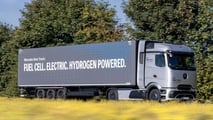
Gallery: Mercedes-Benz NextGenH2 Hydrogen Fuel Cell Truck
29

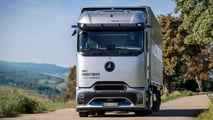
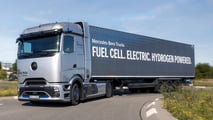
Source: Daimler Truck

Stay informed with our newsletter every weekday
back
Subscribe For more info, read our Privacy Policy & Terms of Use.
In the case of the NextGenH2, refueling can be done from both sides of the truck, as the two tanks are interconnected. The truck maker claims it takes between 10 and 15 minutes for a full refuel, thanks to the use of the sLH2 refueling standard developed in cooperation with Linde.
What do you think?
View
Comments
Because it’s based on the same architecture as the mass-produced Actros truck, the Mercedes-Benz NextGenH2 benefits from all of the features that have proven track record in the real world, including the latest infotainment system and safety assistance systems.
Mercedes-Benz Trucks said the first units with “near production-ready technology” will go into customers’ hands starting at the end of 2026, while full-scale production of fuel cell trucks is expected to start early next decade.
More Hydrogen Cars
Toyota Says This Hydrogen Tacoma Can Rescue Dead EVs In The Wild
Why BMW Is Still Betting Big On Hydrogen
Nikola’s Orphaned Trucks Will Live On In California
The New Hyundai Nexo Shows Hyundai Is Serious About Hydrogen
We want your opinion!
What would you like to see on Insideevs.com?
Take our 3 minute survey.
- The InsideEVs team
Share this Story
- (https://twitter.com/intent/tweet?url=https%3A%2F%2Finsideevs.com%2Fnews%2F785575%2Fmercedes-hydrogen-electric-actros-truck-production%2F&text=Mercedes-Benz%20Is%20Putting%20This%20Hydrogen%20Electric%20Semi%20Truck%20Into%20Production&via=InsideEVs)
- copy
GO TO COMMENTS
(
)
Got a tip for us? Email: tips@insideevs.com
View all comments ( )
Trending
Lucid Is Slashing $15,000 Off The Gravity, But The Deal Won’t Last Long
The Remnants Of The Electric Saab That Never Was Are Going Up For Auction
What We Both Thought After Driving The Rivian R2
Aptera Finally Built Its First Car For Customer Delivery
Latest Stories
- Waymo Is Recalling Its Robotaxis Because They're Not Great At Dealing With Human Instructions Nov 21 - Autonomous Vehicles -
- This EV-Swapped 1967 Porsche 912 Has 300 HP And A Split Battery Pack Nov 21 - News -
- This Plug-In Hybrid SUV Towed A Boeing 747 On Only 2 Wheels. Yes, Really. Nov 21 - Towing -
- BYD's Latest SUV Can Hide Its Steering Wheel When You Don't Need It Nov 20 - China -
- What We Both Thought After Driving The Rivian R2 Nov 20 - Podcast -
- Hyundai’s N Vision 74 Was One Of The Coolest Car Designs In Recent Memory. Now It's Shelved Nov 20 - News -
- The Remnants Of The Electric Saab That Never Was Are Going Up For Auction Nov 20 - News -
RECOMMENDED FOR YOU
The Best EV Lease And Finance Deals In November 2026
Waymo Is Recalling Its Robotaxis Because They're Not Great At Dealing With Human Instructions
Mercedes Is Bringing Hands-Free Driving To Certain U.S. Highways In 2027
This EV-Swapped 1967 Porsche 912 Has 300 HP And A Split Battery Pack
I Tried Mercedes' Answer To Tesla FSD. Here's How It Went
This Plug-In Hybrid SUV Towed A Boeing 747 On Only 2 Wheels. Yes, Really.
This Mercedes Went 539 Miles On A Charge. Is Range Anxiety Finally Dead?