
Why Uber Picked The Lucid Gravity As Its Next-Gen Robotaxi
Uber’s Lucid Gravity robotaxis will enter San Francisco next year. Lucid’s CFO explains why the rideshare giant picked its electric SUV.
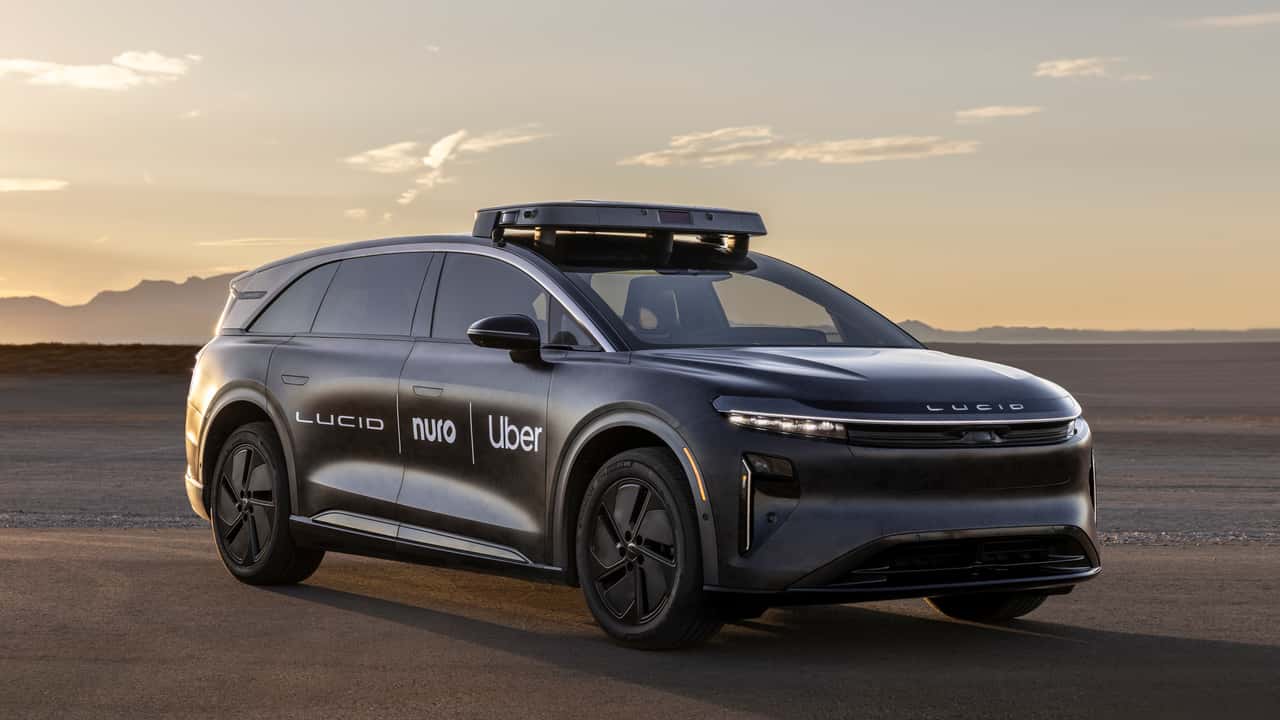

Uber is diving full-steam into the robotaxi race. The ridesharing giant has partnered with as many as 18 companies to launch driverless rides in the U.S. and some overseas markets.
One of Uber’s bets involves a three-way deal with the EV startup Lucid and autonomous-driving company Nuro. The deal involves Uber using Nuro’s robot driver on over 20,000 Lucid vehicles starting next year. Uber also agreed to invest $300 million in Lucid as part of the arrangement.
But why pick an $80,000-plus Lucid Gravity SUV as a robotaxi, especially given the razor-thin margins of the rideshare business?

Speaking at the UBS Global Industrials and Transportation Conference on Wednesday, Lucid CFO Taoufiq Boussaid explained why exactly Uber picked the Gravity for its next-generation robotaxis.
“We had a fit-for-purpose car with a redundant architecture, with all the safety required for this type of application,” Boussaid said. For robotaxis, this “redundancy” is a very big deal, as several automakers have previously explained.
To operate safely, autonomous vehicles need to meet far higher standards than a normal car. They need to have things like redundant steering systems, braking systems, duplicate control units and extra communication pathways.
Without these, robotaxis may need expensive retrofitting to meet safety requirements. The Gravity already has such systems in place, and that would help Uber and Lucid “operationalize as fast as possible,” according to Boussaid. When Lucid announced the deal in July, it touted the Gravity's "redundant electrical and controls architectures."
“[The Gravity] required minimal changes, minimal fitting to operate as a robotaxi as opposed to some of the existing solutions right now where you have to add a lot of sensors like lidar and so forth,” he said.
The Gravity currently offers a Level 2 advanced driver-assistance system called DreamDrive Pro. Robotaxis require far more advanced systems for driverless rides—that’s where Nuro steps in as the autonomy provider.
Lucid will integrate Nuro’s full hardware stack, which includes lidar, radar and cameras, on the Gravity. Uber will then purchase those factory-built, autonomy-ready SUVs and they’ll be available to order exclusively through the Uber app.
Still, Boussaid acknowledged that the Gravity isn’t an obvious robotaxi choice due to its cost. What comes after that, Lucid’s midsize EV platform, may hold more potential. Lucid recently announced that the roughly $50,000 vehicle, which hits production next year, will eventually be capable of eyes-off self-driving thanks to Nvidia's autonomous driving technology.
“The next step of the program would be with the midsize [vehicle] which will be even more advanced in its ability to serve this type of application,” Boussaid said.
Uber has more than a dozen partners for its robotaxi efforts, from Waymo and Avride to May Mobility and Momenta. But the real question is how many of these bets will actually make it past the press-release stage and achieve real scale.
Have a tip? Contact the author: suvrat.kothari@insideevs.com
Related Stories
RECOMMENDED FOR YOU
Driving The Cheapest Lucid Air For 40,000 Miles Came With A Few Surprises
Waymo's Public Fast-Charging Problem Is Infuriating EV Drivers
This YouTuber Got Burned By His Lucid Air And Elon Musk. So He Bought A Mustang Mach-E GT
Tesla's Cybercab Is Built In A Radical New Way. Here's How It Works
The Longest-Range EVs You Can Buy In 2026
‘We Are Long-Term Committed In Europe’: Why Tariffs Won’t Scare Zeekr Off
Lucid Production Plunges As The EV Maker Tries To Clear Inventory