Home
News
Battery Tech
This 1,000-Mile EV Battery Rethinks Pack Design From The Ground Up
Forget cell-to-pack and cell-to-body battery designs. This EV battery company is proposing something entirely different.
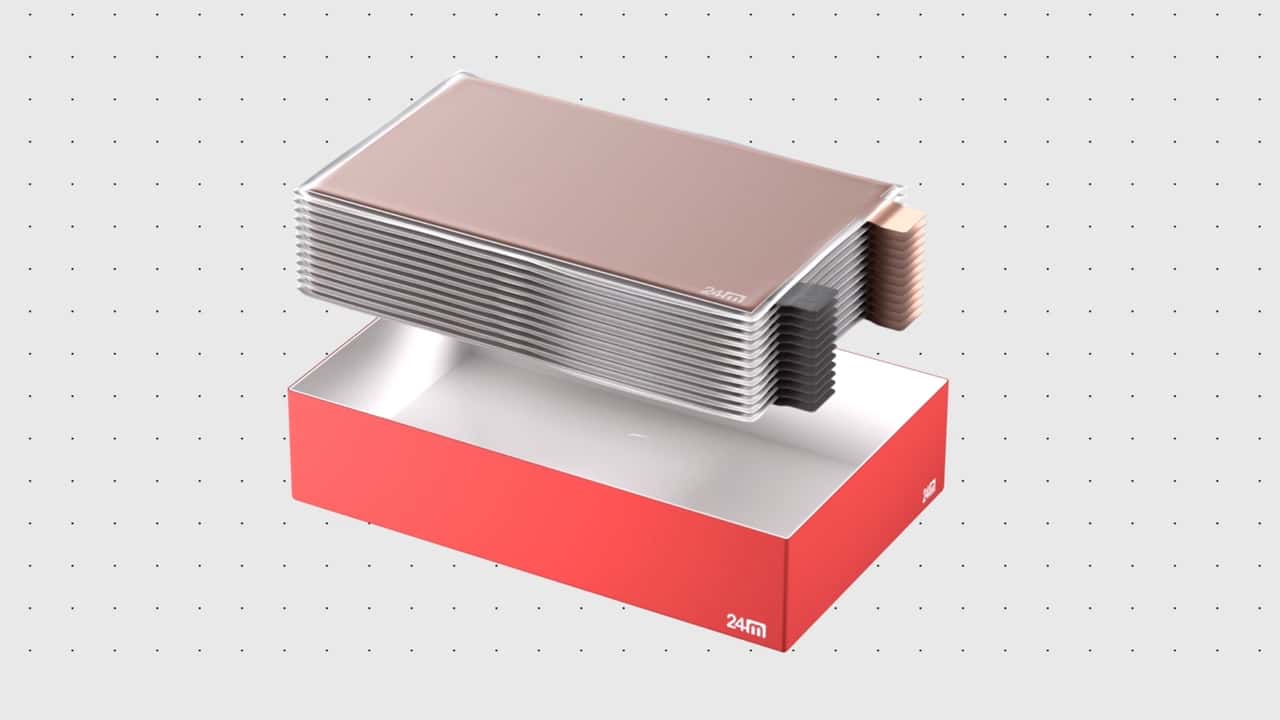
Photo by: 24M
Suvrat Kothari 
By: Suvrat Kothari
Oct 6, 2025 at 3:10pm ET
Add InsideEVs as a preferred source in Google
- (https://twitter.com/intent/tweet?url=https%3A%2F%2Finsideevs.com%2Fnews%2F774828%2Felectrode-to-pack-1000-mile-ev-battery%2F&text=This%201%2C000-Mile%20EV%20Battery%20Rethinks%20Pack%20Design%20From%20The%20Ground%20Up&via=InsideEVs)
- copy
Share
Comment
- An American battery company wants to completely rethink how lithium-ion batteries are made.
- The company claims its electrode-to-pack design eliminates waste and boosts energy efficiency.
- It can accommodate any chemistry and size and suits a variety of applications, according to the company.
By and large, electric vehicle battery makers are working toward one ultimate goal: making battery packs that supply more range for less money. Better safety, fast charging, durability and recyclability are also worthy aims. But they all revolve around the same north star: maximizing range from a smaller battery at the lowest possible cost.
To do that, battery makers are quickly moving away from traditional pack design. Many now skip the step of battery modules and instead integrate battery cells directly into the larger pack (cell-to-pack), or even into the vehicle body itself (cell-to-body). Massachusetts-based 24M Technologies has taken it a step further, developing a novel electrode-to-pack (ETOP) method to enhance both energy efficiency and cost-effectiveness.
The company says traditional cell-and-module designs contain a large portion of inactive and non-energy-carrying materials, like the cylindrical cell casing, for example. Its ETOP manufacturing platform, on the other hand, integrates electrodes—the components that store and release energy—directly into the pack. This eliminates the need for the plastics and metals used in traditional cell casings.
In other words: By eliminating any hardware that isn't actively involved in storing energy, you can pack more energy into a given space. And that improves energy density and range. This is the thinking behind cell-to-body and cell-to-pack designs too, but 24M is getting rid of the cell too.

24M's sealed electrode-to-pack battery design.
Photo by: 24M
24M said its novel platform uses a sealed anode and cathode pair that’s integrated directly into the battery pack, eliminating the need for individual cells or modules. In theory, the vast majority of the battery volume would consist of active energy-carrying components, which would increase energy density and boost range.
In traditional lithium-ion batteries, the electrodes comprise about 30% to 60% of a battery’s volume, according to the company. The rest is taken up by inactive materials, which include structural and supporting components that do not store energy but are still essential to making the battery work safely. With an electrode-to-pack design, the active electrode materials can account for up to 80% of the battery’s volume, the company claims.
That could apparently allow a range of 1,000 miles per charge, 24M Technologies says. That's about double the range of today's very best EVs.
“The pressure to compete on price, design and performance is mounting for American industries that are heavily reliant on imported batteries,” 24M President and CEO Naoki Ota said in a statement. “The U.S. must advance battery innovation, not just scale production to close the gap with competitors overseas.” The company is betting on technology and innovation to stay competitive, since matching Chinese battery makers on scale and commercialization remains an uphill battle.
These batteries are well-suited for electric vertical takeoff and landing (eVTOL) aircraft, 24M said. But the inherent design flexibility and ability to integrate any battery chemistry, size, or voltage means they could be developed for everything from grid batteries to electric vehicles.

Stay informed with our newsletter every weekday
back
Subscribe For more info, read our Privacy Policy & Terms of Use.
While it sounds promising on paper, launching this at scale won't be easy or straightforward. The existing battery supply chain and infrastructure are already built around conventional cell formats. Retooling factories for a fundamentally different process would likely be capital-intensive.
Plus, it’s unclear how 24M plans to address design defects. In modern batteries, defects can often be isolated to a single cell without jeopardizing the entire pack. In a fully sealed electrode pack, how would defects be diagnosed? Additionally, the inactive materials in traditional batteries also provide room for thermal management, as temperature regulation is crucial to performance and longevity.
What do you think?
View
Comments
Still, the company’s strategy of competing with China through innovation and disruptive technology makes sense. Asian companies are far ahead in both battery technology and the supply chains that support it. For the U.S. to gain any meaningful edge in competitiveness, it would need methods designed, developed and manufactured domestically at scale, tailored for American consumers. Without that, competition with companies like CATL and BYD would forever be out of reach.
Have a tip? Contact the author: suvrat.kothari@insideevs.com
Related Stories
Europe’s Cheapest EV Gets A Big Power Boost And An LFP Battery
Many Volkswagen EVs Don’t Have Battery Preconditioning. Now, There’s A Solution
Tesla Model 3 Upgrades In Europe: More Range, More Turn Signal Stalk
Here's How Ford's $30,000 EV Truck Is Going After China's BYD
We want your opinion!
What would you like to see on Insideevs.com?
Take our 3 minute survey.
- The InsideEVs team
Share this Story
- (https://twitter.com/intent/tweet?url=https%3A%2F%2Finsideevs.com%2Fnews%2F774828%2Felectrode-to-pack-1000-mile-ev-battery%2F&text=This%201%2C000-Mile%20EV%20Battery%20Rethinks%20Pack%20Design%20From%20The%20Ground%20Up&via=InsideEVs)
- copy
GO TO COMMENTS
(
)
Got a tip for us? Email: tips@insideevs.com
View all comments ( )
Trending
Lucid Is Slashing $15,000 Off The Gravity, But The Deal Won’t Last Long
The Remnants Of The Electric Saab That Never Was Are Going Up For Auction
What We Both Thought After Driving The Rivian R2
Aptera Finally Built Its First Car For Customer Delivery
Latest Stories
- The U.S. Let Volvo Keep Selling Cars. Polestar Got A No. What About Mercedes? Nov 22 - News -
- Tesla FSD V15 Makes Your Drive Look Like Grand Theft Auto Nov 22 - News -
- Waymo Is Recalling Its Robotaxis Because They're Not Great At Dealing With Human Instructions Nov 21 - Autonomous Vehicles -
- This EV-Swapped 1967 Porsche 912 Has 300 HP And A Split Battery Pack Nov 21 - News -
- This Plug-In Hybrid SUV Towed A Boeing 747 On Only 2 Wheels. Yes, Really. Nov 21 - Towing -
- BYD's Latest SUV Can Hide Its Steering Wheel When You Don't Need It Nov 20 - China -
- What We Both Thought After Driving The Rivian R2 Nov 20 - Podcast -
RECOMMENDED FOR YOU
Ford Just Started Fathom LFP Battery Production In Michigan. It's A Big Deal
The U.S. Let Volvo Keep Selling Cars. Polestar Got A No. What About Mercedes?
Solid-State Cells Can Make The U.S. Competitive In Batteries Again: CEO
Tesla FSD V15 Makes Your Drive Look Like Grand Theft Auto
Ford Tested 36,000 Mustang Mach-E Batteries. Here’s How They Held Up After 100,000 Miles
Waymo Is Recalling Its Robotaxis Because They're Not Great At Dealing With Human Instructions
China Has An Iron Grip On EV Batteries. Here's America’s Plan To Break It