Home
News
Tesla Loses The Most Range In Extreme Hot Weather Test
All the cars in the test fell way short of their official claimed range because of the heat, but the Tesla suffered the most.

Photo by: What Car?
Andrei Nedelea 
By: Andrei Nedelea
Sep 14, 2025 at 7:03am ET
Add InsideEVs as a preferred source in Google
- (https://twitter.com/intent/tweet?url=https%3A%2F%2Finsideevs.com%2Fnews%2F772221%2Fextreme-heat-group-range-test%2F&text=Tesla%20Loses%20The%20Most%20Range%20In%20Extreme%20Hot%20Weather%20Test&via=InsideEVs)
- copy
Share
Comment
- A UK-based publication tested the range of three different EVs in extreme heat in southern Spain.
- The peak temperature during the drive was 111°F (44°C) and the cars were driven at highway speed.
- All vehicles saw a significant gap between their claimed and real-world range, but the Tesla had the biggest difference.
Electric vehicles have a narrow window of ideal temperature where they operate at their most efficient. This is dictated by their lithium-ion battery packs, which are happiest at between 68°F and 77°F (20°C and 25°C), depending on their chemistry, and an EV’s range will take a noticeable dive if the ambient temperature drifts too far from this ideal window.
We’ve seen many tests looking at what effects very low temperatures have on EV range, and in extreme winter conditions with heating on inside the cabin and open-road driving, an EV will struggle to go much further than half its claimed range. But what happens in extreme heat, with temperatures exceeding 104°F (40°C) and even going up to 111°F (44°C)?
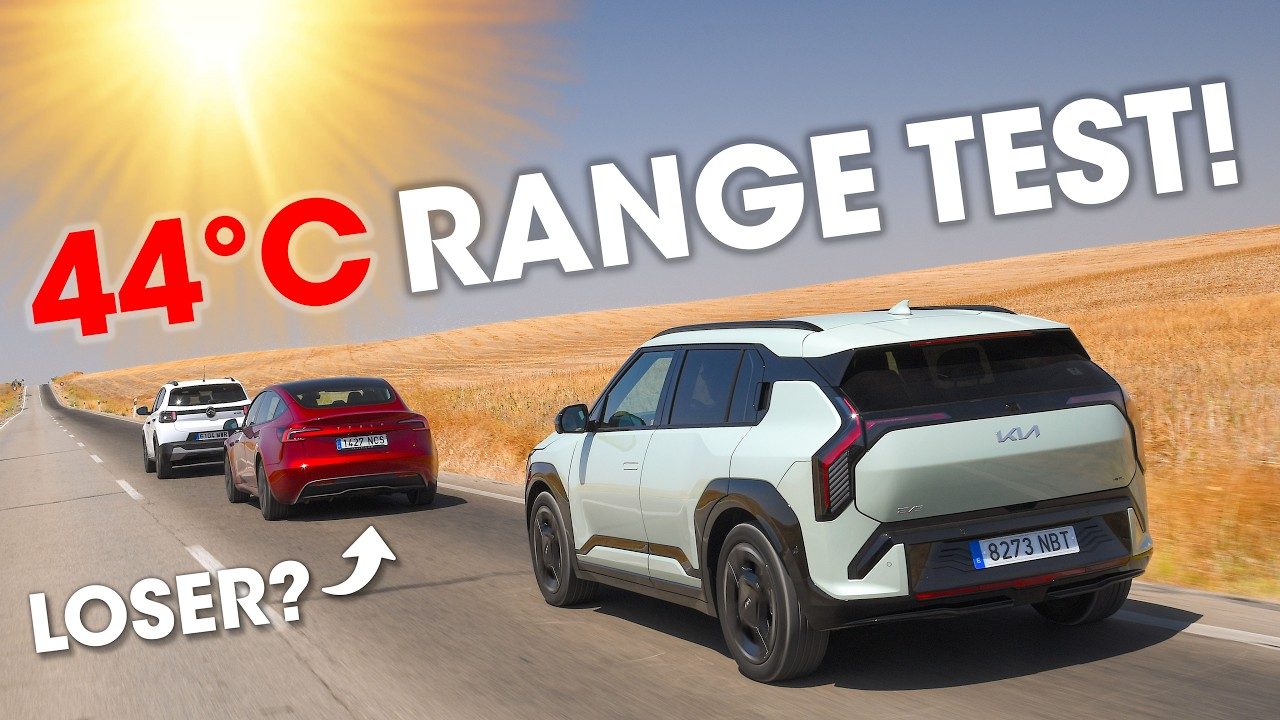
What Car? wanted to find out, so it brought three different EVs to the South of Spain, which is one of Europe’s hottest regions, to see how their range held up. The cheapest was a Citroen e-C3, which had a small air-cooled 44-kilowatt-hour battery, giving it a range of 199 miles (320 km) on the WLTP test cycle.
Next was a Kia EV3 with the long-range 81.4 kWh battery, granting it a WLTP range of 362 miles (582 km). The third car chosen for the test was a Tesla Model 3 Long Range dual-motor, whose 80 kWh battery pack gives it a claimed maximum range of 436 miles (702 km). Both the Kia and Tesla have a liquid thermal management system for their batteries as well as heat pumps.
For the test, the three cars were driven at highway speeds, which isn’t where EVs are at their most efficient, and the compound effect of the higher speed and the extreme outside temperature had a dramatic impact on their range. All three were way off their claimed range ratings.

Stay informed with our newsletter every weekday
back
Subscribe For more info, read our Privacy Policy & Terms of Use.
They didn’t drive the vehicles until they died, although the e-C3 was the closest to running out, as it had to drive more after trying to charge at a non-functional station. What Car? calculated that it would have done 142 miles before running out, which is 28.7% less than advertised, giving it the worst efficiency rating of the entire group: just 2.7 miles/kWh.
The Kia EV3 pulled in to charge with roughly 10% left in its battery and would have theoretically been able to cover 246 miles (396 km) before running out, using 2.9 miles/kWh on average. That’s a 32% difference compared to its official claimed range, but it’s not the worst result of the test.
The Tesla was around 44% off its official range claim with a theoretical maximum range of 244 miles (392 km), so less than the Kia. It had the group’s best efficiency at 3 miles/kWh, but the range drop was significant.
Charging the three vehicles in the same scorching heat revealed something surprising: Both the Kia and Tesla didn’t seem especially affected by the high temperature, and both charged relatively quickly and came close to their official 10% to 80% fast charging times. The Model 3 was charged from 9% to 80% in 32 minutes (not far off its official 27-minute claim), while the Kia went from 10% to 80% in 31 minutes, just 3 minutes off its claimed time.
 The Cadillac Escalade IQ Crushed Its Estimated Range In A 70-MPH Test
Porsche Macan EV Highway Range Test: Here's The Difference 10 MPH Makes
Nissan Ariya 70-MPH Highway Range Test: Can It Reach 250 Miles?
2025 Cadillac Optiq 70 MPH Highway Range Test: A Little Dissapointing
2025 Porsche Taycan Cross Turismo Range Test: ‘Flabbergasted’
What do you think?
View
Comments
The Citroen, with its more rudimentary battery thermal management system, was plugged into a 50 kW charger that provided half of its peak charging power (because the higher-powered charger didn’t work and they had to look for plan B). However, it only charged at a maximum of 38 kW, taking 74 minutes to get from 3% to 80%.
This test is definitely well worth doing, and it shows the true impact driving through such high heat has on EV range. The journalists who performed the test mentioned that the Tesla’s full-length glass roof with cover had them running the air conditioning on a higher setting to keep the cabin cool, and that this made a bigger impact on the final range result than in the other two cars.
We want your opinion!
What would you like to see on Insideevs.com?
Take our 3 minute survey.
- The InsideEVs team
Share this Story
- (https://twitter.com/intent/tweet?url=https%3A%2F%2Finsideevs.com%2Fnews%2F772221%2Fextreme-heat-group-range-test%2F&text=Tesla%20Loses%20The%20Most%20Range%20In%20Extreme%20Hot%20Weather%20Test&via=InsideEVs)
- copy
GO TO COMMENTS
(
)
Got a tip for us? Email: tips@insideevs.com
View all comments ( )
Trending
‘We’re Moving Really Fast’: Ionna CEO On 500 kW EV Chargers And Flagship New Location
Every EV Motor Type Explained: They Aren't All The Same
I Tried Mercedes' Answer To Tesla FSD. Here's How It Went
Tesla Model 3 Maintenance Guide: What Needs Servicing And What Doesn't
Latest Stories
- The BMW i3 Has The Nurburgring Skills To Match Its Impressive Range Nov 18 - News -
- Kia Made Its First EV 40 Years Ago. It Shows How Far Electric Cars Have Come Nov 18 - News -
- Ford Just Started Fathom LFP Battery Production In Michigan. It's A Big Deal Nov 18 - Battery Tech -
- This GM EV1 Lives After A Painstaking Restoration Nov 18 - News -
- ‘We’re Moving Really Fast’: Ionna CEO On 500 kW EV Chargers And Flagship New Location Nov 18 - Charging -
- BMW's First U.S.-Made EV Is Now Rolling Off The Assembly Line Nov 18 - Manufacturing / Production -
- EV Owners Aren’t Worried About Their Batteries. They’re Worried About Myths Nov 18 - News -
RECOMMENDED FOR YOU
Tesla Model 3 Maintenance Guide: What Needs Servicing And What Doesn't
The BMW i3 Has The Nurburgring Skills To Match Its Impressive Range
The Best EV Lease And Finance Deals In November 2026
Kia Made Its First EV 40 Years Ago. It Shows How Far Electric Cars Have Come
The Best Affordable Electric Cars In 2026: Cheap, Reliable Options For Everyone
Ford Just Started Fathom LFP Battery Production In Michigan. It's A Big Deal
The Boring Company Uses Tesla Model 3 Sleds To Shuttle Shipping Containers Through Its Tunnels