Home
News
Technology
Plug-In Hybrids May Be Nowhere Near As Clean As Automakers Claim
New data from the European Environment Agency shows real-world emissions of PHEVs are five times higher than the official numbers.
Photo by: Toyota
Iulian Dnistran 
By: Iulian Dnistran
Sep 11, 2025 at 9:29am ET
Add InsideEVs as a preferred source in Google
- (https://twitter.com/intent/tweet?url=https%3A%2F%2Finsideevs.com%2Fnews%2F771963%2Fphev-emissions-five-times-higher-official%2F&text=Plug-In%20Hybrids%20May%20Be%20Nowhere%20Near%20As%20Clean%20As%20Automakers%20Claim&via=InsideEVs)
- copy
Share
Comment
- Plug-in hybrid vehicles’ real-world emissions are nowhere near what automakers claim in the specs sheets.
- The latest data from Europe shows the gap between the official figures and the real-world numbers has widened.
- That’s despite the fact that the official WLTP emissions figures show a gradual decrease of carbon dioxide emissions over time.
Plug-in hybrid electric vehicles, or PHEVs, are a hotly debated topic in Europe right now. And some new emissions data published by the European Environment Agency (EEA), quoted by the NGO Transport & Environment (T&E), is set to pour more fuel onto a fire that has already been burning for a while in the bloc.
Many owners love PHEVs because they provide the ease of use of a gas engine with greater fuel economy and, in theory, far fewer emissions than a purely fuel-powered car. And automakers say PHEVs can be a remarkably useful tool in reducing emissions when the switch to EVs is proving harder than expected. However, this study indicates that PHEVs emit five times more carbon dioxide into the atmosphere compared to the official figures published by automakers.
That’s despite the fact that PHEVs have, in theory, become more environmentally friendly over time.
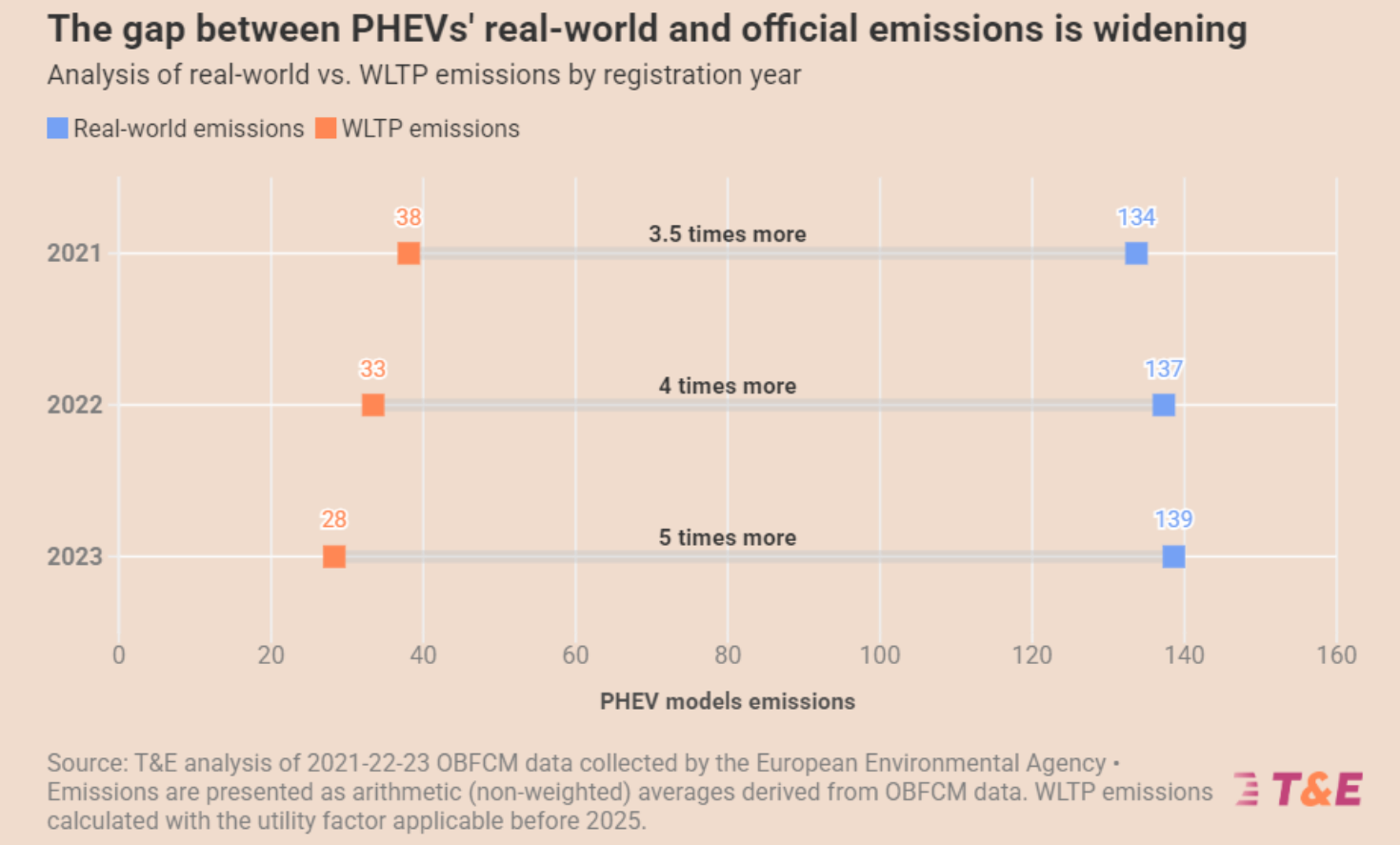
Real-world CO2 emissions of PHEVs compared to the WLTP figures.
Photo by: Transport & Environment (T&E)
According to the EEA report, which is based on data transmitted from over 127,000 on-board fuel consumption meters fitted to PHEVs registered in 2023, the real-world emissions of the observed fleet were 139 grams of CO2/kilometer, while the official WLTP-rated emissions should have been 28 g CO2/km.
By comparison, PHEVs registered in 2022 had real-world emissions that were four times higher than the official figures, with 137 g CO2/km observed, while the average WLTP emissions were rated at 33 g CO2/km. In 2021, the observed emissions were 134 g CO2/km, while the official ratings averaged 38 g CO2/km.
Things are clearly moving in the wrong direction, and it all boils down to how these emissions figures are calculated. Official fuel consumption figures have rarely been on par with the real-world results, and it’s no different when it comes to PHEVs. That’s because they’re produced in a laboratory, to make things easier for homologation, but also to keep things fair for everybody.

The 2023 Volvo V90 T8 Recharge has an advertised fuel economy that's impossible to reach in the real world.
Photo by: Iulian Dnistran / InsideEVs
As the owner of a PHEV myself, I can attest to these findings. While I can reach the advertised all-electric range with ease (and even surpass it), the fuel consumption figures are way off.
On a recent road trip, I started with a full tank of gas and a full battery. At the end of the day, with an empty battery and a nearly empty tank, I had averaged 58.8 miles per gallon (4 liters/100 km). That’s very impressive for a 4,000-pound (2,000-kilogram) wagon with 455 horsepower—but it’s nowhere near the 213 mpg (1.1 l/100 km) quoted by Volvo.
In the EU, something called the Utility Factory (UF) is a central piece in the way the WLTP test for PHEVs is done. In its current form, a PHEV with an all-electric range of 37 miles (60 km) is expected to run in what’s known as charge-depleting mode in 80% of the advertised EV range. However, the EU wants to change the method in the following years, so that the advertised emissions are closer to reality. From 2025-2026, the same PHEV will have to run in charge-depleting mode 54% of the time, and from 2027-2028, that figure will drop even further to 34%, according to T&E. This is to make sure that when a PHEV is using its combustion engine, the emissions are at a low enough level.
According to T&E, in charge-depleting (CD) mode, the vehicle primarily runs on electricity from the battery. However, the ICE might still kick in when additional power is required, such as during rapid acceleration or uphill driving.
More Stories About PHEVs
The Best Plug-In Hybrid, But I Wouldn't Buy One: 2025 Toyota Prius PHEV Review
The Best Plug-In Hybrid Cars of 2025: PHEVs With Great Electric Range And Gas Mileage
How To Get The Most Out Of A Plug-In Hybrid Car
Used Volvo V90 PHEV Ownership Update: Costs, Efficiency And Annoyances
Here’s the problem, though. The European Automobile Manufacturers’ Association (ACEA), which represents several European automakers, recently called on the EU to drop the upcoming changes to the Utility Factor. Ola Kallenius, who is the president of the ACEA and the CEO of Mercedes-Benz, co-signed a letter with Schaeffler’s Powertrain and Chassis CEO, Matthias Zink, saying that the bloc should drop the rule altogether because that’s the only way to stop Chinese competitors from gaining an advantage over local manufacturers.
What do you think?
View
Comments
There’s also the issue of not plugging in, with some owners never using the high-voltage battery’s full potential.
That said, these latest numbers suggest that European automakers are gaming the system to avoid paying fines if their average carbon dioxide emissions exceed the maximum level imposed for the fleet. As flawed as they might be, PHEVs have a place in the transition toward an all-electric future, but car companies need to step up and do what’s right. By the looks of it, that’s not what’s happening right now.

Stay informed with our newsletter every weekday
back
Subscribe For more info, read our Privacy Policy & Terms of Use.
We want your opinion!
What would you like to see on Insideevs.com?
Take our 3 minute survey.
- The InsideEVs team
Share this Story
- (https://twitter.com/intent/tweet?url=https%3A%2F%2Finsideevs.com%2Fnews%2F771963%2Fphev-emissions-five-times-higher-official%2F&text=Plug-In%20Hybrids%20May%20Be%20Nowhere%20Near%20As%20Clean%20As%20Automakers%20Claim&via=InsideEVs)
- copy
GO TO COMMENTS
(
)
Got a tip for us? Email: tips@insideevs.com
View all comments ( )
Trending
Diesel Prices Are Surging. This Electric Trucking Company Is Seeing More Interest
Tesla Opens Self-Driving Cybercab Orders To 'Select Customers' At $29,990
Solid-State Cells Can Make The U.S. Competitive In Batteries Again: CEO
I Took A Rivian R2 On A Camping Trip To The Middle Of The Desert
Latest Stories
- Diesel Prices Are Surging. This Electric Trucking Company Is Seeing More Interest Nov 14 - News -
- Tesla Opens Self-Driving Cybercab Orders To 'Select Customers' At $29,990 Nov 13 - News -
- Do EVs Wear Tires Faster? Here's What The Studies Show Nov 13 - Features -
- The VW ID. Buzz Is Getting A New Job As A Robotaxi Nov 13 - News -
- Audi A4 EV Delayed Amid VW Group Financial Troubles: Report Nov 13 - News -
- Tesla Just Killed Its Cheapest All-Wheel-Drive Model Y Nov 13 - News -
- A Record Number Of Uber Miles Are Happening In EVs Nov 13 - News -
RECOMMENDED FOR YOU
Lucid Overhauled The Air's Infotainment. You Might Need $950 Hardware To Get It
Diesel Prices Are Surging. This Electric Trucking Company Is Seeing More Interest
Mercedes Taps Wayve For Tesla FSD-Like System Within 2 Years
Tesla Opens Self-Driving Cybercab Orders To 'Select Customers' At $29,990
Hyundai's Tesla FSD Rival Is Delayed To 2029. But It May Be Worth The Wait
Do EVs Wear Tires Faster? Here's What The Studies Show
I Experienced The World’s First Electrostatic Speakers In A Production Car. Now I Can't Go Back