Home
Rimac
News
This New Solid-State EV Battery Charges Quicker Than Getting Gas
Rimac's solid-state batteries promise incredible DC fast charging times and higher energy density.
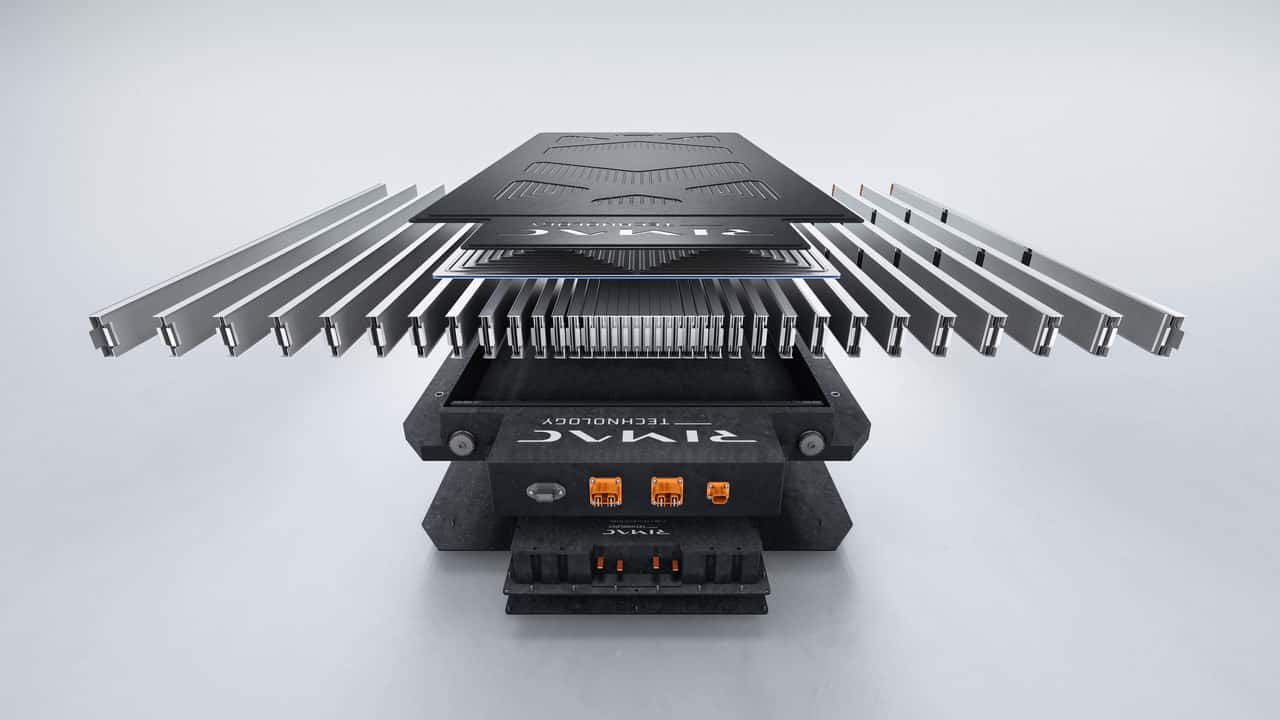
Photo by: Rimac
Iulian Dnistran 
By: Iulian Dnistran
Sep 8, 2025 at 4:55am ET
Add InsideEVs as a preferred source in Google
- (https://twitter.com/intent/tweet?url=https%3A%2F%2Finsideevs.com%2Fnews%2F771520%2Frimac-solid-state-battery-specs%2F&text=This%20New%20Solid-State%20EV%20Battery%20Charges%20Quicker%20Than%20Getting%20Gas&via=InsideEVs)
- copy
Share
Comment
- Rimac has unveiled a new solid-state battery that promises ultra-fast charging speeds and impressive energy density.
- Unveiled today at the IAA Mobility show in Munich, Germany, the upcoming battery has a discharge power of 850 kW.
- It’s smaller, weighs less and charges over two times faster than the company’s latest liquid-based cylindrical cells–under 10 minutes to go from 10% to 80%.
Rimac Technology, the parts developer and manufacturer that’s wholly owned by the Rimac Group, unveiled a game-changing solid-state battery pack for electric cars that promises to make top-ups on the go faster than filling up with gas and getting a coffee.
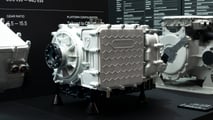
Developed in collaboration with ProLogium and Mitsubishi Chemical Group, the state-of-the-art liquidless high-voltage pack was unveiled today at the IAA Mobility show in Munich, Germany, alongside the latest iteration of the Croatian company’s liquid-based cylindrical cell pack.

Photo by: Rimac
Despite the advancements on the cylindrical cell front, the solid-state pack blows it out of the water with its specs. Let’s get the charging time out of the way first, because that’s the biggest differentiator by far. According to Rimac, a 100-kilowatt-hour solid-state pack can be charged from 10% to 80%, which is the go-to metric for road trips, in just six and a half minutes.
That’s faster than it took me to fill up with gas on a recent road trip I took with my plug-in hybrid wagon, where I had to wait for two people ahead of me to pay for their fill-ups. This is a huge step forward, but there is one caveat: DC fast chargers, which are slowly but surely offering 350 kW speeds across the land, will have to step up.
More Solid-State Battery Stories
All Current And Upcoming EVs With Solid-State Batteries
Solid-State Batteries May Be A 'Weapon' To Beat China, SK On Says
Volkswagen Is Pouring Millions More Into Solid-State Battery Development
Even Affordable EVs Are Getting Solid-State Batteries Now
Thankfully, there’s still time for charging operators to install even more powerful stalls, as Rimac’s solid-state battery will head to a high-performance EV near you starting in the fourth quarter of 2027. As a tier-one supplier for several automakers, Rimac Technology’s parts are already being fitted to cars made by the BMW Group and Porsche.
Getting back to the specs, the next-generation high-voltage battery is marketed as being capable of retaining over 95% of its energy at -4 degrees Fahrenheit (-20 degrees Celsius). There’s also no risk of fire or explosion at the cell level. That’s a big deal, as it makes fire safety a non-issue.
Gallery: Rimac Technology at IAA Mobility 2025
9
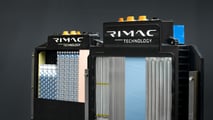
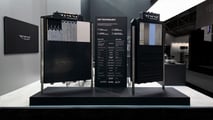


Source: Rimac
The voltage is rated between 540 and 907 volts. The power density is 2,210 Watts/kilogram and 2,980 Watts/liter, which is a big improvement over the latest cylindrical cell pack, which boasts 1,753 W/kg and 2,575 W/l. All of this means that a 100 kWh solid-state pack needs less space than a comparable cylindrical cell pack–285 liters, to be precise, down from 320 liters. It also weighs less–846 pounds (384 kg) versus 1,036 pounds (470 kg).
What do you think?
View
Comments
Rimac’s solid-state pack has pouch cells assembled using the cell-to-pack method. The cells’ chemistry consists of 90% nickel, 5% manganese and 5% cobalt for the cathode and 100% silicon for the anode. The pack is housed in a Thermoplastic composite enclosure and is cooled indirectly with refrigerant, which is different from the cylindrical-type pack, which uses indirect Water-Glycol cooling.
At IAA Mobility, Rimac Technology also unveiled several new electric drive units and domain controllers.

Stay informed with our newsletter every weekday
back
Subscribe For more info, read our Privacy Policy & Terms of Use.
We want your opinion!
What would you like to see on Insideevs.com?
Take our 3 minute survey.
- The InsideEVs team
Share this Story
- (https://twitter.com/intent/tweet?url=https%3A%2F%2Finsideevs.com%2Fnews%2F771520%2Frimac-solid-state-battery-specs%2F&text=This%20New%20Solid-State%20EV%20Battery%20Charges%20Quicker%20Than%20Getting%20Gas&via=InsideEVs)
- copy
GO TO COMMENTS
(
)
Got a tip for us? Email: tips@insideevs.com
View all comments ( )
Trending
I Drove Volvo’s Long-Range Plug-In Hybrid XC60. It’s A Great Stepping Stone To An EV.
I’m Thankful For My Electric Car
Here’s How To Make Your Holiday EV Road Trip Easier
These Are The Top 10 Black Friday EV Deals. Some Are $25,000 Off
Latest Stories
- Rivian's Winter Sale Is Live: Save on Chargers, Accessories, And More Nov 27 - Pricing -
- I Drove Volvo’s Long-Range Plug-In Hybrid XC60. It’s A Great Stepping Stone To An EV. Nov 27 - First Drives -
- A Used Cybertruck Is Selling A Month Faster Than A Ford F-150 Nov 26 - News -
- I’m Thankful For My Electric Car Nov 26 - Opinion -
- Volvo Is Bringing Humanoid Robots Into Its Factories. Here's When They'll Start Working Nov 26 - Manufacturing / Production -
- Ionna Slashes EV Charging Prices For Thanksgiving Nov 26 - Charging -
- Europe Gets This Tiny New Suzuki EV. It Makes A Mini Look Big Nov 25 - News -
RECOMMENDED FOR YOU
Ford Has A Dedicated Battery Abuse Team. It Obsesses Over How Cells Fail
Rivian's Winter Sale Is Live: Save on Chargers, Accessories, And More
Ford Just Started Fathom LFP Battery Production In Michigan. It's A Big Deal
I Drove Volvo’s Long-Range Plug-In Hybrid XC60. It’s A Great Stepping Stone To An EV.
Solid-State Cells Can Make The U.S. Competitive In Batteries Again: CEO
A Used Cybertruck Is Selling A Month Faster Than A Ford F-150
Ford Tested 36,000 Mustang Mach-E Batteries. Here’s How They Held Up After 100,000 Miles