Home
News
Charging
'I Think It's Going To Change The Game': ChargePoint's New 'Micro Grid' Technology Could Make Charging Cheaper
ChargePoint's newest platform can support charging at up to 3 megawatts, far exceeding what the most advanced EVs can accept today.
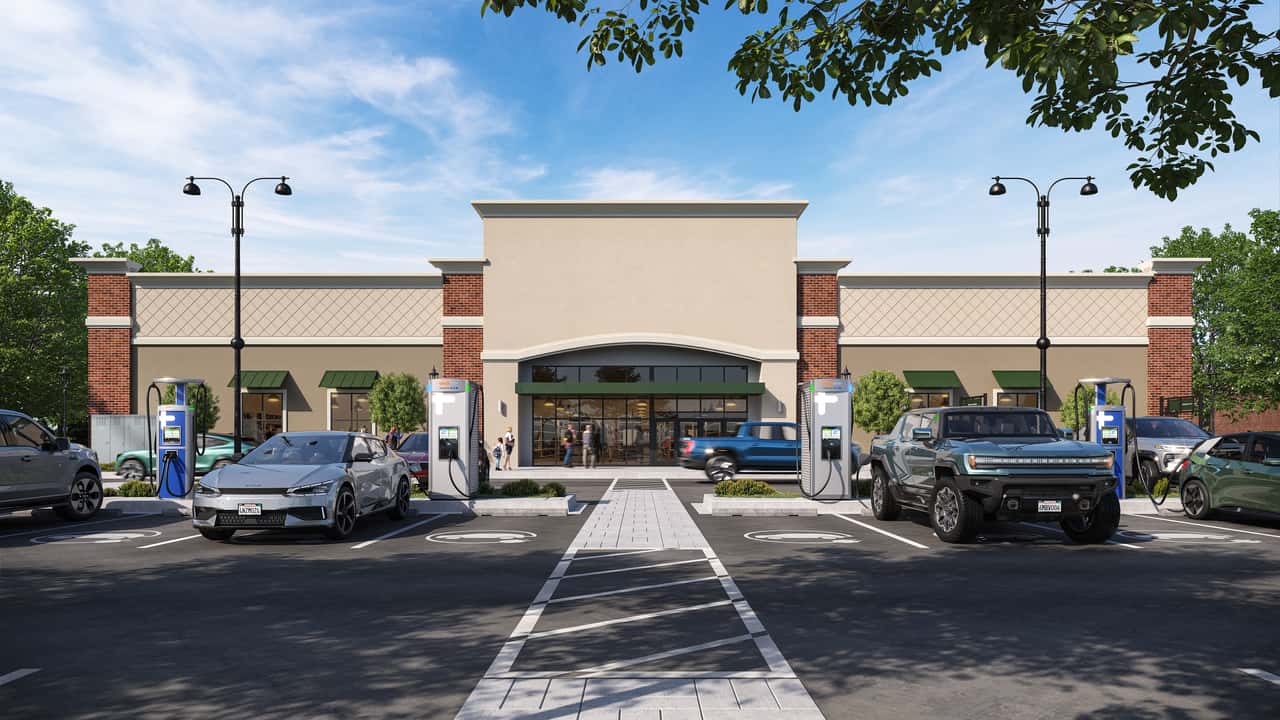
Photo by: ChargePoint
Mack Hogan 
By: Mack Hogan
Aug 28, 2025 at 8:30am ET
Add InsideEVs as a preferred source in Google
- (https://twitter.com/intent/tweet?url=https%3A%2F%2Finsideevs.com%2Fnews%2F770360%2Fchargepoint-express-grid%2F&text=%27I%20Think%20It%27s%20Going%20To%20Change%20The%20Game%27%3A%20ChargePoint%27s%20New%20%27Micro%20Grid%27%20Technology%20Could%20Make%20Charging%20Cheaper&via=InsideEVs)
- copy
Share
Comment
- ChargePoint has partnered with electrical giant Eaton to offer a new micro-grid charging setup, which it says will make fleet charging equipment cheaper, more efficient and more compact.
- By using on-site DC energy from power storage systems or renewables, these chargers can reduce ongoing charging costs by up to 30%.
- The technology cuts out the wasteful AC to DC conversion step, while also allowing users to balance demand with electricity prices, the CEO of ChargePoint told InsideEVs.
ChargePoint has long been an electric-vehicle charging hardware heavyweight. From local utilities using ChargePoint Level 2 dispensers on public infrastructure to private fleet owners operating ChargePoint fast-charging units at logistics hubs, the company quietly powers a large number of electrified vehicles. Now, it's aiming to take its operations to the next level, with its new ChargePoint Express Grid.
The new system—with the chargers built by ChargePoint and the "micro grid" built by electrical giant Eaton—allows charge point operators (like Electrify America or Ionna, for instance) or fleet operators to use a direct current (DC) setup for an entire charging system.
DC Microgrids are systems that run entirely on DC voltage, which is what batteries and solar panels use, rather than alternating current, which is what comes out of your household outlets.
Because batteries can only accept DC voltage and the power grid is AC, all DC fast chargers have to convert the AC into DC, and then step up the voltage of the grid DC with a DC-DC converter. Every time you convert energy, you lose some of it as waste heat, so by cutting out the AC-DC conversion, you get a more efficient system.

Existing dispensers don't natively work with micro-grid setups.
Photo by: InsideEVs
The system also still comes with a DC-DC converter, however, allowing operators to mix grid electricity with local battery storage, solar farms or wind turbines. That can be used to optimize costs, charging batteries up while electricity is cheap only to release it when it gets pricy. Despite including this hardware, ChargePoint says the new system can lead to up to 30% space savings compared to existing solutions.
Combined, the benefits of DC microgrid integration with dynamic load balancing will be extremely powerful, ChargePoint CEO Rick Wilmer told InsideEVs in a video interview.
"This is the debut of a new DC charging architecture and a whole product portfolio that branches off from that architecture is pretty game-changing, in terms of reducing [capital expenditures], [operating expenses], the amount of space, the number of pieces of equipment that are required to build out a charging hub," Wilmer said. "I think it's going to change the game."
Because ChargePoint does not operate its own charging stations, it's offering this to commercial clients starting next year. Charging operators or fleets will be able to get a custom solution designed by Eaton, which will actually build the microgrid they need. He noted that ChargePoint quickly learned in the early days that all vehicles are different, and that integrating the charging experience between vehicle and dispenser was crucial.
Related Stories
Unassuming Black Box Can Charge EVs At Up To 400 kW With A Household Connection
General Motors Has Big Plans For Your Old EV Battery
Lamppost Chargers, Curbside Plugs: How New York Is Pushing Back On Trump's EV Cuts
The World's Largest Tesla Supercharger Station Is Entirely Off-Grid
California May Require Bidirectional Charging EVs. That Could Save Lives
Will Electric Cars Kill The Grid In Hot Summer Months?
"Micro-grids aren't some standard thing that's out there that you can just plug chargers into," he said. You need deep, grid-level integration to make a system like this work. "It became very apparent to me that if you had a deep technological integration with the grid, and Eaton is the builder of the grid, you can bring more innovation and therefore more value to your customers."
Frankly, I can't speak to this solution specifically, because I haven't tested the charging equipment itself. As an idea, however, I think this is clearly the direction the industry is heading.
To me, until we reach some ideal world where the grid is balanced automatically in the background at scale, you're going to see most industrial-scale energy consumers wanting to take advantage of the potential savings involved with dynamic load balancing.

Stay informed with our newsletter every weekday
back
Subscribe For more info, read our Privacy Policy & Terms of Use.
Here's where you enter an interesting, expensive, and positive feedback loop: If you want to balance out your energy costs by drawing from the grid only when it's cheapest, you need a big battery. If you have a big battery, though, you'd be foolish not to be charging it every day with cheap solar energy from your own panels. At that point, why on Earth would you want your company's vehicles to be running on gas? Might as well need EVs, at which point you might want bigger batteries.
At some point, the natural (and obvious) solution for charging stations in sunny areas is to get the energy from nearby, store it in a battery, and then send it to a battery. There's no need for alternating current to ever be involved. The solution simultaneously solves the single biggest problem with using solar power with the power grid, as their fluctuating outputs must be meshed with a grid that is built around a stable 60 Hz signal.
Solar panels produce direct current, and their output varies. Converting this noisy, unstable DC output into the 60-hz AC that our grid requires is a lossy, complicated process. Hooking panels directly to batteries gets around it.
What do you think?
View
Comments
This is why we've seen Tesla already launch an off-grid station, and why there are many more coming. With plenty of opportunity in this space, it's good to see an industry heavyweight jumping in. ChargePoint says Express Grid deliveries will start in the second half of 2026.
Contact the author: Mack.Hogan@insideevs.com
We want your opinion!
What would you like to see on Insideevs.com?
Take our 3 minute survey.
- The InsideEVs team
Share this Story
- (https://twitter.com/intent/tweet?url=https%3A%2F%2Finsideevs.com%2Fnews%2F770360%2Fchargepoint-express-grid%2F&text=%27I%20Think%20It%27s%20Going%20To%20Change%20The%20Game%27%3A%20ChargePoint%27s%20New%20%27Micro%20Grid%27%20Technology%20Could%20Make%20Charging%20Cheaper&via=InsideEVs)
- copy
GO TO COMMENTS
(
)
Got a tip for us? Email: tips@insideevs.com
View all comments ( )
Trending
Kia EV3 Lease Deals Are Here, And It’s Cheaper Than The Chevy Bolt And Nissan Leaf
I Let Android Auto Plan My EV Roadtrip. Here’s How It Worked
This Chevy Bolt Has 470,000 Miles. Here’s How Much A New Battery Was
Here's What It's Like To Take Delivery Of A Rivian R2
latest articles
- Electrify America’s Largest EV Charging Station Is Missing One Big Thing Oct 21 - Charging -
- Can The BMW iX3 Take Down The Tesla Model Y L And Rivian R2? Oct 20 - News -
- Waymo Plans To Have 20,000 Cars By The End Of 2027 Oct 20 - News -
- The Boring Company Uses Tesla Model 3 Sleds To Shuttle Shipping Containers Through Its Tunnels Oct 20 - News -
- How Much Range Do EVs Lose When Parked? (And How to Stop It) Oct 20 - EV 101 -
- This Chinese EV Is Now Made In Europe. More Are Coming Oct 20 - News -
- GM Is Closing Its Detroit EV Battery Plant Oct 20 - Industry -
RECOMMENDED FOR YOU
I Let Android Auto Plan My EV Roadtrip. Here’s How It Worked
Can The BMW iX3 Take Down The Tesla Model Y L And Rivian R2?
America Now Has More Than 80,000 Public Fast Charging Ports
Waymo Plans To Have 20,000 Cars By The End Of 2027
America’s Biggest Non-Tesla EV Fast Charging Network Just Hit A New Milestone
The Boring Company Uses Tesla Model 3 Sleds To Shuttle Shipping Containers Through Its Tunnels
I Tested New York City’s First Lamppost EV Charger. It’s A Game Changer