Home
News
News
Ford's Future EVs Will Have The Same Range, But 1/3 Less Battery
Big batteries may not be the way to win over skeptics.
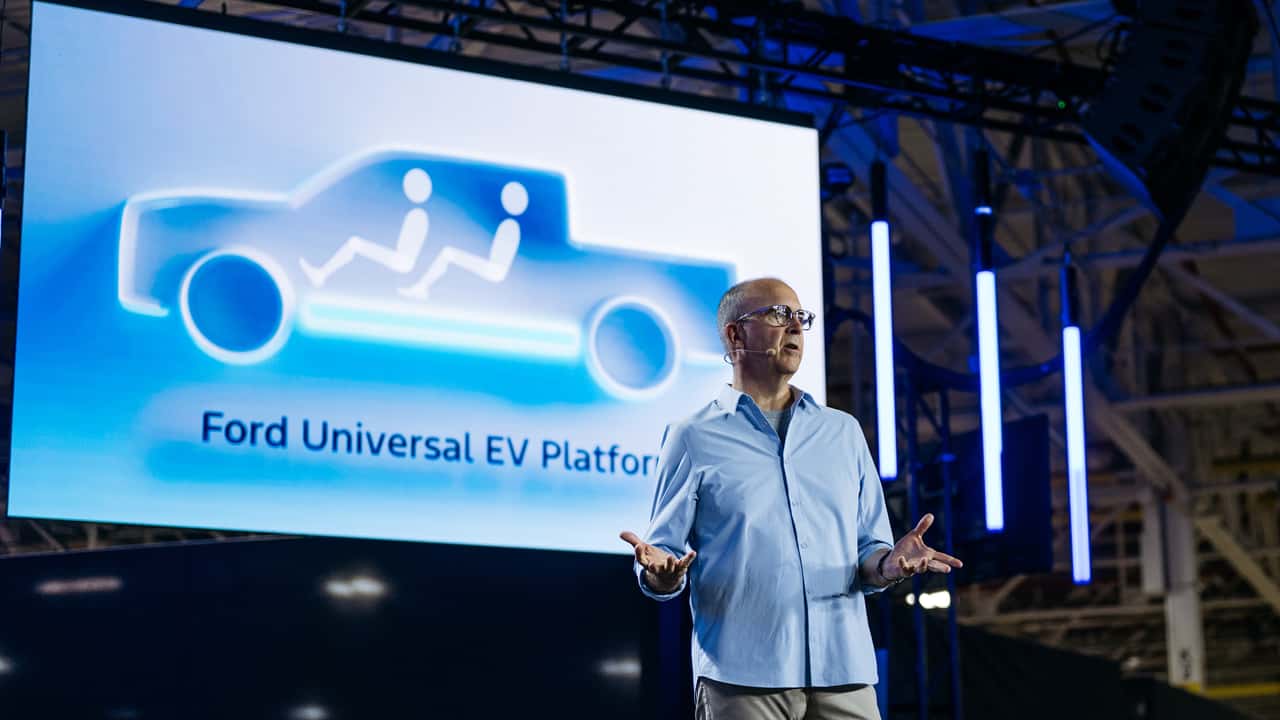
Photo by: Ford
Tim Levin 
By: Tim Levin
Aug 14, 2025 at 5:56pm ET
Add InsideEVs as a preferred source in Google
- (https://twitter.com/intent/tweet?url=https%3A%2F%2Finsideevs.com%2Fnews%2F769060%2Fford-ev-truck-small-battery%2F&text=Ford%27s%20Future%20EVs%20Will%20Have%20The%20Same%20Range%2C%20But%201%2F3%20Less%20Battery&via=InsideEVs)
- copy
Share
Comment
- Ford's "breakthrough" EVs will use batteries that are up to a third smaller than those of competitors.
- But they'll still offer similar range, said the company's top EV boss, Doug Field.
- Many of today's EVs have huge batteries, and that's what makes them heavy and expensive.
On Monday, Ford laid out a bold plan for its next-generation electric vehicles—"breakthrough" EVs designed from the ground-up to be profitable and hit China where it hurts. One cornerstone of that strategy: itty-bitty batteries.
Doug Field, the automaker's top EV boss and a former Tesla executive, said this week that Ford's "obsession with efficiency" will make its future EVs "achieve a similar range as competitors with a battery that is up to one-third smaller." This would be a big deal if Ford can pull it off.
As we reported earlier this week, Ford executives also said that the first vehicle to use the new Ford Universal EV Platform, a $30,000 midsize pickup truck, will offer a battery that's around 51 kilowatt-hours. That's pretty small—about half the size of what you'd find in an F-150 Lightning today.

Keep up with the fast-moving future of transportation straight from your inbox.
back
Subscribe For more info, read our Privacy Policy & Terms of Use.
Without knowing what sort of range that truck will offer, it's hard to say if that's a good thing. Everybody from consumers to automakers themselves wants more affordable EVs, and one way to accomplish that is by using fewer expensive battery cells. The challenge is that Americans also demand lots of driving range; 250 or 300 miles is table stakes these days.
But now, thanks to Field's comments, we know how Ford is thinking about range too. It wants to accomplish both of those goals simultaneously: boost efficiency and shrink battery size, while still hitting competitive range numbers.
That would be a big change from the approach we've seen thus far from Ford and some other manufacturers, especially when it comes to full-size trucks. Big EVs like the Chevrolet Silverado EV and GMC Hummer use enormous batteries that make them extra heavy and expensive. That's why any big electric pickup truck commands a steep price premium over gas versions. It's largely the battery, which can cost $20,000 or $30,000 alone.
On the flip side, if a company like Ford can manage to reduce battery size through better aerodynamics and other efficiency gains, that could solve a lot of the biggest challenges facing the EV market. Lithium-ion batteries have seen tremendous cost drops as the EV industry has scaled up, but they're still the priciest component in an electric car. Shrinking a battery's size, even by a small amount, can eliminate hundreds or thousands of dollars in input costs.
More Battery Stories
 Why General Motors And BMW Still Want China’s EV Batteries
The New Chevy Bolt's EV Batteries Will Come From China
Solid-State Batteries May Be A 'Weapon' To Beat China, SK On Says
Critics Say EVs Are A Fire Hazard. Here’s What The Latest Data Shows
This could translate to more affordable EVs and a better business case for Ford, something it needs badly. The company's EV division has lost some $12 billion over the last two-and-a-half years as it has invested in R&D and sold relatively few vehicles.
In fact, Ford CEO Jim Farley has been beating this drum for a while: that the economics for big EVs don't make sense, and that smaller, lower-cost ones are critical. And the company has talked about boosting efficiency before. Field, when he laid out Ford's previous EV strategy at an investor event in 2024, said the company's (now-scrapped) three-row SUV would have a battery that was a third smaller than its competitors'.
What do you think?
View
Comments
A lot needs to go right for Ford to nail this. It's betting on a new vehicle platform that's designed to be much more efficient, with 20% fewer parts and large aluminum castings that replace dozens of individual components. A structural battery pack that also serves as the vehicle's floor should help reduce a truck's weight and materials cost. Ford, pioneer of the moving assembly line, has also developed a novel manufacturing process to build its next-generation EVs: the "assembly tree."
Contact the author: Tim.Levin@InsideEVs.com
More Battery Stories
This 470,000-Mile Tesla Model S Is Better Than New Thanks To An Upgraded Battery
EV Batteries Can Easily Outlast A Typical Gas Car’s Lifespan: Study
Why Another Battery Maker Slammed The Brakes On More U.S. Plants
Xiaomi's Patented Solid-State Battery Could Go 745 Miles
We want your opinion!
What would you like to see on Insideevs.com?
Take our 3 minute survey.
- The InsideEVs team
Share this Story
- (https://twitter.com/intent/tweet?url=https%3A%2F%2Finsideevs.com%2Fnews%2F769060%2Fford-ev-truck-small-battery%2F&text=Ford%27s%20Future%20EVs%20Will%20Have%20The%20Same%20Range%2C%20But%201%2F3%20Less%20Battery&via=InsideEVs)
- copy
GO TO COMMENTS
(
)
Got a tip for us? Email: tips@insideevs.com
View all comments ( )
Trending
Lucid Is Slashing $15,000 Off The Gravity, But The Deal Won’t Last Long
The Remnants Of The Electric Saab That Never Was Are Going Up For Auction
What We Both Thought After Driving The Rivian R2
Aptera Finally Built Its First Car For Customer Delivery
Latest Stories
- The U.S. Let Volvo Keep Selling Cars. Polestar Got A No. What About Mercedes? Nov 22 - News -
- Tesla FSD V15 Makes Your Drive Look Like Grand Theft Auto Nov 22 - News -
- Waymo Is Recalling Its Robotaxis Because They're Not Great At Dealing With Human Instructions Nov 21 - Autonomous Vehicles -
- This EV-Swapped 1967 Porsche 912 Has 300 HP And A Split Battery Pack Nov 21 - News -
- This Plug-In Hybrid SUV Towed A Boeing 747 On Only 2 Wheels. Yes, Really. Nov 21 - Towing -
- BYD's Latest SUV Can Hide Its Steering Wheel When You Don't Need It Nov 20 - China -
- What We Both Thought After Driving The Rivian R2 Nov 20 - Podcast -
RECOMMENDED FOR YOU
The U.S. Let Volvo Keep Selling Cars. Polestar Got A No. What About Mercedes?
Waymo Is Recalling Its Robotaxis Because They're Not Great At Dealing With Human Instructions
Tesla FSD V15 Makes Your Drive Look Like Grand Theft Auto
This Plug-In Hybrid SUV Towed A Boeing 747 On Only 2 Wheels. Yes, Really.
This EV-Swapped 1967 Porsche 912 Has 300 HP And A Split Battery Pack
BYD's Latest SUV Can Hide Its Steering Wheel When You Don't Need It
Hyundai’s N Vision 74 Was One Of The Coolest Car Designs In Recent Memory. Now It's Shelved