Home
Tesla
News
America's EV Charging Network Is About To Skyrocket
Led by Tesla, ChargePoint and EVgo, the deployment of new public fast charging ports reached record levels in the second quarter.
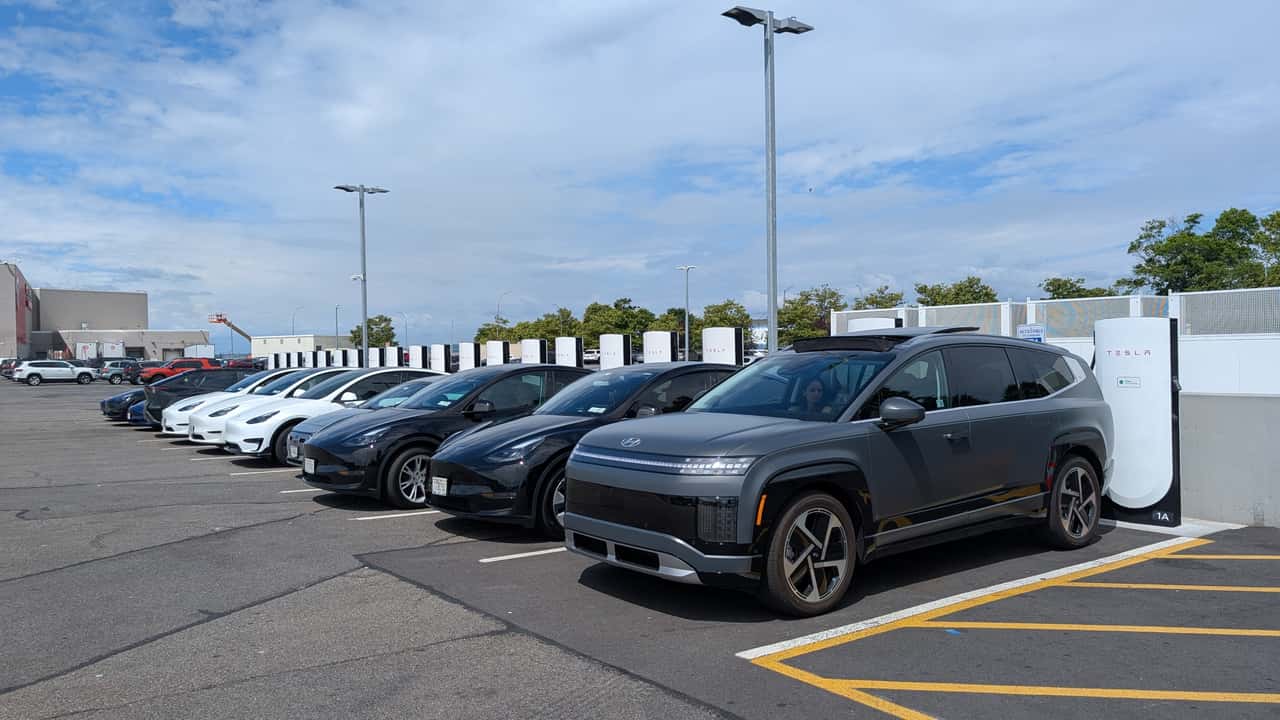
Photo by: Suvrat Kothari
Suvrat Kothari 
By: Suvrat Kothari
Jul 28, 2025 at 9:00am ET
Add InsideEVs as a preferred source in Google
- (https://twitter.com/intent/tweet?url=https%3A%2F%2Finsideevs.com%2Fnews%2F767059%2Frecord-ev-charger-deployment-q2-2025%2F&text=America%27s%20EV%20Charging%20Network%20Is%20About%20To%20Skyrocket&via=InsideEVs)
- copy
Share
Comment
Something profound is unfolding in the U.S. electric vehicle charging market.
Despite an expected decline in EV sales this year—thanks to the Trump administration taking a sledgehammer to pro-EV programs—the country’s charging network is growing bigger. Charging stations are swelling in size, stalls are delivering more power and the result is a better experience for EV drivers plugging in.
Charging companies seem more committed than ever to create the sort of foundation that could shape the future of EVs for years to come. What does that mean for you? It’s mostly good news.

Photo by: Plugshare
The odds of pulling up to a station with broken, crowded, or painfully slow chargers are shrinking. At the same time, the chances of you finding a reliable, high-powered station—complete with WiFi, restrooms and even a decent cup of coffee and a variety of snacks—are steadily increasing.
The deployment of new fast charging ports, as well as stations, is on record pace in 2025, charging data company Paren said in a report released Monday.
America is on track to add 16,700 public fast-charging ports by the end of this year, which would be about 2.4 times the number of ports added in 2022. If this pace continues, the U.S. will have 100,000 public fast-charging ports by 2027.
"Despite the [federal funding] pause and other factors, 2025 will be a record year of fast charging deployment—our estimate of nearly 20% year-over-year increase in new ports," Paren's Chief Analyst Loren McDonald said in an email.
Partly contributing to this trend are what Paren calls “Charging 2.0” companies. That means new companies such as Ionna, Mercedes-Benz High Power Charging, BP Pulse and Walmart that are heralding the next phase of charging in the U.S.
In this phase, new EV charging stations are becoming more standardized, with a minimum of 10 stalls that deliver 350 kilowatts to 400 kilowatts of maximum power. That means more available plugs for EV drivers, less congestion and faster charging times. In fact, 63% of the ports deployed in the second quarter were capable of delivering 250 kilowatts or more power, up from 47% in the first quarter.
Walmart EV charging network
Photo by: EV Charging Stations
The U.S. now has 11,687 public fast charging stations with nearly 60,000 ports. About 4,242 of these ports were added across 784 stations in the second quarter of this year, a 23.3% increase over the previous quarter. Tesla, ChargePoint and EVgo led this quarter-over-quarter speed of deployment.
Tesla still accounted for 40.2% of the new fast-charging ports opened between April and June. Its all-time share is at a solid 54.3%. In terms of overall market share for DC fast charging ports, Electrify America is second (7.9%), followed by ChargePoint (6.9%).
The size of the stations is also growing. In second quarter of 2024, non-Tesla public fast charging stations averaged 3.0 ports per station whereas Tesla averaged 12.4 ports per station. But that's growing fast with non-Tesla stations now averaging 3.8 ports per station whereas Tesla Superchargers now have an average of 15.1 ports at each location.
Even though that’s great news for EV drivers as automakers continue to launch new models, the full picture isn’t rosy.
The average utilization rate of fast charging stations in the U.S. dropped from 16.6% in the first quarter to 16.1% in Q2. In fact, utilization rates dropped in 70% of the states, even though more people in rural America showed higher usage rates with fewer stations available in their regions.
Paren partly attributed that to seasonal changes—an EV battery charges faster in summer compared to winter, where cells can take some time to get up to optimal temperatures.
But the average utilization rates also dropped due to increased installation of new chargers in low-adoption regions. That’s because these newer “Charging 2.0” companies are “future-proofing” and “building ahead of demand.”
“If you look at Ionna, Mercedes-Benz, BP Pulse, Walmart, these big companies have all been very public about their plans to open thousands of fast charging stations between now and 2030,” McDonald told InsideEVs.
“They're all full steam ahead on that and sticking to those goals regardless of what happens with EV sales, tariffs, the loss of the tax credits and all that,” he added. “They have these very concrete plans and they're moving forward with those.”
Ioniq 9 Tesla Charging
Photo by: Patrick George
I saw part of this trend unfold in real time when I charged a Hyundai Ioniq 9 press loaner multiple times at a brand new Tesla Supercharger last week.
Earlier, Brooklyn had only one free-standing Tesla Supercharger with no pay-to-park fees. It had long waiting times 24/7, mainly due to high traffic from rideshare drivers who sometimes charge more than once per day. Tesla opened another Supercharger nearby just last month, which is even bigger with 20 stalls, with 20 more opening soon.
What do you think?
View
Comments
One rideshare driver told me the new station “saved my business.”
Have a tip? Contact the author: suvrat.kothari@insideevs.com
Related Stories
I Got A Parking Ticket For… Using A Charging Station In An Electric Car
Rivian's Hamptons Charging Outpost Is A Better Rest Stop For EV Drivers
Honda And Acura EV Owners Can Now Use Tesla Superchargers
The World's Largest Tesla Supercharger Station Is Entirely Off-Grid
We want your opinion!
What would you like to see on Insideevs.com?
Take our 3 minute survey.
- The InsideEVs team
Share this Story
- (https://twitter.com/intent/tweet?url=https%3A%2F%2Finsideevs.com%2Fnews%2F767059%2Frecord-ev-charger-deployment-q2-2025%2F&text=America%27s%20EV%20Charging%20Network%20Is%20About%20To%20Skyrocket&via=InsideEVs)
- copy
GO TO COMMENTS
(
)
Got a tip for us? Email: tips@insideevs.com
View all comments ( )
Trending
Kia EV3 Lease Deals Are Here, And It’s Cheaper Than The Chevy Bolt And Nissan Leaf
I Let Android Auto Plan My EV Roadtrip. Here’s How It Worked
This Chevy Bolt Has 470,000 Miles. Here’s How Much A New Battery Was
Here's What It's Like To Take Delivery Of A Rivian R2
latest articles
- This Chinese EV Is Now Made In Europe. More Are Coming Oct 20 - News -
- GM Is Closing Its Detroit EV Battery Plant Oct 20 - Industry -
- The 2027 Lexus NX Plug-In Hybrid Gets A Bigger Battery And Fast Charging Oct 20 - Official -
- Kia EV3 Lease Deals Are Here, And It’s Cheaper Than The Chevy Bolt And Nissan Leaf Oct 20 - Pricing -
- Here's What It's Like To Take Delivery Of A Rivian R2 Oct 19 - News -
- Used EVs Hit A Record Share Of Overall Used Car Sales In September Oct 19 - Sales -
- Nio's Little Electric Car Has A Cool Party Trick: Upgradeable Range Oct 19 - News -
RECOMMENDED FOR YOU
Used EVs Hit A Record Share Of Overall Used Car Sales In September
The 2027 Lexus NX Plug-In Hybrid Gets A Bigger Battery And Fast Charging
The Roadster Will Have Tesla’s Most Advanced Battery Pack Yet
Kia EV3 Lease Deals Are Here, And It’s Cheaper Than The Chevy Bolt And Nissan Leaf
Tesla 'Cannot Guarantee' Your Roadster Pre-Order Will Ever Be Delivered
Here's What It's Like To Take Delivery Of A Rivian R2
Tesla Just Revealed The Roadster With A Truly Insane Demo. Here's What You Need To Know