Home
Rivian
News
How Rivian Developed Its Zonal Architecture In Just Two Years
Rivian cut 1.6 miles of wiring from its EVs and reduced the number of computers significantly. This is what it looks like in real life.

Photo by: Out of Spec Reviews (YouTube)
Suvrat Kothari 
By: Suvrat Kothari
Jun 6, 2025 at 1:12pm ET
Add InsideEVs as a preferred source in Google
- (https://twitter.com/intent/tweet?url=https%3A%2F%2Finsideevs.com%2Fnews%2F761865%2Frivian-zonal-architecture-development%2F&text=How%20Rivian%20Developed%20Its%20Zonal%20Architecture%20In%20Just%20Two%20Years&via=InsideEVs)
- copy
Share
Comment
- Rivian does most of its hardware and software work in-house, meaning it's extremely vertically integrated.
- The automaker's second-generation R1T and R1S models are far simpler under the hood. The future models could even be more simplified.
- This is what the reduction in wiring and the number of computers looks like in real life.
Rivian raised eyebrows last year with the debut of its second-generation electric truck and SUV. The R1T and the R1S are not only more advanced than their earlier versions but also radically more streamlined under the hood.
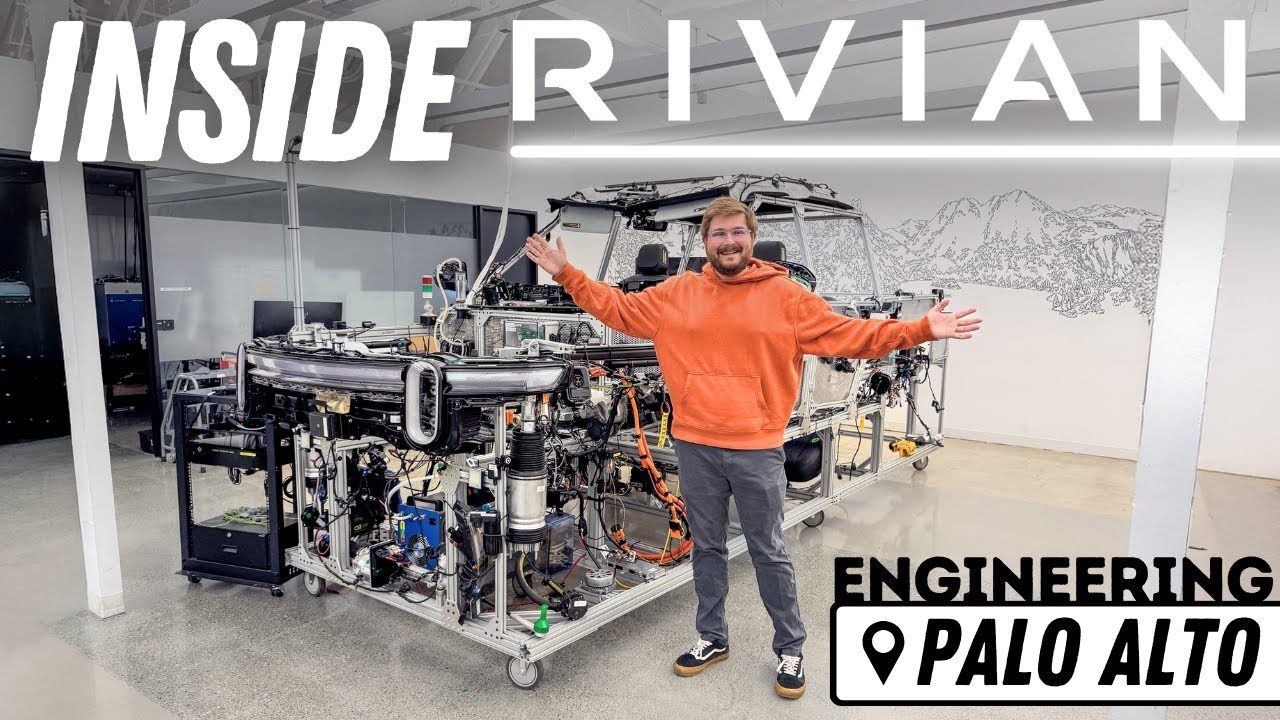
The California-based startup ripped out 1.6 miles of internal wiring harnesses from the old models, slashed the number of onboard computers that manage various vehicle functions and made the cars easier to repair. Now we’re getting to see what that looks like in real life, thanks Kyle Conner of YouTube channel Out Of Spec Reviews, who recently toured Rivian’s engineering headquarters in Palo Alto, California.

Photo by: Rivian
Electric cars have historically been more expensive than their gas-powered counterparts. They are also heavier due to the high-voltage batteries. Now automakers are looking for ways to reduce costs, offset the heavy weight of the battery in other areas and make them easier to repair and update over time. Tesla started this obsession with efficiency and start-ups like Rivian are also getting really good at it.
In the video, Rivian’s Senior Vice President of Electrical Hardware Vidya Rajagopalan explained how the automaker shifted from its first-generation vehicles to the much simpler second-generation models in just two years.
On the second-gen R1T and R1S, Rivian reduced the number of electronic control units (ECUs)—or basically the brains of the car—from 17 to just seven. ECUs control everything from the drivetrain and infotainment to power windows and driver assistance systems.
Fewer ECUs also mean less wiring. As the image below shows, 1.6 miles of wiring is a massive amount of material in terms of sheer volume. By removing it, Rivian shaved off 44 pounds of weight. Cutting down the number of computers likely saved the company thousands of dollars per vehicle and freed up valuable space inside the cabin and under the skin. This theoretically also makes it easier to repair, which wasn’t necessarily the case before.
One Rivian owner previously told InsideEVs that his first-generation R1T was out for repair for nearly a year. That’s because the side camera got damaged in a minor crash, and to replace that, the service center had to yank out the entire wiring harness. It also had to dismantle the dashboard and remove the seats. All this, to replace one small side camera.
That kind of engineering complexity is exactly what Rivian set out to fix with its move to a “zonal architecture.” Instead of relying on dozens of separate computers for specific functions, Rivian now uses a handful of powerful processors located in different zones of the vehicle. These zones communicate over a high-speed network linked to a central computer, drastically reducing the amount of wiring required. If something breaks, the diagnosis is far more local—no need to remove the entire wiring harness.
Rivian reduced 1.6 miles of wiring on the second generation R1 and 2.3 miles of wiring on the R2. This is what that looks like in real life.
Photo by: Rivian
When asked how the company built a full zonal architecture in just two years—a feat that would take a traditional automaker many years—Rajagopalan credited three things: being based in Silicon Valley, prioritizing vertical integration and encouraging close collaboration between hardware and software teams.
“In a legacy OEM, if you want to make a change, you start with a meeting. Then product managers write up a scope-of-work document, followed by legal contracts—and all of that takes time,” she said.
At Rivian, it’s different. “The hardware and software teams sit in the same building,” Rajagopalan added. If you want to make a change, you just walk over to the engineers, talk it out in a meeting room and get to work.
At Rivian’s engineering HQ, test rigs that resemble life-sized vehicle skeletons are outfitted with the company’s latest ECUs, wiring harnesses, sensors and cameras. These stripped-down frames simulate real-world failures and ensure the system is robust by the time it goes into an actual vehicle.
Rivian is also using a liquid-cooled computer for its advanced driver assistance system (ADAS) to manage the heat generated by the massive amounts of data it processes. It’s just like a high-end gaming computer, but the ADAS computers are far more powerful than your regular gaming PCs. At some point in future, they also aim to support higher levels of autonomous driving features in the cars.
Interestingly, Rivian’s ADAS and infotainment computers are bundled together for seamless communication between the two. For infotainment and ADAS, there’s a lot of information overlap—they both need GPS and navigation access, for example. So it makes sense to bundle them together.
“The beauty of the zonal controller is that it is geography-based,” Rajagopalan said. “The older domain controllers were function-based.”
Rivian's autonomy and infotainment computers sit on top of each other.
Photo by: Out of Spec Reviews (YouTube)
Rivian also does all of the software and electrical architecture work in-house, instead of assembling parts made by hundreds of different suppliers. That’s possibly Rivian’s biggest advantage, even though it still has plenty to prove as a carmaker. However, Rivian’s expertise in software and electrical architecture is why Volkswagen agreed to invest over $5 billion in their joint venture for future VW and Rivian models.
What do you think?
View
Comments
“You cannot be a technology leader if you’re an integrator," Rajagopalan said. "You need to bring value and differentiate. We believe technology is our differentiation. And by getting pieces off the shelves from other people, you lose that differentiation."
Have a tip? Contact the author: suvratkothari@insideevs.com
Related Stories
The Rivian R2 Cut Two Miles Of Wiring From The R1S. That's A Big Deal
The 2025 Rivian R1T And R1S Cut 1.6 Miles Of Internal Wiring
Rivian Is Adding A Key Charging Feature To The R1S And R1T EVs
Rivian R2 Program Gets Promising Update From CEO R.J. Scaringe
We want your opinion!
What would you like to see on Insideevs.com?
Take our 3 minute survey.
- The InsideEVs team
Share this Story
- (https://twitter.com/intent/tweet?url=https%3A%2F%2Finsideevs.com%2Fnews%2F761865%2Frivian-zonal-architecture-development%2F&text=How%20Rivian%20Developed%20Its%20Zonal%20Architecture%20In%20Just%20Two%20Years&via=InsideEVs)
- copy
GO TO COMMENTS
(
)
Got a tip for us? Email: tips@insideevs.com
View all comments ( )
Trending
Kia EV3 Lease Deals Are Here, And It’s Cheaper Than The Chevy Bolt And Nissan Leaf
I Let Android Auto Plan My EV Roadtrip. Here’s How It Worked
This Chevy Bolt Has 470,000 Miles. Here’s How Much A New Battery Was
Here's What It's Like To Take Delivery Of A Rivian R2
latest articles
- This Chinese EV Is Now Made In Europe. More Are Coming Oct 20 - News -
- GM Is Closing Its Detroit EV Battery Plant Oct 20 - Industry -
- The 2027 Lexus NX Plug-In Hybrid Gets A Bigger Battery And Fast Charging Oct 20 - Official -
- Kia EV3 Lease Deals Are Here, And It’s Cheaper Than The Chevy Bolt And Nissan Leaf Oct 20 - Pricing -
- Here's What It's Like To Take Delivery Of A Rivian R2 Oct 19 - News -
- Used EVs Hit A Record Share Of Overall Used Car Sales In September Oct 19 - Sales -
- Nio's Little Electric Car Has A Cool Party Trick: Upgradeable Range Oct 19 - News -
RECOMMENDED FOR YOU
Here's What It's Like To Take Delivery Of A Rivian R2
This Chinese EV Is Now Made In Europe. More Are Coming
Rivian Is Giving Some Owners Early Access To Its Latest Hands-Free Driving Tech
GM Is Closing Its Detroit EV Battery Plant
A Rivian R2 Owner Shares The Good And Bad After 2 Months
The 2027 Lexus NX Plug-In Hybrid Gets A Bigger Battery And Fast Charging
Rivian Is Taking Its Battery Recycling Game To The Next Level