Home
Rivian
R1T
Features
‘Terrible’: Rivian’s Longest-Range EV Tested For Its Road-Tripping Abilities
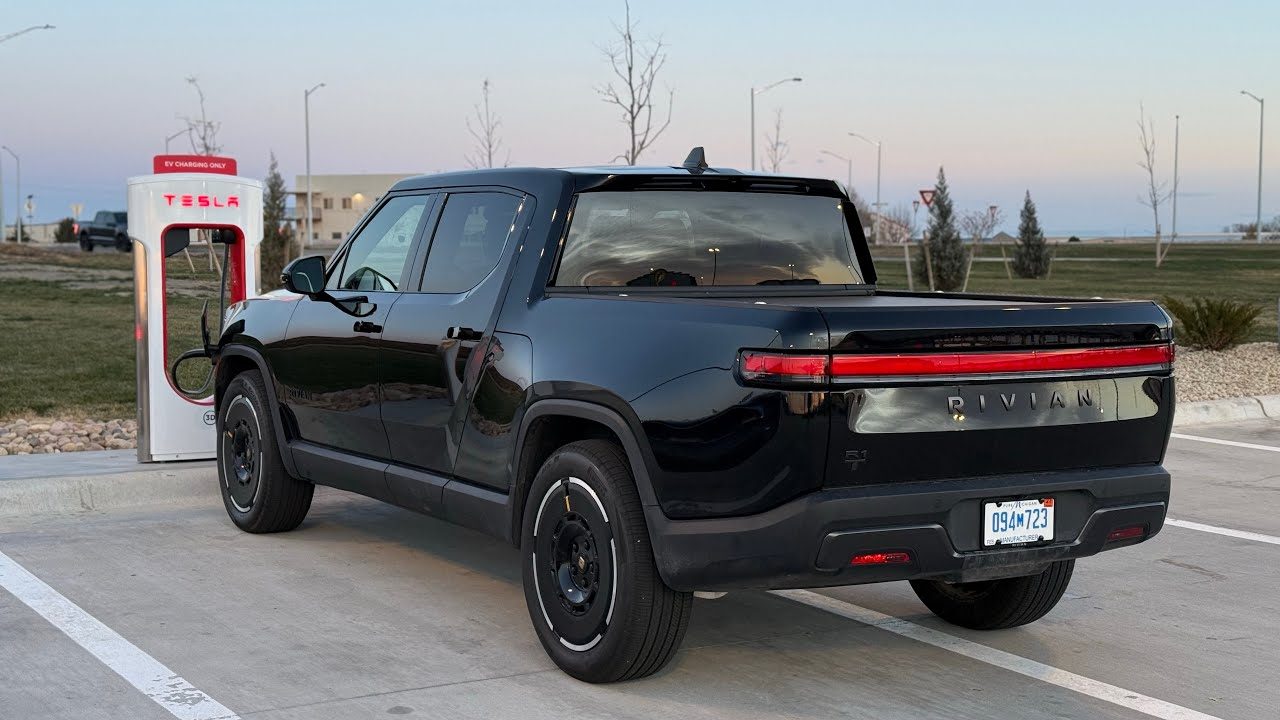
The refreshed Rivian R1T with the Max Pack battery has an EPA rating of 420 miles on a full charge.

Photo by: Out of Spec Reviews (YouTube)
Iulian Dnistran 
By: Iulian Dnistran
Nov 25, 2024 at 9:00am ET
Add InsideEVs as a preferred source in Google
- (https://twitter.com/intent/tweet?url=https%3A%2F%2Finsideevs.com%2Ffeatures%2F742161%2Frivian-r1t-road-trip-charging-test%2F&text=%E2%80%98Terrible%E2%80%99%3A%20Rivian%E2%80%99s%20Longest-Range%20EV%20Tested%20For%20Its%20Road-Tripping%20Abilities&via=InsideEVs)
- copy
Share
Comment
- The 2025 Rivian R1T with the Dual Motor and Max battery pack setup is Rivian's longest-range model.
- It's EPA-rated for 420 miles on a full charge.
Rivian’s refreshed EVs, the R1S and R1T, have dozens of meaningful improvements under the skin. There’s a heat pump, which improves efficiency, and several other tweaks that are meant to make the car easier to manufacture and ultimately cheaper for the end user, including a lithium iron phosphate (LFP) battery for the entry-level version.
The other battery pack versions are also different from the pre-facelift vehicles, and they should be better in every way–that’s to be expected from a refresh. However, as our friend Kyle Conner from Out of Spec Reviews found out, that’s not necessarily the case.
He drove a brand-new, 2025 Rivian R1T with the Dual Motor drivetrain and the Max battery pack to find out how good of a road-tripping vehicle it is. And as it turns out, it could have been better.
More Stuff Like This
 Extended-Range EVs Are The Next Big Thing. Will Drivers Plug Them In?
Scout Motors' EV Gas Range Extender May Give It A Big Edge
2025 Rivian R1S Range Test: How Far The Base Model Goes On The Highway
Cadillac Vistiq Vs. Rivian R1S Vs. Kia EV9: Here’s How They Compare
With an EPA-rated range of 420 miles and a usable battery capacity of 141.5 kilowatt-hours, the EV was driven down to a 10% state of charge en route to a Tesla Supercharger that’s open to all electric vehicles. During the trip to the Supercharger, the battery was preconditioned and was ready to take in the maximum amount of kilowatts available for a 400-volt battery like the one in the R1T–250 kilowatts.
After plugging in the DC fast charger, the electric pickup refused to go over 173 kW, even though the battery was preconditioned and there was no thermal limitation on the charger side. The charging session was stopped after exactly 15 minutes, and the state of charge level went up to 36%. In total, the R1T had taken in 43 kWh of energy during the 15-minute stint.
Then, Conner hit the road at a constant speed of 82 miles per hour on the highway. The problem was that the adaptive cruise control wouldn’t work, so he had to use the accelerator pedal to keep the speed constant, like in the old days.
During the whole test, the climate control was running on Auto and the air suspension was manually set to the lowest level to improve efficiency. After just 75 miles on the highway, the R1T’s state of charge was back at 10% and the efficiency was 1.93 miles/kWh. In other words, not a great road-tripping machine, mainly because of the unimpressive charging performance.
“What an absolutely dreadful charging performance,” Conner said after unplugging the electric pickup from the Supercharger. All the elements needed for a great charging session were there, but the EV refused to accept more power from the stall. In the real world, this means owners will have to spend more time for each charging stop during long trips.
Gallery: 2025 Rivian R1T and R1S
75


“The Rivian is still one of the best vehicles on the market today,” Conner added, referring to the R1T’s off-roading abilities, good ride and overall driving experience. It’s in the charging department where more work needs to be done, he said.
What do you think?
View
Comments
The 2025 Rivian R1T with the Max battery pack, which uses nickel manganese cobalt (NMC) cells, starts at $83,900. It’s the longest-range EV in Rivian’s portfolio. Meanwhile, the entry-level R1T with the Standard battery–which uses LFP cells–starts at $69,900 and has an EPA-estimated range of 270 miles.
By comparison, a 2025 Rivian R1S–that’s the SUV, not the pickup–with the base LFP battery fared better in Out of Spec’s 10% road-tripping challenge. It maxed out at 218 kW instead of 173 kW, added 46.2 kWh of energy in 15 minutes instead of 43 kWh and drove for 91 miles instead of 82 miles before hitting a 10% state of charge again.

Get the best news, reviews, columns, and more delivered straight to your inbox.
back
Subscribe For more info, read our Privacy Policy & Terms of Use.
We want your opinion!
What would you like to see on Insideevs.com?
Take our 3 minute survey.
- The InsideEVs team
Share this Story
- (https://twitter.com/intent/tweet?url=https%3A%2F%2Finsideevs.com%2Ffeatures%2F742161%2Frivian-r1t-road-trip-charging-test%2F&text=%E2%80%98Terrible%E2%80%99%3A%20Rivian%E2%80%99s%20Longest-Range%20EV%20Tested%20For%20Its%20Road-Tripping%20Abilities&via=InsideEVs)
- copy
GO TO COMMENTS
(
)
Got a tip for us? Email: tips@insideevs.com
View all comments ( )
Trending
I Took A Rivian R2 On A Camping Trip To The Middle Of The Desert
Solid-State Cells Can Make The U.S. Competitive In Batteries Again: CEO
BYD's Futuristic EV Charger Can Run On Sunshine And Batteries
Google’s Gemini AI Assistant Now Works On Apple CarPlay
Latest Stories
- Slate Is Selling A $30 'Screenless GPS' For Its Low-Tech Truck Nov 12 - News -
- America's 3 Most Popular SUVs Are About To Be Hybrid Or Electric Nov 12 - News -
- The 2026 Chevy Silverado EV Trail Boss Makes No Sense. I Loved It Anyway Nov 12 - Car Reviews -
- Scout's New Factory Is Already Making Trucks. But You Won't Be Able To Buy One For A While Nov 12 - News -
- BYD's Futuristic EV Charger Can Run On Sunshine And Batteries Nov 12 - Charging -
- I Took A Rivian R2 On A Camping Trip To The Middle Of The Desert Nov 12 - Car Reviews -
- Solid-State Cells Can Make The U.S. Competitive In Batteries Again: CEO Nov 12 - Battery Tech -
RECOMMENDED FOR YOU
The Rivian R1T Is An Awkward Fit For Britain. This Reviewer Loved It Anyway
Slate Is Selling A $30 'Screenless GPS' For Its Low-Tech Truck
I Took A Rivian R2 On A Camping Trip To The Middle Of The Desert
America's 3 Most Popular SUVs Are About To Be Hybrid Or Electric
The AI Boom Is Making Ordinary Car Parts Harder To Get, Rivian Says
The 2026 Chevy Silverado EV Trail Boss Makes No Sense. I Loved It Anyway
Rivian's New Robots Will Initially Handle 20% Of Factory Tasks. The Goal Is 80%, CEO Says